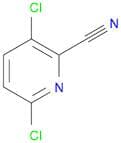
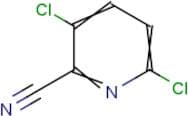
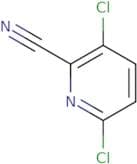
CAS 1702-18-7
:3,6-Dichlorpyridin-2-carbonitril
Beschreibung:
3,6-Dichlorpyridin-2-carbonitril ist eine heterocyclische organische Verbindung, die durch ihren Pyridinring gekennzeichnet ist, der zwei Chlor-Substituenten an den Positionen 3 und 6 sowie eine Cyanogruppe (-C≡N) an der Position 2 enthält. Diese Verbindung ist typischerweise ein Feststoff bei Raumtemperatur und ist bekannt für ihr blassgelbes bis hellbraunes Aussehen. Sie ist in organischen Lösungsmitteln wie Aceton und Dichlormethan löslich, hat jedoch eine begrenzte Löslichkeit in Wasser. Das Vorhandensein beider Chloratome und der Cyanogruppe trägt zu ihrer Reaktivität bei, was sie in verschiedenen chemischen Synthesen nützlich macht, insbesondere in der pharmazeutischen und agrochemischen Industrie. Die Verbindung kann biologische Aktivität zeigen, die für potenzielle Anwendungen in der Arzneimittelentwicklung untersucht werden kann. Sicherheitsvorkehrungen sollten beim Umgang mit dieser Substanz getroffen werden, da sie Gesundheitsrisiken darstellen kann, einschließlich Haut- und Augenreizungen sowie potenzieller Toxizität bei Einnahme oder Einatmen. Eine ordnungsgemäße Lagerung an einem kühlen, trockenen Ort, fern von inkompatiblen Substanzen, wird empfohlen, um ihre Stabilität zu erhalten.
Formel:C6H2Cl2N2
Synonyme:- 2-Pyridinecarbonitrile,3,6-dichloro-
Sortieren nach
Reinheit (%)
0
100
|
0
|
50
|
90
|
95
|
100
4 Produkte.
3,6-Dichloropicolinonitrile
CAS:Formel:C6H2Cl2N2Reinheit:95%Farbe und Form:SolidMolekulargewicht:172.99953,6-Dichloropicolinonitrile
CAS:<p>3,6-Dichloropicolinonitrile is a peroxide that is used in the synthesis of organic compounds. It is produced by the reaction of sodium carbonate and hydrochloric acid with nitric acid as a catalyst. 3,6-Dichloropicolinonitrile has been shown to be more selective than other oxidizing agents such as hydrogen peroxide and potassium permanganate. The product can then be purified by adding diacetate, which selectively reacts with the chlorine to form acetyl chloride and glycolic acid. The resulting mixture can then be distilled to produce 3,6-dichloropicolinonitrile in high purity. 3,6-Dichloropicolinonitrile can also be used in electrochemical methods for the synthesis of cyanides or biochemically for virulent products such as pesticides and organic solvents.</p>Formel:C6H2Cl2N2Reinheit:Min. 95%Molekulargewicht:173 g/mol