CAS 1709-71-3
:3-Acryloyloxy-2-hydroxypropylmethacrylat
Beschreibung:
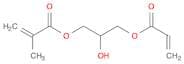
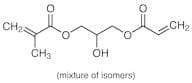
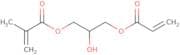
3-Acryloyloxy-2-hydroxypropylmethacrylat (CAS 1709-71-3) ist eine chemische Verbindung, die zur Klasse der Methacrylatester gehört. Sie weist sowohl Acryloyl- als auch Methacrylat-Funktionalitäten auf, die zu ihrer Reaktivität und Nützlichkeit in der Polymerchemie beitragen. Diese Verbindung zeichnet sich durch ihre Fähigkeit zur radikalischen Polymerisation aus, was sie wertvoll für die Herstellung verschiedener Polymere und Copolymere macht. Sie besitzt eine Hydroxylgruppe, die ihre Hydrophilie verbessert und die Haftungseigenschaften in Formulierungen verbessern kann. Das Vorhandensein sowohl von Acryloyl- als auch von Methacrylat-Funktionalitäten ermöglicht vielseitige Anwendungen in Beschichtungen, Klebstoffen und zahnmedizinischen Materialien. Darüber hinaus ermöglicht ihre Struktur die Vernetzung, was die mechanischen Eigenschaften der resultierenden Polymere verbessern kann. Insgesamt wird 3-Acryloyloxy-2-hydroxypropylmethacrylat für seine Rolle bei der Schaffung von Materialien mit maßgeschneiderten Eigenschaften anerkannt, die für eine Vielzahl von industriellen und biomedizinischen Anwendungen geeignet sind.
Formel:C10H14O5
InChl:InChI=1S/C10H14O5/c1-4-9(12)14-5-8(11)6-15-10(13)7(2)3/h4,8,11H,1-2,5-6H2,3H3
InChI Key:InChIKey=ZODNDDPVCIAZIQ-UHFFFAOYSA-N
SMILES:C(C(COC(C=C)=O)O)OC(C(C)=C)=O
Synonyme:- 1-(Acryloyloxy)-2-hydroxy-3-(methacryloyloxy)propane
- 1-Acryloyloxy-3-(methacryloyloxy)-2-propanol
- 1-Methacryloyloxy-3-acryloyloxy-2-propanol
- 2-Hydroxy-1-acryloxy-3-methacryloxypropane
- 2-Hydroxy-1-acryloyloxy-3-methacryloyloxypropane
- 2-Hydroxy-3-acryloyloxy-1-methacryloyloxypropane
- 2-Hydroxy-3-acryloyloxypropyl methacrylate
- 2-Hydroxy-3-methacryloyloxypropyl acrylate
- 2-Propenoic acid, 2-methyl-, 2-hydroxy-3-[(1-oxo-2-propen-1-yl)oxy]propyl ester
- 2-Propenoic acid, 2-methyl-, 2-hydroxy-3-[(1-oxo-2-propenyl)oxy]propyl ester
- 3-(Acryloxy)-2-hydroxypropyl methacrylate
- 3-(Acryloyloxy)-2-Hydroxypropyl 2-Methylprop-2-Enoate
- 3-(Acryloyloxy)-2-hydroxypropyl methacrylate
- 3-Acryloyloxy glycerol monomethacrylate
- Acrylic acid-glycidyl methacrylate 1:1 adduct
- Ahpma
- Blemmer GAM
- G 201P
- Light Ester G 201P
- Methacrylic acid, 2,3-dihydroxypropyl ester, 3-acrylate
- Weitere Synonyme anzeigen
Sortieren nach
Reinheit (%)
0
100
|
0
|
50
|
90
|
95
|
100
5 Produkte.
3-(Acryloyloxy)-2-hydroxypropyl methacrylate
CAS:Formel:C10H14O5Reinheit:80%Farbe und Form:LiquidMolekulargewicht:214.21523-(Acryloyloxy)-2-Hydroxypropyl Methacrylate
CAS:3-(Acryloyloxy)-2-Hydroxypropyl MethacrylateReinheit:80%,stabilized with MEHQMolekulargewicht:214.22g/mol1-(Acryloyloxy)-3-(methacryloyloxy)-2-propanol (mixture of isomers) (stabilized with MEHQ)
CAS:Formel:C10H14O5Reinheit:>80.0%(GC)Farbe und Form:Colorless to Almost colorless clear liquidMolekulargewicht:214.221-(Acryloyloxy)-3-(methacryloyloxy)-2-propanol (stabilized with MEHQ)
CAS:1-(Acryloyloxy)-3-(methacryloyloxy)-2-propanol (stabilized with MEHQ) is a polymer that is used as an antimicrobial agent. It is synthesized by the reaction of acrylates and methacrylates with a crosslinker, such as MEHQ. This polymer has shown to have strong activity against bacteria and fungi, but it does not have any effect on viruses. The compound has the ability to bind to the surface of cells and cause cell death through the disruption of protein synthesis or by causing membrane leakage. FT-IR spectroscopy has shown that this polymer contains hydroxyl groups, which may account for its antimicrobial properties. The use of multi-walled carbon nanotubes in this polymer may also be responsible for its antimicrobial properties because they are able to bind to organic compounds like chloride ions and hydrogen bonds. 1-(Acryloyloxy)-3Formel:C10H14O5Reinheit:Min. 95%Farbe und Form:Clear LiquidMolekulargewicht:214.22 g/mol3-(Acryloyloxy)-2-hydroxypropyl methacrylate Stabilised with MEHQ
CAS:Formel:C10H14O5Reinheit:95.0%Farbe und Form:LiquidMolekulargewicht:214.217