CAS 172702-58-8
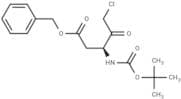
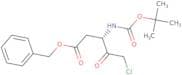
:Boc-Asp(OBzl)-Chlormethylketon
Beschreibung:
Boc-Asp(OBzl)-Chlormethylketon, mit der CAS-Nummer 172702-58-8, ist eine chemische Verbindung, die ein geschütztes Aspartinsäurederivat aufweist. Die "Boc"-Gruppe (tert-Butyloxycarbonyl) dient als Schutzgruppe für die Aminofunktionalität, während die "OBzl"-Gruppe (Benzylether) die Hydroxylgruppe der Aspartinsäure schützt. Das Vorhandensein einer Chloromethylketon-Gruppe weist darauf hin, dass diese Verbindung eine reaktive Chloromethylgruppe besitzt, die an nucleophilen Substitutionsreaktionen teilnehmen kann, was sie nützlich in der Peptidsynthese und anderen organischen Transformationen macht. Diese Verbindung wird typischerweise im Bereich der medizinischen Chemie und der Peptidsynthese verwendet, da sie die Bildung von Peptidbindungen erleichtert und Aminosäuren modifizieren kann. Ihre Reaktivität und Schutzgruppen ermöglichen selektive Reaktionen, was sie zu einem wertvollen Zwischenprodukt in der Synthese komplexerer Moleküle macht. Wie bei vielen chemischen Substanzen sind eine ordnungsgemäße Handhabung und Sicherheitsvorkehrungen aufgrund potenzieller Gefahren im Zusammenhang mit reaktiven funktionellen Gruppen unerlässlich.
Formel:C17H22ClNO5
Sortieren nach
Reinheit (%)
0
100
|
0
|
50
|
90
|
95
|
100
3 Produkte.
Boc-Asp(OBzl)-CMK
CAS:Boc-Asp(OBzl)-CMK, an inhibitor of IL-1 converting enzyme (ICE, caspase1), prevents the death of CHP100 neuroblastoma cells and inhibits IL-1β release induced by the viral coat protein [1].Formel:C17H22ClNO5Farbe und Form:SolidMolekulargewicht:355.81Boc-Asp(OBzl)-chloromethylketone
CAS:Boc-Asp(OBzl)-chloromethylketone is a synthetic molecule that is immunoreactive with gp120, the virus protein. It has been shown to inhibit the proliferation of human neuroblastoma cells and induce cell death. This compound also has an effect on cytokine production in vitro. This drug is currently being studied as a potential treatment for HIV infection. Boc-Asp(OBzl)-chloromethylketone binds to the receptor type and viral type, which are essential for the virus life cycle and induces antibody production in vivo.Formel:C17H22ClNO5Reinheit:Min. 95%Molekulargewicht:355.81 g/mol