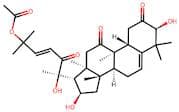
CAS 17278-28-3
:Isocucurbitacin B
Beschreibung:
Isocucurbitacin B ist eine natürlich vorkommende Verbindung, die als Cucurbitacin klassifiziert ist, eine Art tetracyclischer Triterpen. Es wird hauptsächlich aus verschiedenen Pflanzen der Familie Cucurbitaceae, wie Gurken und Kürbissen, gewonnen. Diese Verbindung ist bekannt für ihren bitteren Geschmack und wurde auf ihre potenziellen pharmakologischen Eigenschaften untersucht, einschließlich anti-krebs, entzündungshemmender und antimikrobieller Aktivitäten. Isocucurbitacin B weist eine komplexe molekulare Struktur auf, die durch mehrere Ringe und funktionelle Gruppen gekennzeichnet ist, was zu seiner biologischen Aktivität beiträgt. Es kommt typischerweise in niedrigen Konzentrationen in pflanzlichen Quellen vor, was seine direkte Anwendung in therapeutischen Kontexten einschränken kann. Darüber hinaus kann es aufgrund seiner bitteren Natur als natürlicher Abschreckungsmittel gegen Herbivorie in Pflanzen dienen. Die Forschung zu Isocucurbitacin B untersucht weiterhin seine Wirkmechanismen und potenziellen Anwendungen in der Medizin, insbesondere im Bereich der Onkologie. Weitere Studien sind jedoch erforderlich, um seine Wirksamkeit und Sicherheit in klinischen Anwendungen vollständig zu verstehen.
Formel:C32H46O8
InChl:InChI=1/C32H46O8/c1-17(33)40-27(2,3)13-12-23(36)32(9,39)25-21(35)15-29(6)22-11-10-18-19(14-20(34)26(38)28(18,4)5)31(22,8)24(37)16-30(25,29)7/h10,12-13,19,21-22,25-26,35,38-39H,11,14-16H2,1-9H3/b13-12+/t19-,21-,22+,25-,26-,29+,30-,31+,32+/m1/s1
InChI Key:InChIKey=WTBZNVRBNJWSPF-DZEACCAPSA-N
SMILES:C[C@]12[C@@](C)([C@@]([C@@](C(/C=C/C(OC(C)=O)(C)C)=O)(C)O)([C@H](O)C1)[H])CC(=O)[C@]3(C)[C@]2(CC=C4[C@]3(CC(=O)[C@@H](O)C4(C)C)[H])[H]
Synonyme:- (1S,4R,9beta,16alpha,17alpha,23E)-1,16,20-trihydroxy-9,10,14-trimethyl-2,11,22-trioxo-4,9-cyclo-9,10-secocholesta-5,23-dien-25-yl acetate
- (1S,4R,9beta,16alpha,23E)-1,16,20-trihydroxy-9,10,14-trimethyl-2,11,22-trioxo-4,9-cyclo-9,10-secocholesta-5,23-dien-25-yl acetate
- (3α,9β,10α,16α,23E)-25-(Acetyloxy)-3,16,20-trihydroxy-9-methyl-19-norlanosta-5,23-diene-2,11,22-trione
- 19-Norlanosta-5,23-diene-2,11,22-trione, 25-(acetyloxy)-3,16,20-trihydroxy-9-methyl-, (3alpha,9beta,10alpha,16alpha,23E)-
- 19-Norlanosta-5,23-diene-2,11,22-trione, 25-(acetyloxy)-3,16,20-trihydroxy-9-methyl-, (3α,9β,10α,16α,23E)-
- 2-Epicucurbiticin B
- Cucurbitcin B, 2-Epi-
- Nsc 106400
- epi-Isocucurbitacin B
- Isocucurbitacin B
- (3alpha,9beta,10alpha,16alpha,23E)-25-(Acetyloxy)-3,16,20-trihydroxy-9-methyl-19-norlanosta-5,23-diene-2,11,22-trione
Sortieren nach
Reinheit (%)
0
100
|
0
|
50
|
90
|
95
|
100
6 Produkte.
Isocucurbitacin B
CAS:Isocucurbitacin B has significant activities against HeLa and HT-29 human cancer cells with IC50 values ranging from 0.93 to 9.73uM.Formel:C32H46O8Reinheit:99.84%Farbe und Form:SolidMolekulargewicht:558.7Isocucurbitacin B
CAS:Isocucurbitacin B has significantly activities against HeLa and HT-29 human cancer cells with IC50 values ranging from 0.93 to 9.73uM.Formel:C32H46O8Reinheit:95%~99%Molekulargewicht:558.712Isocucurbitacin B
CAS:Kontrolliertes ProduktIsocucurbitacin B is a triterpenoid saponin that has cytotoxic and anticancer properties. It has been shown to inhibit the growth of cancer cells in vivo, as well as to induce apoptosis in vitro. Isocucurbitacin B also inhibits the proliferation of human colon cancer cells by inducing G1 cell cycle arrest and apoptosis. The compound has been found to be chemically stable and does not react with other chemical substances. Isocucurbitacin B is used as a pharmaceutical preparation for animals, but not humans.Formel:C32H46O8Reinheit:Min. 95%Molekulargewicht:558.7 g/mol