CAS 17350-74-2
:N,N-Dimethyltyrosin
Beschreibung:
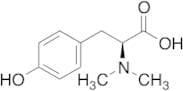
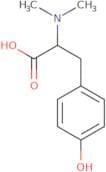
N,N-Dimethyltyrosin, auch bekannt als 3,4-Dimethyl-L-Tyrosin, ist ein Aminosäurederivat, das durch das Vorhandensein von zwei Methylgruppen gekennzeichnet ist, die am Stickstoffatom der Aminogruppe in der Tyrosinstruktur angebracht sind. Diese Modifikation beeinflusst seine Löslichkeit und biologische Aktivität. Die Verbindung ist typischerweise ein weißes bis off-white kristallines Pulver und ist in Wasser und organischen Lösungsmitteln löslich, was sie vielseitig für verschiedene Anwendungen in der biochemischen Forschung macht. N,N-Dimethyltyrosin wird häufig in Studien zur Funktion von Neurotransmittern und zur Proteinsynthese verwendet, da es als Substrat oder Inhibitor in enzymatischen Reaktionen dienen kann. Seine strukturelle Ähnlichkeit mit Tyrosin ermöglicht es ihm, an ähnlichen biochemischen Wegen teilzunehmen, aber die Methylierung verändert seine Wechselwirkung mit Enzymen und Rezeptoren. Darüber hinaus ist es wichtig für die Synthese bestimmter Arzneimittel und kann bei der Entwicklung neuer therapeutischer Mittel eingesetzt werden. Wie bei vielen Aminosäurederivaten ist es entscheidend, N,N-Dimethyltyrosin mit Vorsicht zu behandeln und die entsprechenden Sicherheitsprotokolle in Laborumgebungen zu befolgen.
Formel:C11H15NO3
InChl:InChI=1/C11H15NO3/c1-12(2)10(11(14)15)7-8-3-5-9(13)6-4-8/h3-6,10,13H,7H2,1-2H3,(H,14,15)
SMILES:CN(C)C(Cc1ccc(cc1)O)C(=O)O
Sortieren nach
Reinheit (%)
0
100
|
0
|
50
|
90
|
95
|
100
2 Produkte.
N,N-Dimethyl L-Tyrosine
CAS:Kontrolliertes ProduktFormel:C11H15NO3Farbe und Form:NeatMolekulargewicht:209.242(2S)-2-(Dimethylamino)-3-(4-hydroxyphenyl)propanoic acid
CAS:(2S)-2-(Dimethylamino)-3-(4-hydroxyphenyl)propanoic acid is a potent antagonist of the ryanodine receptor (RYR), which is a calcium release channel in the sarcoplasmatic reticulum. It has been shown to inhibit neuronal death induced by oxidative injury and also to protect against mitochondrial dysfunction. This compound has also been found to be an antinociceptive agent and is detectable at low concentrations in vivo. The pharmacokinetic properties of this drug are not well understood, but it appears to be rapidly absorbed from the gastrointestinal tract and eliminated via the urinary system.Formel:C11H15NO3Reinheit:Min. 95%Farbe und Form:PowderMolekulargewicht:209.24 g/mol