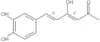
CAS 173933-40-9
:Hispolon
Beschreibung:
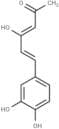
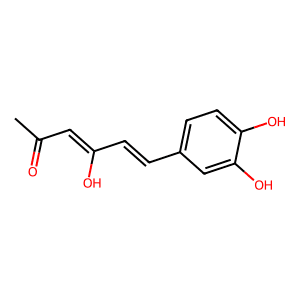
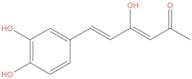
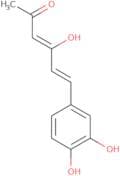
Hispolon, mit der CAS-Nummer 173933-40-9, ist eine natürlich vorkommende Verbindung, die hauptsächlich aus bestimmten Arten von Pilzen, insbesondere aus der Gattung Phellinus, gewonnen wird. Es wird als phenolische Verbindung klassifiziert und ist bekannt für seine potenziellen biologischen Aktivitäten, einschließlich antioxidativer, entzündungshemmender und antimikrobieller Eigenschaften. Hispolon hat im Bereich der medizinischen Chemie Interesse geweckt, da es in der Lage ist, verschiedene zelluläre Signalwege zu modulieren, was zu seinen therapeutischen Effekten beitragen kann. Die Verbindung weist typischerweise eine komplexe Struktur auf, die durch mehrere aromatische Ringe und Hydroxylgruppen gekennzeichnet ist, die für ihre Reaktivität und Interaktion mit biologischen Systemen verantwortlich sind. Die Forschung zu Hispolon ist im Gange, wobei Studien seine potenziellen Anwendungen in der Pharmazie, insbesondere im Kontext der Krebsbehandlung und anderer gesundheitsbezogener Vorteile, untersuchen. Wie bei vielen Naturstoffen ist jedoch eine weitere Untersuchung erforderlich, um seine Wirkmechanismen und potenziellen Nebenwirkungen vollständig zu verstehen.
Formel:C12H12O4
InChl:InChI=1S/C12H12O4/c1-8(13)6-10(14)4-2-9-3-5-11(15)12(16)7-9/h2-7,14-16H,1H3/b4-2+,10-6-
InChI Key:InChIKey=QDVIEIMMEUCFMW-QXYPORFMSA-N
SMILES:C(=C/C(=C/C(C)=O)/O)\C1=CC(O)=C(O)C=C1
Synonyme:- 3,5-Hexadien-2-one, 6-(3,4-dihydroxyphenyl)-4-hydroxy-, (3Z,5E)-
- Hispolon
- 3,5-Hexadien-2-one, 6-(3,4-dihydroxyphenyl)-4-hydroxy-, (Z,E)-
- (3Z,5E)-6-(3,4-Dihydroxyphenyl)-4-hydroxy-3,5-hexadien-2-one
- Hispolone
Sortieren nach
Reinheit (%)
0
100
|
0
|
50
|
90
|
95
|
100
4 Produkte.
Hispolon
CAS:Hispolon: polyphenol from Phellinus linteus with anti-cancer, anti-diabetic, antiviral, and hepatoprotective properties.Formel:C12H12O4Reinheit:99.94%Farbe und Form:SoildMolekulargewicht:220.22Hispolon
CAS:Hispolon is a naturally occurring polyketide compound, which is derived from the mushroom Phellinus linteus, commonly found in Asia. This compound is known for its diverse biological activities, primarily functioning as an antioxidant, anti-inflammatory, and antitumor agent. The mode of action of hispolon involves the modulation of multiple cellular pathways. It has been shown to induce apoptosis in cancer cells by triggering intrinsic and extrinsic apoptotic pathways. Additionally, hispolon exhibits the ability to inhibit the NF-κB pathway, subsequently decreasing the expression of pro-inflammatory cytokines and leading to an anti-inflammatory effect.
Formel:C12H12O4Reinheit:Min. 95%Molekulargewicht:220.22 g/mol