CAS 1746-77-6
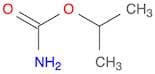
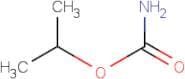
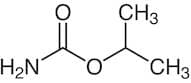
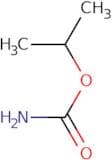
:Propan-2-ylcarbamat
Beschreibung:
Propan-2-ylcarbamat, auch bekannt als Isopropylcarbamat, ist eine organische Verbindung, die durch ihre Carbamat-Funktionalgruppe gekennzeichnet ist, die aus einer Carbonylgruppe (C=O) besteht, die an ein Stickstoffatom (N) gebunden ist, das ebenfalls mit einer Isopropylgruppe (C3H7) verbunden ist. Diese Verbindung erscheint typischerweise als farblose bis blassgelbe Flüssigkeit mit einem schwachen Geruch. Sie ist in Wasser und verschiedenen organischen Lösungsmitteln löslich, was sie vielseitig für verschiedene Anwendungen macht. Propan-2-ylcarbamat wird hauptsächlich in der Synthese von Arzneimitteln und Agrochemikalien verwendet und dient als Zwischenprodukt in der Herstellung anderer chemischer Verbindungen. Ihre chemische Stabilität und relativ geringe Toxizität tragen zu ihrer Nützlichkeit in industriellen Prozessen bei. Wie bei vielen Carbamaten ist es jedoch wichtig, sie mit Vorsicht zu behandeln, da potenzielle gesundheitliche Auswirkungen mit der Exposition verbunden sind. Insgesamt ist Propan-2-ylcarbamat eine wertvolle Verbindung in der organischen Chemie, mit Anwendungen, die ihre einzigartigen chemischen Eigenschaften nutzen.
Formel:C4H9NO2
InChl:InChI=1S/C4H9NO2/c1-3(2)7-4(5)6/h3H,1-2H3,(H2,5,6)
InChI Key:InChIKey=OVPLZYJGTGDFNB-UHFFFAOYSA-N
SMILES:O(C(C)C)C(N)=O
Synonyme:- 1-Methylethyl carbamate
- Carbamic acid isopropyl ester
- Carbamic acid, 1-methylethyl ester
- NSC 60539
- Propan-2-yl carbamate
- Isopropyl carbamate
Sortieren nach
Reinheit (%)
0
100
|
0
|
50
|
90
|
95
|
100
6 Produkte.
Carbamic acid, 1-methylethyl ester
CAS:Formel:C4H9NO2Reinheit:97%Farbe und Form:SolidMolekulargewicht:103.1198Carbamic acid isopropyl ester
CAS:Carbamic acid isopropyl esterReinheit:97%Molekulargewicht:103.12g/molIsopropyl Carbamate
CAS:Formel:C4H9NO2Reinheit:>98.0%(GC)(N)Farbe und Form:White to Almost white powder to crystalMolekulargewicht:103.12Carbamic acid isopropyl ester
CAS:Carbamic acid isopropyl ester (CiPA) is a drug that is used to treat metabolic disorders and autoimmune diseases. It has been shown to be effective in clinical trials for the treatment of chronic schizophrenia and psychotic disorder. CiPA inhibits the activity of lysine residues on proteins, which are involved in the metabolism of amino acids. It also binds to amide groups and carbonyl groups on proteins, leading to inhibition of protein synthesis and other biological processes. The pharmacokinetic properties of CiPA are thought to be due to its ability to inhibit liver cells, which can lead to an increase in the elimination rate of this drug from the body.Formel:C4H9NO2Reinheit:Min. 95%Molekulargewicht:103.12 g/mol