CAS 17567-17-8
:Kaliumhydridtris(3,5-dimethylpyrazolyl)borat
Beschreibung:
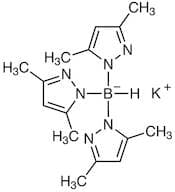
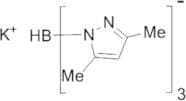
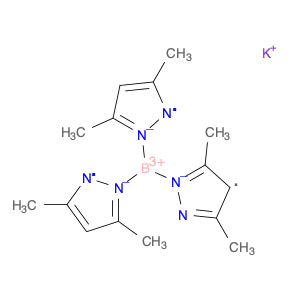
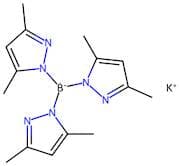
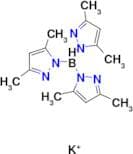
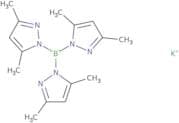
Kaliumhydridtris(3,5-dimethylpyrazolyl)borat, allgemein bekannt als K[HB(3,5-DMP)3], ist eine Koordinationsverbindung, die ein Borzentrum aufweist, das an drei 3,5-Dimethylpyrazol-Liganden koordiniert ist. Diese Verbindung zeichnet sich durch ihre einzigartige Struktur aus, bei der das Boratom durch die Anwesenheit der Pyrazolringe stabilisiert wird, die zu ihren chelatbildenden Eigenschaften beitragen. Das Kaliumion dient als Gegenion und gleicht die negative Ladung des Boratkomplexes aus. Diese Substanz ist bekannt für ihre Rolle in verschiedenen chemischen Reaktionen, insbesondere im Bereich der Organometallchemie und Katalyse, wo sie als Ligand für Übergangsmetalle wirken kann. Sie zeigt eine gute Löslichkeit in polaren Lösungsmitteln und ist unter Standardlaborbedingungen relativ stabil. Die Anwesenheit der Dimethylgruppen an den Pyrazolringen erhöht das sterische Volumen um das Borzentrum, was seine Reaktivität und Wechselwirkung mit anderen chemischen Spezies beeinflusst. Insgesamt ist Kaliumhydridtris(3,5-dimethylpyrazolyl)borat eine wertvolle Verbindung in der synthetischen Chemie, insbesondere bei der Entwicklung neuer katalytischer Systeme.
Formel:C15H22BKN6
InChl:InChI=1/C15H22BN6.K/c1-10-7-13(4)20(17-10)16(21-14(5)8-11(2)18-21)22-15(6)9-12(3)19-22;/h7-9,16H,1-6H3;/q-1;+1
InChI Key:InChIKey=NTWZGFNSHCFHIJ-UHFFFAOYSA-N
SMILES:[B+3]([H-])([N-]1C(C)=CC(C)=N1)([N-]2C(C)=CC(C)=N2)[N-]3C(C)=CC(C)=N3.[K+]
Synonyme:- 1H-Pyrazole, 3,5-dimethyl-, boron complex
- Borate(1-), tris(3,5-dimethyl-1H-pyrazolato-N<sup>1</sup>)hydro-, potassium, (T-4)-
- Borate(1-), tris(3,5-dimethyl-1H-pyrazolato-κN<sup>1</sup>)hydro-, potassium, (T-4)-
- Borate(1-), tris(3,5-dimethylpyrazolato)hydro-, potassium
- NSC 376448
- Potassium Tris(3,5-Dimethyl-1-Pyrazolyl)-Borohydride
- Potassium Tris(3,5-Dimethylpyrazol-1-Yl)Borohydride
- Potassium hydridotris(3,5-dimethylpyrazol-1-yl)borate
- Potassium hydridotris(3,5-dimethylpyrazolyl)borate(1-)
- Potassium hydridotris-(3,5-dimethylpyrazolyl)borate
- Potassium hydrotris(3,5-dimethyl-1H-pyrazol-1-yl)borate
- Potassium hydrotris(3,5-dimethyl-1H-pyrazol-1-yl)borate(1-)
- Potassium hydrotris(3,5-dimethylpyrazol-1-yl)borate(1-)
- Potassium hydrotris(3,5-dimethylpyrazolyl)borate
- Potassium hydrotris(3,5-dimethylpyrazolyl)borate(1-)
- Potassium tri(3,5-dimethyl-1-pyrazolyl)borohydride
- Potassium tris(3,5-dimethylpyrazol-1-yl)hydroborate
- Potassium tris(3,5-dimethylpyrazolyl)hydroborate
- Potassiumhydrotris(3,5-dimethylpyrazol-1-yl)borate,97%
- potassium tris(3,5-dimethyl-1H-pyrazol-1-yl)(hydrido)borate(1-)
- Borate(1-), tris(3,5-dimethyl-1H-pyrazolato-N1)hydro-, potassium, (T-4)-
- Borate(1-), tris(3,5-dimethyl-1H-pyrazolato-κN1)hydro-, potassium, (T-4)-
- Scorpionates
- Potassium tris(3,5-dimethyl-1-pyrazolyl)borohydride,99%
- POTASSIUM HYDROTRIS(3,5-DIMETHYLPYRAZOL-1-YL)BORATE
- Tp ligand
- Weitere Synonyme anzeigen
Sortieren nach
Reinheit (%)
0
100
|
0
|
50
|
90
|
95
|
100
6 Produkte.
Potassium Tris(3,5-dimethylpyrazol-1-yl)borohydride
CAS:Formel:C15H22BKN6Reinheit:>98.0%(T)Farbe und Form:White to Almost white powder to crystalMolekulargewicht:336.29Potassium hydrotris(3,5-dimethylpyrazol-1-yl)borate, 97%
CAS:Potassium hydrotris(3,5-dimethylpyrazol-1-yl)borate, 97%
Formel:C15H22BN6KReinheit:97%Farbe und Form:white pwdr.Molekulargewicht:336.29POTASSIUM HYDROTRIS(3,5-DIMETHYLPYRAZOL-1-YL)BORATE
CAS:Formel:C15H22BKN6Reinheit:98%Farbe und Form:SolidMolekulargewicht:336.2847Potassiumhydrotris(3,5-Dimethylpyrazol-1-Yl)Borate
CAS:Potassiumhydrotris(3,5-Dimethylpyrazol-1-Yl)BorateReinheit:98%Molekulargewicht:336.28g/molPotassium tris(3,5-dimethyl-1-pyrazolyl)borohydride
CAS:Reinheit:98.0%Farbe und Form:SolidMolekulargewicht:336.29Potassium tris(3,5-dimethyl-1-pyrazolyl)borohydride
CAS:Potassium tris(3,5-dimethyl-1-pyrazolyl)borohydride is a catalytic reagent that converts various ketones to their corresponding cyclic 3,5-dimethylpyrazoles. It has been used for the synthesis of 1,4-dihydropyridines and for the conversion of aliphatic nitro compounds to their corresponding anilines. The yields are high and it has been shown to be more efficient than other methods in the literature. This reagent also has an intramolecular reaction mechanism and is able to reduce chloride ions into chloride gas.Formel:C15H22BKN6Reinheit:Min. 95%Farbe und Form:PowderMolekulargewicht:336.28 g/mol