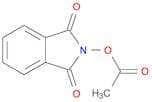
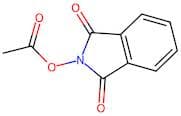
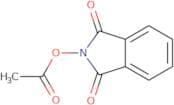
CAS 17720-64-8
:2-(Acetyloxy)-1H-isoindol-1,3(2H)-dion
Beschreibung:
2-(Acetyloxy)-1H-isoindol-1,3(2H)-dion, auch bekannt unter seiner CAS-Nummer 17720-64-8, ist eine chemische Verbindung, die durch ihre Isoindolstruktur gekennzeichnet ist, die ein verschmolzenes Benzol- und Pyrrolringsystem aufweist. Diese Verbindung enthält eine Acetyloxygruppe, die zu ihrer Reaktivität und potenziellen Anwendungen in der organischen Synthese beiträgt. Sie erscheint typischerweise als Feststoff bei Raumtemperatur und ist in organischen Lösungsmitteln löslich, was ihre unpolaren Eigenschaften widerspiegelt. Das Vorhandensein von Dione-Funktionalgruppen zeigt an, dass sie an verschiedenen chemischen Reaktionen teilnehmen kann, wie z.B. nucleophile Additionen und Kondensationsreaktionen. Ihre einzigartige Struktur ermöglicht es ihr, biologische Aktivität zu zeigen, was sie in der medizinischen Chemie von Interesse macht. Darüber hinaus kann die Verbindung licht- und feuchtigkeitsempfindlich sein, was eine sorgfältige Handhabung und Lagerbedingungen erfordert. Insgesamt ist 2-(Acetyloxy)-1H-isoindol-1,3(2H)-dion eine vielseitige Verbindung mit potenziellen Anwendungen in der Pharmazie und organischen Synthese.
Formel:C10H7NO4
InChl:InChI=1S/C10H7NO4/c1-6(12)15-11-9(13)7-4-2-3-5-8(7)10(11)14/h2-5H,1H3
InChI Key:InChIKey=IJRNYIWWGDQEIY-UHFFFAOYSA-N
SMILES:O=C1C=2C(C(=O)N1OC(C)=O)=CC=CC2
Synonyme:- 2-(Acetyloxy)-1H-isoindole-1,3(2H)-dione
- NSC 101749
- N-Acetoxyphthalimide
- Phthalimide, N-acetoxy-
- 1H-Isoindole-1,3(2H)-dione, 2-(acetyloxy)-
Sortieren nach
Reinheit (%)
0
100
|
0
|
50
|
90
|
95
|
100
4 Produkte.
1H-Isoindole-1,3(2H)-dione, 2-(acetyloxy)-
CAS:Formel:C10H7NO4Reinheit:98%Farbe und Form:SolidMolekulargewicht:205.16691,3-Dioxoisoindolin-2-yl acetate
CAS:1,3-Dioxoisoindolin-2-yl acetateReinheit:98%Molekulargewicht:205.17g/mol1,3-Dioxo-2,3-dihydro-1H-isoindol-2-yl acetate
CAS:1,3-Dioxo-2,3-dihydro-1H-isoindol-2-yl acetate is a reactive intermediate that can be used as a starting material for the synthesis of other organic compounds. It is synthesized by the reaction of an acid with an aldehyde or ketone in the presence of a base. The rate of this reaction depends on the functional groups present in both reactants and their relative concentrations. This intermediate can be converted to another chemical compound through various reactions, including hydroxymethylation, decarboxylation and oxidation. This chemical has been used as a cocatalyst for the production of 5-hydroxymethylfurfural (HMF).Formel:C10H7NO4Reinheit:Min. 95%Molekulargewicht:205.17 g/mol