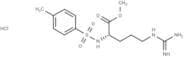
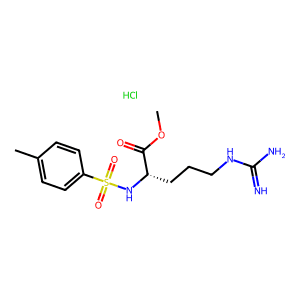
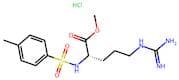
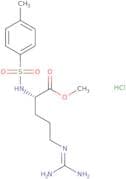
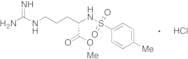
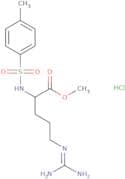
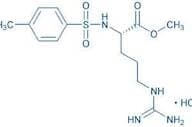
![L-Arginine, N2-[(4-methylphenyl)sulfonyl]-, methyl ester, hydrochloride (1:1)](/_next/image/?url=https%3A%2Fstatic.cymitquimica.com%2Fcas-image%2Fthumb-webp%2F373065-l-arginine-n2-4-methylphenyl-sulfonyl-methyl-ester-hydrochloride-1-1.webp&w=3840&q=75)
CAS 1784-03-8
:L-Arginin, N2-[(4-methylphenyl)sulfonyl]-, Methylester, Hydrochlorid (1:1)
Beschreibung:
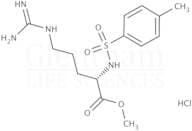
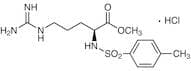
L-Arginin, N2-[(4-methylphenyl)sulfonyl]-, Methylester, Hydrochlorid (1:1) ist eine chemische Verbindung, die eine Kombination aus einer Aminosäure, L-Arginin, und einer Sulfonylgruppe, die an ein Methylphenyl-Moiety gebunden ist, aufweist. Diese Verbindung zeichnet sich durch ihre basische Aminosäurestruktur aus, die eine Guanidiniumgruppe umfasst, die zu ihrer Rolle in verschiedenen biologischen Prozessen beiträgt, wie z.B. der Proteinsynthese und der Produktion von Stickstoffmonoxid. Das Vorhandensein des Methylesters weist darauf hin, dass es sich um ein Derivat von L-Arginin handelt, das seine Löslichkeit und Bioverfügbarkeit verbessern kann. Die Hydrochloridform deutet darauf hin, dass es sich um ein Salz handelt, das typischerweise die Stabilität und Handhabungseigenschaften verbessert. Diese Verbindung kann verschiedene pharmakologische Aktivitäten aufweisen, einschließlich potenzieller Rollen in der kardiovaskulären Gesundheit und der Immunfunktion. Ihre Sulfonylgruppe kann auch ihre Reaktivität und Wechselwirkung mit biologischen Zielen beeinflussen. Insgesamt ist L-Arginin, N2-[(4-Methylphenyl)sulfonyl]-, Methylester, Hydrochlorid sowohl für die biochemische Forschung als auch für potenzielle therapeutische Anwendungen von Interesse.
Formel:C14H22N4O4S·ClH
InChl:InChI=1S/C14H22N4O4S.ClH/c1-10-5-7-11(8-6-10)23(20,21)18-12(13(19)22-2)4-3-9-17-14(15)16;/h5-8,12,18H,3-4,9H2,1-2H3,(H4,15,16,17);1H/t12-;/m0./s1
InChI Key:InChIKey=JIQFFACVQXXHMY-YDALLXLXSA-N
SMILES:S(N[C@@H](CCCNC(=N)N)C(OC)=O)(=O)(=O)C1=CC=C(C)C=C1.Cl
Synonyme:- <span class="text-smallcaps">L</span>-Arginine, N<sup>2</sup>-[(4-methylphenyl)sulfonyl]-, methyl ester, hydrochloride (1:1)
- <span class="text-smallcaps">L</span>-Arginine, N<sup>2</sup>-[(4-methylphenyl)sulfonyl]-, methyl ester, monohydrochloride
- Arginine, N<sup>2</sup>-(p-tolylsulfonyl)-, methyl ester, monohydrochloride, <span class="text-smallcaps">L</span>-
- N-alpha-Toluenesulfonylarginine methyl ester hydrochloride
- N-alpha-Tosyl-L-arginine methyl ester hydrochloride
- N-p-Tosyl-L-arginine methyl ester hydrochloride
- N-α-p-Tosyl-L-arginine methyl ester hydrochloride
- N<sup>α</sup>-Tosyl-<span class="text-smallcaps">L</span>-arginine methyl ester hydrochloride
- Nalpha-(4-Toluenesulfonyl)-L-Arginine Methyl Ester Hydrochloride
- Tame
- Tos-Arg-OMe . HCl
- Tos-Arg-OMe・HCl
- Tosyl-<span class="text-smallcaps">L</span>-arginine methyl ester hydrochloride
- Tosylarginine methyl ester hydrochloride
- methyl N5-(diaminomethylidene)-N2-[(4-methylphenyl)sulfonyl]-L-ornithinate hydrochloride
- methyl N5-(diaminomethylidene)-N2-[(4-methylphenyl)sulfonyl]ornithinate hydrochloride
- na-P-tosyl-L-arginine methyl*ester hydrochloride
- α-N-Tosyl-<span class="text-smallcaps">L</span>-arginine methyl ester hydrochloride
- L-Arginine, N2-[(4-methylphenyl)sulfonyl]-, methyl ester, hydrochloride (1:1)
- α-N-Tosyl-L-arginine methyl ester hydrochloride
- Nα-Tosyl-L-arginine methyl ester hydrochloride
- L-Arginine, N2-[(4-methylphenyl)sulfonyl]-, methyl ester, monohydrochloride
- Weitere Synonyme anzeigen
Sortieren nach
Reinheit (%)
0
100
|
0
|
50
|
90
|
95
|
100
11 Produkte.
Nα-Tosyl-L-arginine Methyl Ester Hydrochloride
CAS:Formel:C14H22N4O4S·HClReinheit:>98.0%(T)Farbe und Form:White to Almost white powder to crystalMolekulargewicht:378.87Tos-Arg-OMe · HCl
CAS:A good substrate for trypsin, thrombin, and urokinase as well as for plasma and glandular kallikreins. By competing for the arginine-binding site in the reactive center of proteases, L-TAME is also able to act as a reversible inhibitor. It suppresses, e.g., the TNF secretion of human leukocytes which is evidently dependent upon the action of serine proteases.Formel:C14H22N4O4S·HClReinheit:> 99%Farbe und Form:White PowderMolekulargewicht:378.88L-Arginine, N2-[(4-methylphenyl)sulfonyl]-, methyl ester, hydrochloride (1:1)
CAS:Formel:C14H23ClN4O4SReinheit:98%Farbe und Form:SolidMolekulargewicht:378.8748TAME hydrochloride
CAS:TAME hydrochloride (Tos-Arg-OMe HCl) is a kind od amino acid derivatives.Formel:C14H23ClN4O4SReinheit:99.11% - 99.21%Farbe und Form:White Fine Crystalline PowderMolekulargewicht:378.87N-α-p-Tosyl-L-Arginine Methyl Ester Hydrochloride
CAS:N-α-p-Tosyl-L-Arginine Methyl Ester HydrochlorideReinheit:98%Molekulargewicht:378.87g/molTAME Hydrochloride
CAS:Formel:C14H22N4O4S·HClReinheit:≥ 98.0%Farbe und Form:White to almost white powderMolekulargewicht:378.87N-alpha-Tosyl-L-arginine methyl ester hydrochloride
CAS:N-alpha-Tosyl-L-arginine methyl ester hydrochloride is a potent inhibitor of the serine protease leishmania. It inhibits the enzyme by binding to its active site and interfering with the enzymatic reaction. This drug has been shown to be effective in treating bladder infections caused by leishmania, although it can cause a decrease in responsiveness in an animal model. N-alpha-Tosyl-L-arginine methyl ester hydrochloride also has anti-HIV activities, which may be due to its ability to inhibit HIV replication. The drug is most likely absorbed through the apical surface of the bladder epithelium and then diffuses into the extracellular space, where it inhibits key enzymes involved in viral replication.Formel:C14H22N4O4S·HClReinheit:Min. 95%Farbe und Form:White Off-White PowderMolekulargewicht:378.88 g/molN-4-Tosyl-L-arginine Methyl Ester Hydrochloride
CAS:Applications N-4-Tosyl-L-arginine Methyl Ester Hydrochloride acts as a synthetic substrate of serine proteases and thus is used to determine serine proteases from diverse organic sources.
References Hummel, B. et al.: Can. J. Biochem. Physiol., 37, 1393 (1959); Matsuda, Y. et al.: J. Biochem. 80, 671 (1976);Formel:C14H23ClN4O4SFarbe und Form:NeatMolekulargewicht:378.87TAME hydrochloride
CAS:Tos-Arg-OMe • HCl is a peptide that has been shown to modulate the responsiveness of cells to sodium channels. Tos-Arg-OMe • HCl may also be useful as an anti-cancer drug, as it inhibits cancer cell growth and induces apoptosis. This peptide has been shown to be an effective treatment for HIV infection by inhibiting viral replication. It also reduces inflammation and prevents the development of other opportunistic infections in animal models.Formel:C14H22N4O4S·ClHReinheit:Min. 95%Molekulargewicht:378.87 g/mol


![L-Arginine, N2-[(4-methylphenyl)sulfonyl]-, methyl ester, hydrochloride (1:1)](/_next/image/?url=https%3A%2Fstatic.cymitquimica.com%2Fproducts%2FIN%2Fthumb%2FDA0025ZQ.jpg&w=3840&q=75)