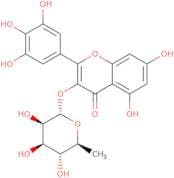
CAS 17912-87-7
:Myricitrin
Beschreibung:
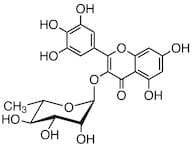
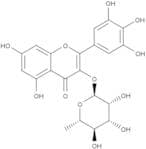
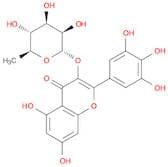
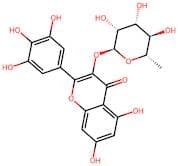
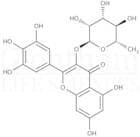
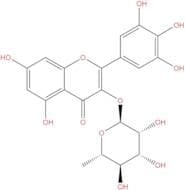
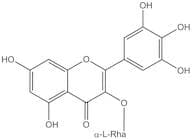
Myricitrin, mit der CAS-Nummer 17912-87-7, ist ein Flavonoid-Glycosid, das hauptsächlich in verschiedenen Pflanzen, insbesondere in den Myrica-Arten, vorkommt. Es ist durch seine Struktur gekennzeichnet, die aus einem Myricetin-Aglykon besteht, das an eine Rhamnose-Zuckergruppe gebunden ist. Myricitrin zeigt mehrere biologische Aktivitäten, einschließlich antioxidativer, entzündungshemmender und potenziell antimikrobieller Eigenschaften, was es für die pharmakologische Forschung von Interesse macht. Die Verbindung ist typischerweise in polaren Lösungsmitteln löslich, was ihre glykosidische Natur widerspiegelt, und wird oft wegen ihrer gesundheitlichen Vorteile, insbesondere in der traditionellen Medizin, untersucht. Darüber hinaus wurde Myricitrin hinsichtlich seiner Rolle beim Schutz von Zellen vor oxidativem Stress und seines Potenzials zur Modulation verschiedener biochemischer Wege untersucht. Seine Präsenz in diätetischen Quellen deutet darauf hin, dass es zu den gesundheitlichen Vorteilen beitragen könnte, die mit pflanzenbasierten Diäten verbunden sind. Insgesamt stellt Myricitrin eine bedeutende Verbindung im Bereich der Naturprodukte und der Phytochemie dar, mit laufenden Forschungen zu seinen therapeutischen Anwendungen.
Formel:C21H20O12
InChl:InChI=1/C21H20O12/c1-6-14(26)17(29)18(30)21(31-6)33-20-16(28)13-9(23)4-8(22)5-12(13)32-19(20)7-2-10(24)15(27)11(25)3-7/h2-6,14,17-18,21-27,29-30H,1H3
InChI Key:InChIKey=DCYOADKBABEMIQ-OWMUPTOHSA-N
SMILES:O(C1=C(OC=2C(C1=O)=C(O)C=C(O)C2)C3=CC(O)=C(O)C(O)=C3)[C@H]4[C@H](O)[C@H](O)[C@@H](O)[C@H](C)O4
Synonyme:- 17912-87-7
- 3,3′,4′,5,5′,7-Hexahydroxyflavone, 3-rhamnoside
- 3-O-Rhamnosylmyricetin
- 3-[(6-Deoxy-α-<span class="text-smallcaps">L</span>-mannopyranosyl)oxy]-5,7-dihydroxy-2-(3,4,5-trihydroxyphenyl)-4H-1-benzopyran-4-one
- 4H-1-Benzopyran-4-one, 3-[(6-deoxy-α-<span class="text-smallcaps">L</span>-mannopyranosyl)oxy]-5,7-dihydroxy-2-(3,4,5-trihydroxyphenyl)-
- 4H-1-benzopyran-4-one, 3-[(6-deoxy-alpha-L-mannopyranosyl)oxy]-5,7-dihydroxy-2-(3,4,5-trihydroxyphenyl)-
- 5,7-Dihydroxy-3-{[(2S,3R,4R,5R,6S)-3,4,5-trihydroxy-6-methyltetrahydro-2H-pyran-2-yl]oxy}-2-(3,4,5-trihydroxyphenyl)-4H-chromen-4-on
- 5,7-Dihydroxy-3-{[(2S,3R,4R,5R,6S)-3,4,5-trihydroxy-6-methyltetrahydro-2H-pyran-2-yl]oxy}-2-(3,4,5-trihydroxyphenyl)-4H-chromen-4-one
- 5,7-Dihydroxy-4-oxo-2-(3,4,5-trihydroxyphenyl)-4H-chromen-3-yl 6-deoxy-a-L-mannopyranoside
- 5,7-Dihydroxy-4-oxo-2-(3,4,5-trihydroxyphenyl)-4H-chromen-3-yl 6-deoxy-alpha-L-mannopyranoside
- 5,7-dihydroxy-4-oxo-2-(3,4,5-trihydroxyphenyl)-4H-chromen-3-yl 6-deoxyhexopyranoside
- 6-Désoxy-alpha-L-mannopyranoside de 5,7-dihydroxy-4-oxo-2-(3,4,5-trihydroxyphényl)-4H-chromén-3-yle
- Myricetin 3-O-rhamnopyranoside
- Myricetin 3-O-rhamnoside
- Myricetin 3-O-α-<span class="text-smallcaps">L</span>-rhamnopyranoside
- Myricetin 3-O-α-<span class="text-smallcaps">L</span>-rhamnoside
- Myricetin 3-O-α-<span class="text-smallcaps">L</span>-rhamnpyronoside
- Myricetin 3-O-α-rhamnopyranoside
- Myricetin 3-rhamnoside
- Myricetin-3-O-α-rhamnoside
- Myricetin-3-O-β-rhamnopyranoside
- Myricitrin
- Myricitrine
- Myricitroside
- NSC 19803
- 4H-1-Benzopyran-4-one, 3-[(6-deoxy-α-L-mannopyranosyl)oxy]-5,7-dihydroxy-2-(3,4,5-trihydroxyphenyl)-
- 3-[(6-Deoxy-α-L-mannopyranosyl)oxy]-5,7-dihydroxy-2-(3,4,5-trihydroxyphenyl)-4H-1-benzopyran-4-one
- MYRICITRIN WITH HPLC
- MIRICITRIN
- 3-[(6-Deoxy-alpha-L-Mannopyranosyloxy)]-5,7-dihydroxy-2-(3,4,5-trihydroxyphenyl)-4H-chroMen-4-one
- CANNABISCITRIN
- 3,3′,4′,5,5′,7-Hexahydroxyflavone 3-O-rhamnoside
- Myricetin 3-O-α-L-rhamnopyranoside
- mannopyranosyl)oxy]-5,7-dihydroxy-2-(3,4,5-trihydroxyphenyl)-
- MYRICITRIN HPLC 98+%
- YRICITRIN
- Myricitrin(Myricitrine)
- MYRICITRIN(MYRICETIN-3-O-RHAMNOSIDE)(SH)
- 5,7-dihydroxy-3-((2s,3r,4r,5r,6s)-3,4,5-trihydroxy-6-methyl-tetrahydro-pyran-2-yloxy)-2-(3,4,5-trihydroxy-phenyl)-1-benzopyran-4-one
- 3-[(6-deoxy-alpha-L-mannopyranosyl)oxy]-5,7-dihydroxy-2-(3,4,5-trihydroxyphenyl)-4H-benzopyran-4-one
- Myricitrin, froM Myrica rubra
- Myricetin 3-α-L-rhamnopyranoside
- MYRICETIN-3-O-RHAVINOSIDE
- 5,7-Dihydroxy-3-((2S,3R,4R,5R,6S)-3,4,5-trihydroxy-6-methyl-tetrahydro-pyran-2-yloxy)-2-(3,4,5-trihydroxy-phenyl)-1-benzopyran-4-one
- 3',4',5,5',7-Pentahydroxy-3-(α-L-rhamnopyranosyloxy)flavone
- 4H-1-Benzopyran-4-one,3-[(6-deoxy-α-L-
- 3-[(6-deoxy-α-L-mannopyranosyl)oxy]-5,7-dihydroxy-2-(3,4,5-trihydroxyphenyl)-4H-benzopyran-4-one
- Myricetrin
- Weitere Synonyme anzeigen
Sortieren nach
Reinheit (%)
0
100
|
0
|
50
|
90
|
95
|
100
10 Produkte.
Myricitrin
CAS:Formel:C21H20O12Reinheit:>98.0%(HPLC)Farbe und Form:Light yellow to Yellow to Orange powder to crystalMolekulargewicht:464.38Myricitrin
CAS:Myricitrin analytical standard provided with w/w absolute assay, to be used for quantitative titration.Formel:C21H20O12Reinheit:(HPLC) ≥99%Farbe und Form:PowderMolekulargewicht:464.38Myricitrin
CAS:Formel:C21H20O12Reinheit:(HPLC) ≥ 98.0%Farbe und Form:White to light yellow powderMolekulargewicht:464.38Myricetrin
CAS:Myricitrin exhibits hepatoprotective, anti-inflammatory,antioxidant, anti-allergic, antinociception, anxiolytic-like, and antipsychotic-like effects. Myricitrin can be used as a drug candidate for the treatment of cardiovascular diseases, by effectively protecting cells from ox-LDL-induced endothelial cell apoptosis and reducing atherosclerotic plaque formation. Myricitrin is also a nitric oxide (NO) and protein kinase C (PKC) inhibitor that has central nervous system activity.Formel:C21H20O12Reinheit:95%~99%Molekulargewicht:464.379Myricitrin
CAS:Myricitrin (Myricitrine), a flavonoid compound isolated from the root bark of Myrica cerifera, exerts antinociceptive effects.Formel:C21H20O12Reinheit:99.72%Farbe und Form:Light Yellow To Off-White Crystalline PowderMolekulargewicht:464.38Myricitrin
CAS:Natural glycosideFormel:C21H20O12Reinheit:≥ 95.0 % (HPLC)Farbe und Form:PowderMolekulargewicht:464.38Myricitrin
CAS:Myricitrin is a natural compound that is found in the bark of the Myrica tree. It has been shown to have antioxidant effects and pro-apoptotic activities. Myricitrin has been shown to induce apoptosis in HL-60 cells through activation of the caspase-3 pathway, which includes cleavage of poly (ADP-ribose) polymerase and activation of caspases. In addition, myricitrin induces apoptosis by binding to DNA and inhibiting transcription. The physiological effects of myricetin are similar to those of myricitrin due to their structural similarity. However, there is no data available on the anti-inflammatory properties or hypoglycemic effect of myricetin.Formel:C21H20O12Reinheit:Min. 95%Farbe und Form:White PowderMolekulargewicht:464.38 g/mol