CAS 1798-60-3
:(R)-Phenylacetylcarbinol
Beschreibung:
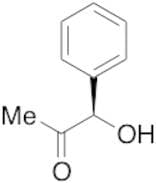
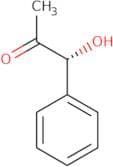
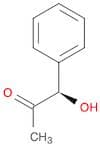
(R)-Phenylacetylcarbinol, mit der CAS-Nummer 1798-60-3, ist eine organische Verbindung, die durch ihre chirale Struktur gekennzeichnet ist, die eine Phenylgruppe enthält, die an ein Kohlenstoffatom gebunden ist, das sowohl eine Hydroxyl- als auch eine Acetylgruppe trägt. Diese Verbindung ist bei Raumtemperatur eine farblose bis blassgelbe Flüssigkeit und ist bekannt für ihr angenehmes blumiges Aroma, was sie in der Parfümindustrie nützlich macht. Sie ist in organischen Lösungsmitteln wie Ethanol und Ether löslich, hat jedoch eine begrenzte Löslichkeit in Wasser. Die Verbindung ist in der organischen Synthese von Bedeutung und wird häufig als Zwischenprodukt in der Herstellung verschiedener Arzneimittel und feiner Chemikalien verwendet. Ihre Chiralität ermöglicht die Herstellung von enantiomerenreinen Substanzen, was entscheidend für die Entwicklung von Arzneimitteln mit spezifischen biologischen Aktivitäten ist. Darüber hinaus kann (R)-Phenylacetylcarbinol verschiedenen chemischen Reaktionen unterzogen werden, einschließlich Oxidation und Veresterung, was ihre Nützlichkeit in der synthetischen organischen Chemie weiter erhöht. Sicherheitsdaten zeigen, dass sie mit Vorsicht behandelt werden sollte, wie viele organische Verbindungen, aufgrund potenzieller reizender Eigenschaften.
Formel:C9H10O2
InChl:InChI=1S/C9H10O2/c1-7(10)9(11)8-5-3-2-4-6-8/h2-6,9,11H,1H3/t9-/m0/s1
InChI Key:InChIKey=ZBFFNPODXBJBPW-VIFPVBQESA-N
SMILES:[C@@H](C(C)=O)(O)C1=CC=CC=C1
Synonyme:- (-)-(1R)-1-Hydroxy-1-phenyl-2-propanone
- (1R)-1-Phenyl-1-hydroxypropan-2-one
- (1R)-1-hydroxy-1-phenylpropan-2-one
- (R)-1-Hydroxy-1-phenyl-2-propanone
- (R)-1-Hydroxy-1-phenylpropanone
- (R)-Hydroxy-1-Phenyl-2-propanedione
- (R)-Phenylacetylcarbinol
- 1-Hydroxy-1-Phenylpropan-2-One
- 2-Propanone, 1-hydroxy-1-phenyl-, (1R)-
- 2-Propanone, 1-hydroxy-1-phenyl-, (R)-
- <span class="text-smallcaps">D</span>-(-)-1-Hydroxy-1-phenylpropanone
- <span class="text-smallcaps">D</span>-(-)-1-Phenyl-1-hydroxy-2-propanone
- <span class="text-smallcaps">D</span>-(-)-Phenylacetylcarbinol
- l-Phenylacetylcarbinol
- D-(-)-1-Hydroxy-1-phenylpropanone
- Weitere Synonyme anzeigen
Sortieren nach
Reinheit (%)
0
100
|
0
|
50
|
90
|
95
|
100
5 Produkte.
Ephedrine Hydrochloride EP Impurity A
CAS:Kontrolliertes ProduktFormel:C9H10O2Farbe und Form:Pale Yellow LiquidMolekulargewicht:150.18(R)-1-Hydroxy-1-phenylpropanone
CAS:Kontrolliertes ProduktApplications (R)-1-Hydroxy-1-phenylpropanone is used as a reagent in the preparation of chiral (amino)alkanol derivatives and determination of their activity as antibacterial agents and antifungal agents. It is also an intermediate used in the synthesis of Pseudoephedrine and Ephedrine.
References Chennakesava, R. K., et al.: Bioorg. Med. Chem. Lett., 24, 3057 (2014); Baxter, E., et al.: Org. Reactions, 59 (2002); Astrova, M., et al.: Res. on Chem. Intermediates, 33, 663 (2007)Formel:C9H10O2Farbe und Form:Light YellowMolekulargewicht:150.17Ephedrine Hydrochloride EP Impurity A
CAS:Kontrolliertes ProduktEphedrine Hydrochloride EP Impurity A is a product of the biotransformations of pseudoephedrine. It has been shown that this impurity can be formed in enzymatic reactions where pseudoephedrine is acted upon by β-unsaturated ketones or by filamentous fungi. Ephedrine Hydrochloride EP Impurity A is a chiral compound, which means that it has two different forms that are non-superimposable mirror images of each other. The enantiomers (left and right) are the individual molecules that make up the racemic mixture. In some cases, ephedrine hydrochloride ep impurity a may be present as a result of a reaction between pseudoephedrine and an enzyme preparation containing β-unsaturated ketones, such as acetone peroxide or benzoyl peroxide. This impurity has been shown to inhibit candida glabrata and to have kinetic properties similar to that of ephedFormel:C9H10O2Reinheit:Min. 96 Area-%Farbe und Form:Clear Viscous LiquidMolekulargewicht:150.17 g/mol2-Propanone, 1-hydroxy-1-phenyl-, (1R)-
CAS:Kontrolliertes ProduktFormel:C9H10O2Farbe und Form:LiquidMolekulargewicht:150.1745