CAS 1799711-22-0
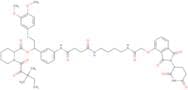
:(1R)-3-(3,4-Dimethoxyphenyl)-1-[3-[[4-[[4-[[2-[[2-(2,6-dioxo-3-piperidinyl)-2,3-dihydro-1,3-dioxo-1H-isoindol-4-yl]oxy]acetyl]amino]butyl]amino]-1,4-dioxobutyl]amino]phenyl]propyl (2S)-1-(3,3-dimethyl-1,2-dioxopentyl)-2-piperidincarboxylat
Beschreibung:
Die chemische Substanz mit dem Namen "(1R)-3-(3,4-Dimethoxyphenyl)-1-[3-[[4-[[4-[[2-[[2-(2,6-dioxo-3-piperidinyl)-2,3-dihydro-1,3-dioxo-1H-isoindol-4-yl]oxy]acetyl]amino]butyl]amino]-1,4-dioxobutyl]amino]phenyl]propyl (2S)-1-(3,3-dimethyl-1,2-dioxopentyl)-2-piperidincarboxylat" und der CAS-Nummer "1799711-22-0" ist eine komplexe organische Verbindung, die durch ihre komplizierte molekulare Struktur gekennzeichnet ist, die mehrere funktionelle Gruppen wie Amide, Ester und Dioxo-Moieties umfasst. Diese Verbindung weist wahrscheinlich eine signifikante biologische Aktivität aufgrund ihrer strukturellen Merkmale auf, die mit verschiedenen biologischen Zielen interagieren können. Das Vorhandensein von Piperidin- und Isoindolringen deutet auf potenzielle pharmakologische Eigenschaften hin, möglicherweise im Bereich der medizinischen Chemie. Darüber hinaus können die Dimethoxyphenyl- und Dioxopentylgruppen ihre Löslichkeit und Bioverfügbarkeit beeinflussen. Als synthetische Verbindung könnte sie von Interesse für die Arzneimittelentwicklung sein, insbesondere für Bedingungen, die eine Modulation spezifischer biologischer Wege erfordern. Detaillierte Studien zu ihrer Pharmakodynamik, Pharmakokinetik und Toxizität wären jedoch unerlässlich, um ihre potenziellen Anwendungen vollständig zu verstehen.
Formel:C53H64N6O14
InChl:InChI=1S/C53H64N6O14/c1-6-53(2,3)47(64)51(68)58-28-10-7-16-37(58)52(69)73-38(21-18-32-19-22-39(70-4)41(29-32)71-5)33-13-11-14-34(30-33)56-43(61)25-24-42(60)54-26-8-9-27-55-45(63)31-72-40-17-12-15-35-46(40)50(67)59(49(35)66)36-20-23-44(62)57-48(36)65/h11-15,17,19,22,29-30,36-38H,6-10,16,18,20-21,23-28,31H2,1-5H3,(H,54,60)(H,55,63)(H,56,61)(H,57,62,65)/t36?,37-,38+/m0/s1
InChI Key:InChIKey=RIBCWKRMNKOGRN-GGJINPDOSA-N
SMILES:O=C1C=2C(C(=O)N1C3C(=O)NC(=O)CC3)=CC=CC2OCC(NCCCCNC(CCC(NC4=CC([C@H](OC(=O)[C@H]5N(C(C(C(CC)(C)C)=O)=O)CCCC5)CCC6=CC(OC)=C(OC)C=C6)=CC=C4)=O)=O)=O
Synonyme:- (1R)-3-(3,4-Dimethoxyphenyl)-1-[3-[[4-[[4-[[2-[[2-(2,6-dioxo-3-piperidinyl)-2,3-dihydro-1,3-dioxo-1H-isoindol-4-yl]oxy]acetyl]amino]butyl]amino]-1,4-dioxobutyl]amino]phenyl]propyl (2S)-1-(3,3-dimethyl-1,2-dioxopentyl)-2-piperidinecarboxylate
- 2-Piperidinecarboxylic acid, 1-(3,3-dimethyl-1,2-dioxopentyl)-, (1R)-3-(3,4-dimethoxyphenyl)-1-[3-[[4-[[4-[[2-[[2-(2,6-dioxo-3-piperidinyl)-2,3-dihydro-1,3-dioxo-1H-isoindol-4-yl]oxy]acetyl]amino]butyl]amino]-1,4-dioxobutyl]amino]phenyl]propyl ester, (2S)-
- dFKBP-1
Sortieren nach
Reinheit (%)
0
100
|
0
|
50
|
90
|
95
|
100
2 Produkte.
dFKBP-1
CAS:dFKBP-1 is a potent and PROTAC-based FKBP12 degrader. dFKBP-1 incorporates the ligand SLF of FKBP12, the Thalidomide based cereblon ligand and a linker[1].Formel:C53H64N6O14Reinheit:98%Farbe und Form:SolidMolekulargewicht:1009.11dFKBP-1
CAS:dFKBP-1 is a heat shock protein derived from Drosophila melanogaster, which is commonly used as a model organism in genetic and molecular biology research. This protein, known as Drosophila FK506-binding protein 1 (dFKBP-1), originates from Drosophila and is involved in essential cellular processes.Formel:C53H64N6O14Reinheit:Min. 95%Molekulargewicht:1,009.1 g/mol