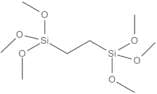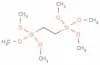
CAS 18406-41-2
:1,2-Bis(trimethoxysilyl)ethan
- 1,1,1,4,4,4-Hexamethoxy-1,4-disilabutane
- 1,2-(Trimethoxysilyl)ethane
- 1,2-Bis(trimethoxysilyl)ethane
- 1,2-Di(trimethoxysilyl) ethane
- 1,2-Ethylenebis(trimethoxysilane)
- 1,4-Disilabutane, 1,1,1,4,4,4-hexamethoxy-
- 2,7-Dioxa-3,6-disilaoctane, 3,3,6,6-tetramethoxy-
- 3,3,6,6-Tetramethoxy-2,7-Dioxa-3,6-Disilaoctane
- Ethylenebis[trimethoxysilane]
- Kbm 3026
- Lmd 26M
- Weitere Synonyme anzeigen
HEXAMETHOXYDISILYLETHANE
CAS:Formel:C8H22O6Si2Reinheit:90%Farbe und Form:LiquidMolekulargewicht:270.42771,2-Bis(trimethoxysilyl)ethane
CAS:1,2-Bis(trimethoxysilyl)ethane
Reinheit:96%Molekulargewicht:270.43g/mol1,2-BIS(TRIMETHOXYSILYL)ETHANE, tech
CAS:Non-functional Alkoxy Silane
Silane coupling agents have the ability to form a durable bond between organic and inorganic materials to generate desired heterogeneous environments or to incorporate the bulk properties of different phases into a uniform composite structure. The general formula has two classes of functionality. The hydrolyzable group forms stable condensation products with siliceous surfaces and other oxides such as those of aluminum, zirconium, tin, titanium, and nickel. The organofunctional group alters the wetting or adhesion characteristics of the substrate, utilizes the substrate to catalyze chemical transformations at the heterogeneous interface, orders the interfacial region, or modifies its partition characteristics, and significantly effects the covalent bond between organic and inorganic materials.
Dipodal Silane
Dipodal silanes are a series of adhesion promoters that have intrinsic hydrolytic stabilities up to ~10,000 times greater than conventional silanes and are used in applications such as plastic optics, multilayer printed circuit boards and as adhesive primers for ferrous and nonferrous metals. They have the ability to form up to six bonds to a substrate compared to conventional silanes with the ability to form only three bonds to a substrate. Many conventional coupling agents are frequently used in combination with 10-40% of a non-functional dipodal silane, where the conventional coupling agent provides the appropriate functionality for the application, and the non-functional dipodal silane provides increased durability. Also known as bis-silanes additives enhance hydrolytic stability, which impacts on increased product shelf life, ensures better substrate bonding and also leads to improved mechanical properties in coatings as well as composite applications.
Alkyl Silane - Dipodal Surface Bonding
Aliphatic, fluorinated aliphatic or substituted aromatic hydrocarbon substituents are the hydrophobic entities which enable silanes to induce surface hydrophobicity. The organic substitution of the silane must be non-polar. The hydrophobic effect of the organic substitution can be related to the free energy of transfer of hydrocarbon molecules from an aqueous phase to a homogeneous hydrocarbon phase. A successful hydrophobic coating must eliminate or mitigate hydrogen bonding and shield polar surfaces from interaction with water by creating a non-polar interphase. Although silane and silicone derived coatings are in general the most hydrophobic, they maintain a high degree of permeability to water vapor. This allows coatings to breathe and reduce deterioration at the coating interface associated with entrapped water. Since ions are not transported through non-polar silane and silicone coatings, they offer protection to composite structures ranging from pigmented coatings to rebar reinforced concrete. A selection guide for hydrophobic silanes can be found on pages 22-31 of the Hydrophobicity, Hydrophilicity and Silane Surface Modification brochure.
1,2-Bis(trimethoxysilyl)ethane; 3,3,6,6-Tetramethoxy-2,7-dioxa-3,6-disilaoctane
Caution: Inhalation HazardAir Transport ForbiddenVapor pressure, 20 °C: 0.08 mmEmployed in fabrication of multilayer printed circuit boardsFormel:C8H22O6Si2Reinheit:95%Farbe und Form:LiquidMolekulargewicht:270.43