CAS 1849-54-3
:3-Hydroxy-4-pyridincarbaldehyd
Beschreibung:
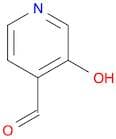
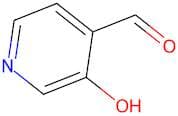
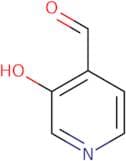
3-Hydroxy-4-pyridincarbaldehyd, auch bekannt als 3-Hydroxy-4-pyridincarbaldehyd, ist eine organische Verbindung, die durch ihre Pyridinringstruktur gekennzeichnet ist, die eine Hydroxylgruppe und eine Aldehydfunktionalgruppe aufweist. Diese Verbindung erscheint typischerweise als feste oder kristalline Substanz und ist in polaren Lösungsmitteln wie Wasser und Alkoholen löslich, was auf die Anwesenheit der Hydroxylgruppe zurückzuführen ist. Sie zeigt Eigenschaften, die sowohl für Aldehyde als auch für phenolische Verbindungen typisch sind, einschließlich Reaktivität in Kondensationsreaktionen und Potenzial für Wasserstoffbrückenbindungen. Die Anwesenheit des Pyridinrings trägt zu ihrem aromatischen Charakter bei und kann ihre Reaktivität und Wechselwirkungen mit anderen chemischen Spezies beeinflussen. Diese Verbindung kann in verschiedenen Anwendungen genutzt werden, einschließlich als Zwischenprodukt in der organischen Synthese, in der Entwicklung von Arzneimitteln oder als Ligand in der Koordinationschemie. Ihre einzigartigen strukturellen Merkmale machen sie zu einem interessanten Thema sowohl in der akademischen Forschung als auch in industriellen Anwendungen.
Formel:C6H5NO2
InChl:InChI=1S/C6H5NO2/c8-4-5-1-2-7-3-6(5)9/h1-4,9H
InChI Key:InChIKey=NVLPDIRQWJSXLZ-UHFFFAOYSA-N
SMILES:C(=O)C=1C(O)=CN=CC1
Synonyme:- 3-Hydroxy-4-formylpyridine
- 3-Hydroxy-4-pyridinealdehyde
- 3-Hydroxy-4-pyridinecarboxaldehyde
- 3-Hydroxy-Isonicotinaldehyde
- 3-Hydroxyisonicotinaldehyde
- 3-Hydroxypyridine-4-Carboxaldehyde
- 3-Hydroxypyridine-4-carbaldehyde
- 4-Formyl-3-Hydroxypyridine
- 4-Formyl-3-hydroxypyridine 3-Hydroxy-isonicotinaldehyde
- 4-Pyridinecarboxaldehyde, 3-hydroxy-
- Isonicotinaldehyde, 3-hydroxy-
Sortieren nach
Reinheit (%)
0
100
|
0
|
50
|
90
|
95
|
100
5 Produkte.
3-Hydroxypyridine-4-carboxaldehyde
CAS:Formel:C6H5NO2Reinheit:98%Farbe und Form:SolidMolekulargewicht:123.10943-Hydroxypyridine-4-carboxaldehyde
CAS:3-Hydroxypyridine-4-carboxaldehydeFormel:C6H5NO2Reinheit:98%Farbe und Form: cream solidMolekulargewicht:123.11g/mol3-Hydroxypyridine-4-carboxaldehyde
CAS:Formel:C6H5NO2Reinheit:95%Farbe und Form:SolidMolekulargewicht:123.1113-Hydroxypyridine-4-carboxaldehyde
CAS:Kontrolliertes ProduktFormel:C6H5NO2Farbe und Form:NeatMolekulargewicht:123.1093-Hydroxyisonicotinaldehyde
CAS:3-Hydroxyisonicotinaldehyde is a disulfide bond that plays an important role in enzyme catalysis. The active site of the enzyme, which contains a nucleophilic attack on the electrophilic carbon atom, is composed of two cysteine residues with their sulfhydryl group (-SH) bonded to each other through a disulfide bond. This bond can be broken by either an acidic environment or protonation. In the absence of these conditions, the -SH groups are coordinated to metal ions and form a complex. The hydroxyl group (-OH) on one cysteine residue can coordinate to the nitrogen atom on the other cysteine residue and form tautomers. These tautomers correspond to two different configurations of the molecule: one where both sulfur atoms are in a trans configuration (tautomer A), and one where they are in a cis configuration (tautomer B). The biological properties of 3-hydroxyisonFormel:C6H5NO2Reinheit:Min. 95%Molekulargewicht:123.11 g/mol