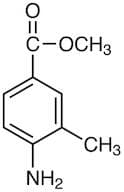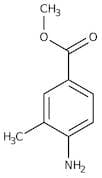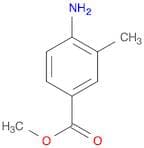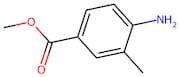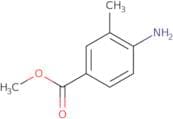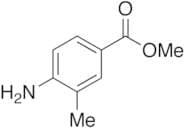
CAS 18595-14-7
:Methyl 4-amino-3-methylbenzoat
Beschreibung:
Methyl 4-amino-3-methylbenzoat, auch bekannt als Methyl 4-Amino-3-toluat, ist eine organische Verbindung, die durch ihre aromatische Struktur gekennzeichnet ist, die eine Methylgruppe und eine Aminogruppe umfasst, die an ein Benzoatgerüst gebunden sind. Diese Verbindung erscheint typischerweise als weißer bis cremefarbener Feststoff und ist in organischen Lösungsmitteln wie Ethanol und Aceton löslich, hat jedoch eine begrenzte Löslichkeit in Wasser aufgrund ihrer hydrophoben aromatischen Natur. Das Vorhandensein der Aminogruppe verleiht basische Eigenschaften, die es ihr ermöglichen, an verschiedenen chemischen Reaktionen teilzunehmen, einschließlich nucleophiler Substitutionen und Kupplungsreaktionen. Methyl 4-amino-3-methylbenzoat wird häufig in der Synthese von Farbstoffen, Arzneimitteln und Agrochemikalien verwendet, da ihre funktionellen Gruppen für verschiedene Anwendungen modifiziert werden können. Sicherheitsdaten zeigen, dass, wie bei vielen organischen Verbindungen, Vorsicht geboten ist, da sie Gesundheitsrisiken darstellen kann, wenn sie eingenommen oder eingeatmet wird. Bei der Arbeit mit dieser Substanz in einem Laborumfeld sollten geeignete Sicherheitsprotokolle befolgt werden.
Formel:C9H11NO2
InChl:InChI=1/C9H11NO2/c1-6-5-7(9(11)12-2)3-4-8(6)10/h3-5H,10H2,1-2H3
InChI Key:InChIKey=ZHIPSMIKSRYZFV-UHFFFAOYSA-N
SMILES:C(OC)(=O)C1=CC(C)=C(N)C=C1
Synonyme:- (4-(Methoxycarbonyl)-2-methylphenyl)amine
- 3-Methyl-4-Aminobenzoic Acid Methyl Ester
- 4-Amino-3-Toluic Acid Methyl Ester
- 4-Amino-3-methylbenzoic acid methyl ester
- 4-Amino-3-methylbenzoic acid methylester
- 4-Amino-M-Toluic Acid Methyl Ester
- Akos Bb-3094
- Benzoic acid, 4-amino-3-methyl-, methyl ester
- Buttpark 37\12-51
- Methyl 3-Methyl-4-Aminobenzoate
- Methyl 4-Amino-3-Methylbenzenecarboxylate
- Methyl 4-Amion-3-Methylbenzoate
- Methyl-4-Amino-3-Methylbenzate
- Methyl3-Methyl-4-Aminobenzoate
- m-Toluic acid, 4-amino-, methyl ester
- Methyl 4-amino-3-methylbenzoate
- Methyl 4-Aminol-3-Methylbenzoate
- Methyl 4-amino-3-methylbenzoate 98%
- 4-Amino-m-toluic acid methyl ester (COOCH3=1)
- Weitere Synonyme anzeigen
Sortieren nach
Reinheit (%)
0
100
|
0
|
50
|
90
|
95
|
100
8 Produkte.
Methyl 4-Amino-3-methylbenzoate
CAS:Formel:C9H11NO2Reinheit:>98.0%(GC)(T)Farbe und Form:White to Yellow to Orange powder to crystalMolekulargewicht:165.19Methyl 4-amino-3-methylbenzoate, 98%
CAS:This Thermo Scientific Chemicals brand product was originally part of the Alfa Aesar product portfolio. Some documentation and label information may refer to the legacy brand. The original Alfa Aesar product / item code or SKU reference has not changed as a part of the brand transition to Thermo SciFormel:C9H11NO2Reinheit:98%Molekulargewicht:165.19Methyl 4-Amino-3-methylbenzoate
CAS:Formel:C9H11NO2Reinheit:98%Farbe und Form:SolidMolekulargewicht:165.1891Methyl 4-amino-3-methylbenzoate
CAS:Methyl 4-amino-3-methylbenzoateFormel:C9H11NO2Reinheit:98%Farbe und Form: solidMolekulargewicht:165.19g/molMethyl 4-amino-3-methylbenzoate
CAS:Methyl 4-amino-3-methylbenzoate is an aromatic compound that belongs to the class of achyranthes bidentata. It can be synthesized by reacting butyryl chloride with methyl 3-nitrobenzoate. The five-membered ring in this molecule is derived from the reaction of three molecules of butyryl chloride with one molecule of methyl 3-nitrobenzoate. This reaction produces a number of possible products, including methyl 4-amino-3-methylbenzoate and 2,2,2-trichloroethyl 4-(4'-nitrophenyl)butanoate. The synthesis optimizes the reaction conditions by using a catalytic reduction technique. This reduces the amount of anilines produced and increases the yield of desired product (i.e., methyl 4-amino-3-methylbenzoate).Formel:C9H11NO2Reinheit:Min. 95%Molekulargewicht:165.19 g/molMethyl 4-amino-3-methylbenzoate
CAS:Formel:C9H11NO2Reinheit:98%Farbe und Form:SolidMolekulargewicht:165.192Methyl 4-Amino-3-methylbenzoate
CAS:Kontrolliertes ProduktApplications Methyl 4-Amino-3-methylbenzoate is used in the synthesis of neuroprotective hydrazides used in the treatment of Alzheimer’s. It is also used in the research and development of diphenylamine-based retinoids.
References Chiruta, C. et al.: Bioorg. Med. Chem. Lett., 21, 2733 (2013); Ohta, K. et al.: Bioorg. Med. Chem. Lett., 23, 81 (2013);Formel:C9H11NO2Farbe und Form:NeatMolekulargewicht:165.19