CAS 18684-24-7
:Prolylhydroxyprolin
Beschreibung:
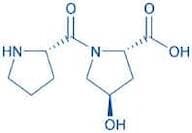
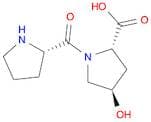
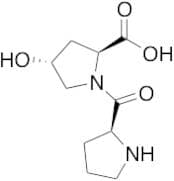
Prolylhydroxyprolin, mit der CAS-Nummer 18684-24-7, ist ein natürlich vorkommendes Aminosäurederivat und eine modifizierte Form von Prolin. Es ist durch das Vorhandensein einer Hydroxylgruppe gekennzeichnet, die an die Prolinstruktur gebunden ist, was seine Löslichkeit und Reaktivität erhöht. Diese Verbindung kommt häufig in Kollagen vor und ist im Kontext der Proteinsynthese und -stabilität, insbesondere in Bindegeweben, von Bedeutung. Prolylhydroxyprolin spielt eine Rolle bei der Stabilisierung von Kollagen-Dreifachhelixstrukturen und trägt zur strukturellen Integrität verschiedener Gewebe bei. Es wird auch auf seine potenziellen therapeutischen Anwendungen untersucht, einschließlich seiner Auswirkungen auf die Wundheilung und Gewebereparatur. In Bezug auf die physikalischen Eigenschaften ist Prolylhydroxyprolin typischerweise ein weißes kristallines Feststoff, wasserlöslich und weist einen spezifischen Schmelzpunktbereich auf. Seine biochemischen Eigenschaften machen es sowohl für die ernährungswissenschaftliche als auch für die pharmazeutische Forschung von Interesse, insbesondere bei der Entwicklung von Nahrungsergänzungsmitteln, die darauf abzielen, die Hautgesundheit und die Gelenkfunktion zu verbessern.
Formel:C10H16N2O4
InChl:InChI=1S/C10H16N2O4/c13-6-4-8(10(15)16)12(5-6)9(14)7-2-1-3-11-7/h6-8,11,13H,1-5H2,(H,15,16)/t6-,7+,8+/m1/s1
InChI Key:InChIKey=ONPXCLZMBSJLSP-CSMHCCOUSA-N
SMILES:C(=O)(N1[C@H](C(O)=O)C[C@@H](O)C1)[C@@H]2CCCN2
Synonyme:- (2E)-non-2-enal
- <span class="text-smallcaps">L</smallcap>-Proline, 4-hydroxy-1-<smallcap>L</span>-prolyl-, trans-
- <span class="text-smallcaps">L</smallcap>-Proline, <smallcap>L</span>-prolyl-4-hydroxy-, (4R)-
- <span class="text-smallcaps">L</smallcap>-Prolyl-<smallcap>L</span>-hydroxyproline
- G 3025
- H-Pro-Hyp-OH
- Proline, 4-hydroxy-1-<span class="text-smallcaps">L</smallcap>-prolyl-, <smallcap>L</span>-
- Proline, 4-hydroxy-1-<span class="text-smallcaps">L</span>-prolyl-
- Prolylhydroxyproline
- L-Proline, 4-hydroxy-1-L-prolyl-, trans-
- L-Proline, L-prolyl-4-hydroxy-, (4R)-
- Proline, 4-hydroxy-1-L-prolyl-, L-
- Weitere Synonyme anzeigen
Sortieren nach
Reinheit (%)
0
100
|
0
|
50
|
90
|
95
|
100
6 Produkte.
H-Pro-Hyp-OH
CAS:According to Shigemura et al. Pro-Hyp, a food-derived collagen peptide in human blood, stimulates the growth of fibroblasts from mouse skin. Nakatani et al. observed a chondroprotective effect of the dipeptide in mouse articular cartilage. Inoue et al. showed in a clinical study that ingestion of the dipeptides Pro-Hyp and Hyp-Gly could improve facial skin moisture and elasticity and reduce facial ageing.Formel:C10H16N2O4Reinheit:> 98%Farbe und Form:WhiteMolekulargewicht:228.25Pro-Hyp-OH
CAS:Pro-Hyp-OH is a model system of the human collagen prolyl hydroxylase. It is a glycoprotein that converts the inactive pro-collagen to the active collagen. Pro-Hyp-OH has been shown to have anti-inflammatory effects and may be used as a potential treatment for skin disorders. This product has also been found to increase the rate of transport of glycopeptides across 3T3-L1 preadipocytes, which may be due to its ability to bind to collagen. The structural analysis of Pro-Hyp-OH has revealed that it is composed of two domains, one with an alpha helical structure and another in beta sheet form. This product is also used in the diagnosis of collagen diseases such as osteogenesis imperfecta, Ehlers Danlos syndrome type IV, and dermatosparaxis.
Formel:C10H16N2O4Reinheit:(%) Min. 90%Farbe und Form:White PowderMolekulargewicht:228.25 g/mol(2S,4R)-1-(L-prolyl)-4-hydroxypyrrolidine-2-carboxylic acid
CAS:Reinheit:95%Molekulargewicht:228.2480011