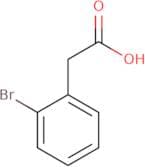
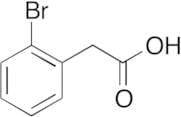
CAS 18698-97-0
:2-Bromphenylessigsäure
Beschreibung:
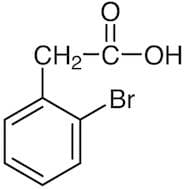
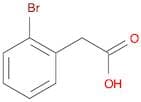
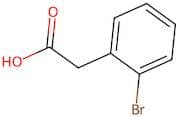
2-Bromphenylessigsäure ist eine organische Verbindung, die durch ihre aromatische Struktur und das Vorhandensein eines Bromatoms sowie einer Carbonsäurefunktion gekennzeichnet ist. Sie weist ein Bromatom auf, das an der zweiten Position eines Phenylrings angebracht ist, der weiter mit einer Essigsäureeinheit verbunden ist. Diese Verbindung erscheint typischerweise als weißer bis off-white fester Stoff und ist in organischen Lösungsmitteln löslich, mit begrenzter Löslichkeit in Wasser aufgrund ihres hydrophoben aromatischen Bestandteils. Das Vorhandensein des Bromsubstituenten kann ihre Reaktivität beeinflussen, was sie in verschiedenen chemischen Synthesen und Anwendungen, einschließlich Pharmazeutika und Agrochemikalien, nützlich macht. 2-Bromphenylessigsäure kann an verschiedenen chemischen Reaktionen teilnehmen, wie nucleophilen Substitutionen und Kupplungsreaktionen, aufgrund ihrer funktionellen Gruppen. Darüber hinaus kann sie biologische Aktivität zeigen, die in der medizinischen Chemie untersucht werden kann. Sicherheitsdaten sollten für den Umgang und die Lagerung konsultiert werden, wie bei jeder chemischen Substanz, um sicherzustellen, dass die richtigen Vorsichtsmaßnahmen getroffen werden.
Formel:C8H7BrO2
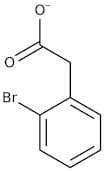
InChl:InChI=1/C8H7BrO2/c9-7-4-2-1-3-6(7)5-8(10)11/h1-4H,5H2,(H,10,11)/p-1
InChI Key:InChIKey=DWXSYDKEWORWBT-UHFFFAOYSA-N
SMILES:c1ccc(c(c1)CC(=O)[O-])Br
Synonyme:- (2-Bromophenyl)Acetate
- -Rarechem Al Bo 0109
- 2-(2-Bromophenyl)acetic acid
- 2-Bromobenzeneacetic acid
- 2-Bromophenylacetic acid, 98+%
- Acetic acid, (o-bromophenyl)-
- Benzeneacetic acid, 2-bromo-
- Labotest-Bb Lt00454446
- O-Bromophenylacetic Acid
- Timtec-Bb Sbb006626
Sortieren nach
Reinheit (%)
0
100
|
0
|
50
|
90
|
95
|
100
9 Produkte.
2-Bromophenylacetic Acid
CAS:Formel:C8H7BrO2Reinheit:>98.0%(GC)(T)Farbe und Form:White to Almost white powder to crystalMolekulargewicht:215.052-Bromophenylacetic acid, 98+%
CAS:Employed as a pharmaceutical intermediate. It is also used in organic synthesis. This Thermo Scientific Chemicals brand product was originally part of the Alfa Aesar product portfolio. Some documentation and label information may refer to the legacy brand. The original Alfa Aesar product / item codeFormel:C8H6BrO2Reinheit:98+%Farbe und Form:White to pale cream, Crystalline powder or powder or crystalsMolekulargewicht:214.042-(2-Bromophenyl)acetic acid
CAS:Formel:C8H7BrO2Reinheit:98%Farbe und Form:SolidMolekulargewicht:215.04402-Bromophenylacetic acid
CAS:2-Bromophenylacetic acidFormel:C8H7BrO2Reinheit:98%Farbe und Form: white solidMolekulargewicht:215.04g/mol2-Bromophenylacetic acid
CAS:2-Bromophenylacetic acid is a potent inhibitor of the human enzyme COX-2. It has been shown to have anticancer activity, which may be due to its ability to inhibit cellular proliferation and induce apoptosis in cancer cells. This compound has been tested in a variety of experimental models, including chromatographic assays and striatal membrane preparations, with promising results. 2-Bromophenylacetic acid also has potent inhibitory activity on the human enzyme COX-2 and can be used as a dietary supplement for anticancer therapy. COX-2 inhibitors are usually administered as ethyl esters or solutes in order to prevent degradation by esterases or glucuronidases. The 2-bromophenyl group is electron donating and this may increase the reactivity of the carbon adjacent to it and lead to an acylation reaction with nucleophilic groups such as thiols or amines.Formel:C8H7BrO2Reinheit:Min. 95%Farbe und Form:White PowderMolekulargewicht:215.04 g/mol2-Bromophenylacetic Acid
CAS:Kontrolliertes ProduktApplications 2-Bromophenylacetic Acid is used as the starting material in the synthesis of 2,3,3a,12b-Tetradehydro Asenapine (T291630); a degredation product of Asenapine (A788000) which is a combined serotonin (5HT2) and dopamine (D2) receptor antagonist structurally related to Mianserin (M341500, HCl). Also used as an antipsychotic.
References Meltzer, H., et al.: J. Pharmacol. Exp. Ther., 251, 238 (1989); Schotte, A., et al.: Brain Res., 631, 191 (1993); Andree, B., et al.: Psychopharmacology, 131, 339 (1997); Richelson, E., et al.: Life Sci., 68, 29 (2000)Formel:C8H7BrO2Farbe und Form:NeatMolekulargewicht:215.04