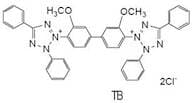
CAS 1871-22-3
:Blaues Tetrazolium
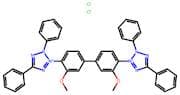
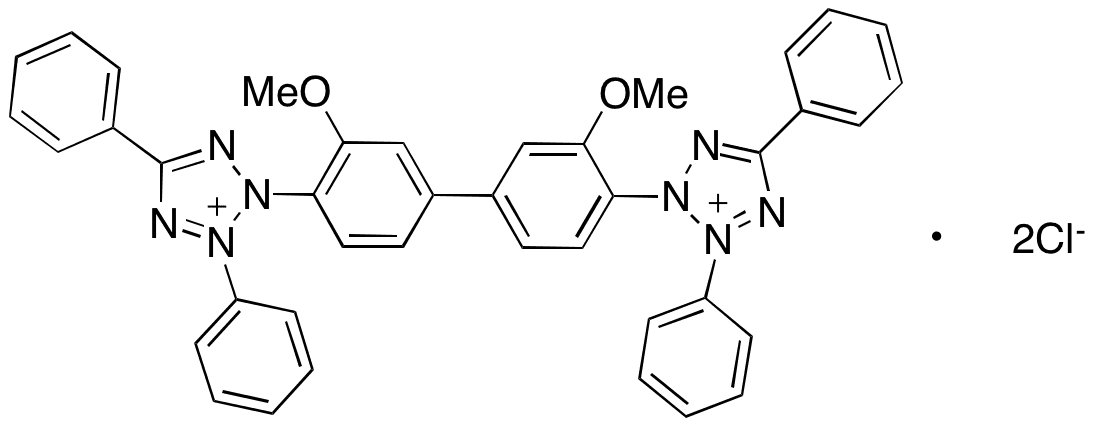
- 2,2′,5,5′-Tetraphenyl-3,3′-(3,3′-dimethoxy-4,4′-diphenylene)ditetrazolium chloride
- 2,2′-(m,m′-Dimethoxy-p,p′-biphenylene)bis(3,5-diphenyltetrazolium chloride)
- 2H-Tetrazolium, 2,2′-(3,3′-dimethoxy[1,1′-biphenyl]-4,4′-diyl)bis[3,5-diphenyl-, chloride (1:2)
- 2H-Tetrazolium, 2,2′-(3,3′-dimethoxy[1,1′-biphenyl]-4,4′-diyl)bis[3,5-diphenyl-, dichloride
- 2H-Tetrazolium, 3,3′-(3,3′-dimethoxy-4,4′-biphenylylene)bis[2,5-diphenyl-, dichloride
- 3,3-(3,3-Dimethoxy-4,4-biphenylene)bis(2,5-diphenyl-2H-tetrazolium chloride)
- 3,3′-(3,3′-Dimethoxy-4,4′-biphenylylene)bis[2,5-diphenyl-2H-tetrazolium chloride]
- 3,3′-Dianisolebis[4,4′-(3,5-diphenyl)tetrazolium chloride]
- BT (dye)
- BTC
- Blue Tetrazolium chloride
- Ditetrazolium chloride
- NSC 27623
- Tetrazole blue
- Tetrazolium Blue BT
- Tetrazolium Blue Chloride
- Tetrazolium blue
- Weitere Synonyme anzeigen
Blue Tetrazolium
CAS:Formel:C40H32Cl2N8O2Reinheit:>95.0%(T)Farbe und Form:White to Amber powder to crystalMolekulargewicht:727.65Blue Tetrazolium chloride
CAS:Blue Tetrazolium chloride is useful in the prepartion of DNA cation complexes and immunoadsorbents for anti-DNA antibodies. It is used in assay of reducing sugars. In combination with 4-nitrocatechol, tetrazolium blue chloride forms a ternary complex with molybdenum(VI) for extraction and spectrophoFormel:C40H36Cl2N8O2Farbe und Form:Pale yellow to yellow, PowderMolekulargewicht:731.683,3'-(3,3'-Dimethoxy-[1,1'-biphenyl]-4,4'-diyl)bis(2,5-diphenyl-2H-tetrazol-3-ium) chloride
CAS:Formel:C40H32Cl2N8O2Reinheit:95%Farbe und Form:SolidMolekulargewicht:727.6405Tetrazolium Blue Chloride
CAS:Formel:C40H32Cl2N8O2Reinheit:(HPLC) ≥ 95.0%Farbe und Form:Yellow powderMolekulargewicht:727.66Blue Tetrazolium [for Biochemical Research]
CAS:Formel:C40H32Cl2N8O2Reinheit:>95.0%(T)Farbe und Form:White to Amber powder to crystalMolekulargewicht:727.653,3'-Dianisole-4,4'-bis(3,5-diphenyltetrazolium chloride
CAS:3,3'-Dianisole-4,4'-bis(3,5-diphenyltetrazolium chlorideFormel:C40H32N8O2·2ClReinheit:By hplc: 98% (Typical Value in Batch COA)Farbe und Form: yellow powderMolekulargewicht:727.64g/molTetrazolium Blue Chloride (>90%)
CAS:Kontrolliertes ProduktStability Light Sensitive
Applications Tetrazolium Blue Chloride is used for its anti-plasmodium activity. Also used in the study of inhibition of diphenyltetrazolium bromide (MTT) reduction by β-amyloid peptides resulting in neurodegenerative manifestations. Dyes and metabolites.
References Cui, X. et al.: Bioorg, Med. Chem., 16, 1927 (2008); Shearman, M. et al.: J. Neurochem, 65, 218 (1995);Formel:C40H32N8O2·2ClReinheit:>90%Farbe und Form:NeatMolekulargewicht:727.6Tetrazolium blue chloride
CAS:Tetrazolium blue chloride is a chemical compound that is used in the diagnosis of leukemia. It is a tetrazolium salt that reacts with reduced nicotinamide adenine dinucleotide (NADH) and produces an insoluble blue product. Tetrazolium blue chloride has been shown to be effective in treating human leukemic cells by causing DNA damage, which leads to cell death. Tetrazolium blue chloride has also been found to be an anti-inflammatory agent due to its ability to inhibit prostaglandin synthesis and production of reactive oxygen species.
Formel:C40H32N8O2·2ClReinheit:90 To 110%Farbe und Form:Yellow PowderMolekulargewicht:727.64 g/molBlue Tetrazolium chloride
CAS:Blue tetrazolium chloride is an analytical method that is used to measure the rate of microbial growth. It has been used to study the effects of radiation, and it has also been shown to be a useful tool for detecting the presence of bacteria in biological samples. Blue tetrazolium chloride can be used as a selective agent for dextran sulfate and caffeic acid, which are present in human polymorphonuclear leukocytes, but not in squamous cells. This compound can also be used to detect the presence of antioxidant vitamins such as vitamin C and vitamin E. The optimum concentration for this compound is 2-3 microliters per milliliter in 0.1N HCl solution at room temperature.
Formel:C40H32Cl2N8O2Molekulargewicht:727.64 g/molBlue Tetrazolium Chloride (BTC, Tetrazolium Blue Chloride) extrapure AR
CAS:Formel:C40H32O2N8Cl2Farbe und Form:Lemon yellow, Crystalline powder, Clear, YellowMolekulargewicht:727.66


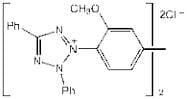

![3,3'-(3,3'-Dimethoxy-[1,1'-biphenyl]-4,4'-diyl)bis(2,5-diphenyl-2H-tetrazol-3-ium) chloride](/_next/image/?url=https%3A%2Fstatic.cymitquimica.com%2Fproducts%2FIN%2Fthumb%2FDA007S1S.jpg&w=3840&q=75)


![Blue Tetrazolium [for Biochemical Research]](/_next/image/?url=https%3A%2Fstatic.cymitquimica.com%2Fproducts%2F3B%2Fthumb%2FB3581.jpg&w=3840&q=75)