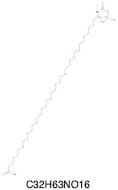
![Poly(oxy-1,2-ethanediyl), α-(2-carboxyethyl)-ω-[2-[[(1,1-dimethylethoxy)carbonyl]amino]ethoxy]-](/_next/image/?url=https%3A%2Fstatic.cymitquimica.com%2Fcas-image%2Fthumb-webp%2F422549-poly-oxy-12-ethanediyl-a-2-carboxyethyl-o-2-11-dimethylethoxy-carbonyl-amino-ethoxy.webp&w=3840&q=75)
CAS 187848-68-6
:Poly(oxy-1,2-ethandiyl), α-(2-carboxyethyl)-ω-[2-[[(1,1-dimethylethoxy)carbonyl]amino]ethoxy]-
Beschreibung:
Poly(oxy-1,2-ethandiyl), α-(2-carboxyethyl)-ω-[2-[[(1,1-dimethylethoxy)carbonyl]amino]ethoxy]- ist ein synthetisches Polymer, das durch sein Polyether-Rückgrat gekennzeichnet ist, das aus Ethylenoxid abgeleitet ist. Diese Verbindung weist funktionelle Gruppen auf, die Carbonsäure- und Aminfunktionen umfassen, was zu ihren potenziellen Anwendungen in der Biokonjugation und in Arzneimittellieferungssystemen beiträgt. Das Vorhandensein der Dimethylethoxycarbonylgruppe deutet darauf hin, dass es schützende oder stabilisierende Rollen in chemischen Reaktionen oder Formulierungen haben könnte. Die Struktur des Polymers ermöglicht die Löslichkeit in wässrigen Umgebungen, was es für biologische Anwendungen geeignet macht. Darüber hinaus kann das Vorhandensein sowohl hydrophiler als auch hydrophober Segmente in seiner Struktur die Wechselwirkungen mit verschiedenen Biomolekülen erleichtern und seine Nützlichkeit in biomedizinischen Bereichen erhöhen. Insgesamt veranschaulicht diese Verbindung die Vielseitigkeit von polyetherbasierten Materialien in fortschrittlichen Anwendungen, insbesondere in der Entwicklung gezielter Therapien und intelligenter Arzneimittellieferungssysteme.
Formel:(C2H4O)nC10H19NO5
InChl:InChI=1S/C12H23NO6/c1-12(2,3)19-11(16)13-5-7-18-9-8-17-6-4-10(14)15/h4-9H2,1-3H3,(H,13,16)(H,14,15)
InChI Key:InChIKey=OZMXZVCAXAQCHJ-UHFFFAOYSA-N
SMILES:O(C(NCCOCCOCCC(O)=O)=O)C(C)(C)C
Synonyme:- O-[2-(Boc-amino)ethyl]-Oμ-(2-carboxyethyl)polyethylene glycol 5,000
- Poly(oxy-1,2-ethanediyl), α-(2-carboxyethyl)-ω-[2-[[(1,1-dimethylethoxy)carbonyl]amino]ethoxy]-
- Polyethylene glycol 2-(tert-butoxycarbonylamino)ethyl 2-carboxylethyl ether
Sortieren nach
Reinheit (%)
0
100
|
0
|
50
|
90
|
95
|
100
5 Produkte.
Polyethylene glycol 2-(tert-butoxycarbonylamino)ethyl 2-carboxylethyl ether
CAS:Formel:C32H63NO16Reinheit:95%Farbe und Form:LiquidMolekulargewicht:717.8397t-Boc-N-amido-PEG24-acid
CAS:t-Boc-N-amido-PEG24-acidReinheit:95% PEG24Molekulargewicht:1,246.47g/molm-dPEG®8-MAL
CAS:m-dPEG®8-MAL is a PEG compound with two different functional groups (also known as heterobifunctional). Unlike homobifunctional PEG compounds (same functional group on both ends), this type of compounds are more versatile as have two different anchor points. m-dPEG®8-MAL is used as a linker and spacer to add a PEG moiety, via pegylation (a bioconjugation technique) to proteins, peptides, oligonucleotides, small molecules and nanoparticles.Formel:C56H111NO28Reinheit:Min. 95%Molekulargewicht:1,246.47 g/molt-boc-N-Amido-dPEG®36-Acid
CAS:t-boc-N-Amido-dPEG®36-Acid is a PEG compound with two different functional groups (also known as heterobifunctional). Unlike homobifunctional PEG compounds (same functional group on both ends), this type of compounds are more versatile as have two different anchor points. t-boc-N-Amido-dPEG®36-Acid is used as a linker and spacer to add a PEG moiety, via pegylation (a bioconjugation technique) to proteins, peptides, oligonucleotides, small molecules and nanoparticles.Formel:C80H159NO40Reinheit:Min. 95%Molekulargewicht:1,775.1 g/molm-dPEG®4-MAL
CAS:m-dPEG®4-MAL is a PEG compound with two different functional groups (also known as heterobifunctional). Unlike homobifunctional PEG compounds (same functional group on both ends), this type of compounds are more versatile as have two different anchor points. m-dPEG®4-MAL is used as a linker and spacer to add a PEG moiety, via pegylation (a bioconjugation technique) to proteins, peptides, oligonucleotides, small molecules and nanoparticles.
Formel:C32H63NO61Reinheit:Min. 95%Molekulargewicht:717.84 g/mol