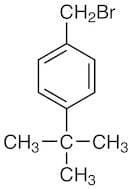
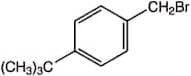
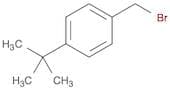
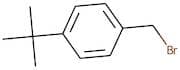
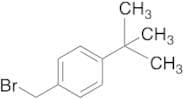
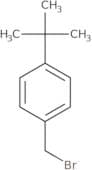
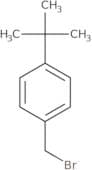
CAS 18880-00-7
:4-tert-Butylbenzylbromid
- 1-(Bromomethyl)-4-(1,1-dimethylethyl)benzene
- 1-(Bromomethyl)-4-Tert-Butylbenzene
- 1-tert-Butyl-4-(bromomethyl)benzene
- 4-(1,1-Dimethylethyl)benzyl bromide
- 4-(Tert-Butyl)Benzyl Bromide
- 4-tert-Butyl-1-bromomethylbenzene
- 4-tert-Butylbenzyl bromide
- 4-tert-Butylphenylmethyl bromide
- Benzene, 1-(bromomethyl)-4-(1,1-dimethylethyl)-
- Bromo(4-tert-butylphenyl)methane
- NSC 186287
- Toluene, α-bromo-p-tert-butyl-
- p-tert-Butylbenzyl bromide
- Weitere Synonyme anzeigen
1-(Bromomethyl)-4-tert-butylbenzene
CAS:Formel:C11H15BrReinheit:>98.0%(GC)Farbe und Form:Colorless to Yellow clear liquidMolekulargewicht:227.154-tert-Butylbenzyl bromide, 97%
CAS:This Thermo Scientific Chemicals brand product was originally part of the Alfa Aesar product portfolio. Some documentation and label information may refer to the legacy brand. The original Alfa Aesar product / item code or SKU reference has not changed as a part of the brand transition to Thermo SciFormel:C11H15BrReinheit:97%Farbe und Form:Liquid, Clear colorless to yellowMolekulargewicht:227.15Benzene, 1-(bromomethyl)-4-(1,1-dimethylethyl)-
CAS:Formel:C11H15BrReinheit:95%Farbe und Form:LiquidMolekulargewicht:227.14084-(tert-Butyl)benzyl bromide
CAS:4-(tert-Butyl)benzyl bromideReinheit:99%Farbe und Form:Pale Yellow LiquidMolekulargewicht:227.14g/molp-tert-Butylbenzyl bromide
CAS:Formel:C11H15BrReinheit:97.0%Farbe und Form:Liquid, ClearMolekulargewicht:227.1454-tert-Butylbenzyl Bromide
CAS:Kontrolliertes ProduktApplications 4-tert-Butylbenzyl Bromide was used as a reagent in the organic synthesis of several compounds including that of C(5)-substituted analogs of inhibitor BRP-7. Also used in the preparation of hydroxy-based sphingosine kinase inhibitors.
Not a dangerous good if item is equal to or less than 1g/ml and there is less than 100g/ml in the package
References Levent, S., et al.: Eur. J. Med. Chem., 122, 510 (2016); Xi, M., et al.: Bioorgan. Med. Chem., 24, 3218 (2016);Formel:C11H15BrFarbe und Form:NeatMolekulargewicht:227.144-tert-Butylbenzyl Bromide-D13
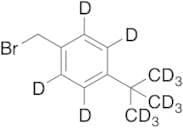
CAS:Kontrolliertes ProduktApplications 4-tert-Butylbenzyl Bromide-D13 is the labeled form of 4-tert-Butylbenzyl Bromide (B692457), which was used as a reagent in the organic synthesis of several compounds including that of C(5)-substituted analogs of inhibitor BRP-7. Also used in the preparation of hydroxy-based sphingosine kinase inhibitors;Also, it is an intermediate used in the synthesis of Pyridaben-d13 (P991262), which is deuterium labelled Pyridaben. Pyridaben is a pyridazinone derivative used as an insecticide and acaricide. In the European Union, Pyridaben has been authorized for use as an insecticide and acaricide from 1 May 2011. In Germany, Austria and Switzerland, no plant protection products containing this active substance are authorized. Pyridaben is a colorless solid that is practically insoluble in water. Cann
References Levent, S., et al.: Eur. J. Med. Chem., 122, 510 (2016); Xi, M., et al.: Bioorgan. Med. Chem., 24, 3218 (2016);Formel:C11D13H2BrFarbe und Form:NeatMolekulargewicht:240.2214-tertButylbenzyl bromide
CAS:4-tertButylbenzyl bromide is a chemical intermediate that is used in the synthesis of other chemicals. It is a useful building block and a versatile intermediate. 4-tertButylbenzyl bromide can be used as a reagent for organic chemistry, pharmaceuticals, and agrochemicals. It is also used to synthesize derivatives such as 4-tertButylbenzaldehyde and 4-tertButyldiphenylmethane. This chemical has been listed under CAS No. 18880-00-7.Formel:C3H5BrMolekulargewicht:120.98 g/mol4-tert-Butylbenzyl bromide
CAS:4-tert-Butylbenzyl bromide is a chemical reagent that is used in the synthesis of other organic compounds. It is a hydrated, hydrogen sulfate salt that can be prepared by reacting trifluoroacetic acid with benzyl alcohol. 4-tert-Butylbenzyl bromide can also be synthesized by treating 4-bromobenzaldehyde with potassium hydroxide and water in an autoclave. It reacts as a nucleophile, attacking the electrophilic carbon atom of an ethoxylate to form a butyric acid ester. This reaction mechanism has been confirmed by both gravimetric analysis and structural analysis of the product. Hydrogen bonding between molecules may play an important role in this reaction, as well as intermolecular hydrogen bonding between the aromatic ring and the alkyl chain. The reaction rate is dependent on temperature and pressure, which are controlled through distillation or vacuum distillation
Formel:C11H15BrReinheit:Min. 95%Molekulargewicht:227.14 g/mol