CAS 19064-64-3
:3,6-Dichlor-4-methylpyridazin
Beschreibung:
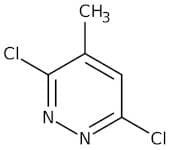
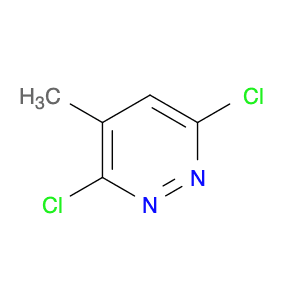
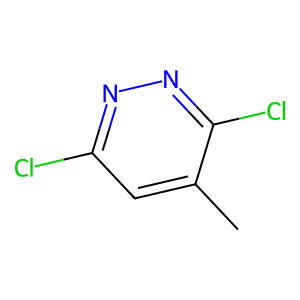
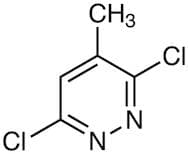
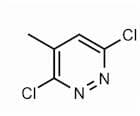
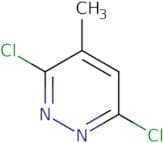
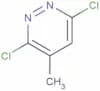
3,6-Dichlor-4-methylpyridazin ist eine heterocyclische organische Verbindung, die durch einen Pyridazinring gekennzeichnet ist, der ein sechsgliedriger aromatischer Ring ist, der zwei Stickstoffatome an den Positionen 1 und 2 enthält. Diese Verbindung weist zwei Chlor-Substituenten an den Positionen 3 und 6 sowie eine Methylgruppe an der Position 4 des Rings auf. Sie ist typischerweise ein farbloser bis blassgelber Feststoff mit einem moderaten Schmelzpunkt. Die Anwesenheit von Chloratomen trägt zu ihrer Reaktivität und potenziellen Anwendungen in verschiedenen chemischen Reaktionen bei, einschließlich als Baustein in der Synthese von Agrochemikalien und Pharmazeutika. Die Verbindung ist in organischen Lösungsmitteln löslich, hat jedoch eine begrenzte Löslichkeit in Wasser, was für viele chlorierte organische Verbindungen typisch ist. Sicherheitsdaten zeigen, dass sie mit Vorsicht behandelt werden sollte, da potenzielle Toxizität und Umweltbedenken im Zusammenhang mit chlorierten Verbindungen bestehen. Insgesamt ist 3,6-Dichlor-4-methylpyridazin sowohl in industriellen als auch in Forschungsumgebungen von Interesse aufgrund seiner einzigartigen strukturellen Merkmale und Reaktivität.
Formel:C5H4Cl2N2
InChl:InChI=1S/C5H4Cl2N2/c1-3-2-4(6)8-9-5(3)7/h2H,1H3
InChI Key:InChIKey=ROYHWGZNGMXQEU-UHFFFAOYSA-N
SMILES:CC1=C(Cl)N=NC(Cl)=C1
Synonyme:- 3,6-Dichloro-5-methylpyridazine
- 4-Methyl-3,6-dichloropyridazine
- NSC 66367
- Pyridazine, 3,6-dichloro-4-methyl-
- 3,6-Dichloro-4-methylpyridazine
Sortieren nach
Reinheit (%)
0
100
|
0
|
50
|
90
|
95
|
100
8 Produkte.
3,6-Dichloro-4-methylpyridazine, 97%
CAS:This Thermo Scientific Chemicals brand product was originally part of the Alfa Aesar product portfolio. Some documentation and label information may refer to the legacy brand. The original Alfa Aesar product / item code or SKU reference has not changed as a part of the brand transition to Thermo SciFormel:C5H4Cl2N2Reinheit:97%Farbe und Form:Crystals or powder or crystalline powder, Pale cream to cream to pale brownMolekulargewicht:163.00Pyridazine, 3,6-dichloro-4-methyl-
CAS:Formel:C5H4Cl2N2Reinheit:98%Farbe und Form:SolidMolekulargewicht:163.00473,6-Dichloro-4-methylpyridazine
CAS:3,6-Dichloro-4-methylpyridazineFormel:C5H4Cl2N2Reinheit:≥95%Farbe und Form:Beige PowderMolekulargewicht:163.00g/mol3,6-Dichloro-4-methylpyridazine
CAS:Formel:C5H4Cl2N2Reinheit:>98.0%(GC)Farbe und Form:White to Orange to Green powder to crystalMolekulargewicht:163.003,6-Dichloro-4-methylpyridazine
CAS:Formel:C5H4Cl2N2Reinheit:97%Farbe und Form:SolidMolekulargewicht:1633,6-Dichloro-4-methylpyridazine
CAS:3,6-Dichloro-4-methylpyridazine is a vibrational and intramolecular hydrogen bond inhibitor. It has been shown to have anticancer activity in mice with wild-type virus. It is an inhibitor of the enzyme DNA polymerase, which is responsible for the synthesis of DNA. 3,6-Dichloro-4-methylpyridazine binds reversibly to the active site of the enzyme and blocks its catalytic activity. The compound also has a binding affinity for the sodium hydroxide solution (NaOH) in water (aq.), which may be due to its ability to form hydrogen bonds with hydroxyl groups on the surface of NaOH. This property may be essential for this drug's anticancer properties. The binding affinity between 3,6-dichloro-4-methylpyridazine and NaOH is much stronger than that between other drugs and NaOH because it forms two hydrogen bonds with NaFormel:C5H4Cl2N2Reinheit:Min. 95%Farbe und Form:Slightly Yellow PowderMolekulargewicht:163 g/mol