CAS 1914-58-5
:(3E)-4-Phenyl-3-butensäure
Beschreibung:
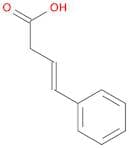
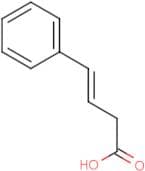
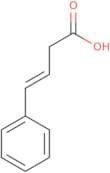
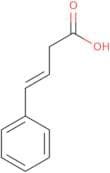
(3E)-4-Phenyl-3-butensäure, mit der CAS-Nummer 1914-58-5, ist eine organische Verbindung, die durch ihre Struktur als ungesättigte Carbonsäure gekennzeichnet ist. Sie weist eine Phenylgruppe auf, die an ein Butensäuregerüst gebunden ist, spezifisch an der Position 4, was zu ihrer einzigartigen Reaktivität und Eigenschaften beiträgt. Diese Verbindung erscheint typischerweise als farblose bis blassgelbe Flüssigkeit oder Feststoff, abhängig von ihrer Reinheit und Temperatur. Sie ist bekannt für ihre potenziellen Anwendungen in der organischen Synthese und als Zwischenprodukt in der Herstellung verschiedener pharmazeutischer Produkte und Agrochemikalien. Das Vorhandensein der Doppelbindung im Butensäureanteil verleiht ihr eine spezifische Reaktivität, die sie anfällig für elektrophile Additionsreaktionen macht. Darüber hinaus bietet die Carbonsäurefunktionalität saure Eigenschaften, die es ihr ermöglichen, an Säure-Base-Reaktionen teilzunehmen. Ihre Löslichkeit in organischen Lösungsmitteln und die begrenzte Löslichkeit in Wasser sind typisch für Verbindungen dieser Art. Insgesamt ist (3E)-4-Phenyl-3-butensäure eine wertvolle Verbindung in der synthetischen organischen Chemie, mit Implikationen in verschiedenen chemischen Prozessen.
Formel:C10H10O2
InChl:InChI=1S/C10H10O2/c11-10(12)8-4-7-9-5-2-1-3-6-9/h1-7H,8H2,(H,11,12)/b7-4+
InChI Key:InChIKey=PSCXFXNEYIHJST-QPJJXVBHSA-N
SMILES:C(=C/CC(O)=O)\C1=CC=CC=C1
Synonyme:- (3E)-4-Phenyl-3-butenoic acid
- (3E)-4-phenylbut-3-enoate
- (3E)-4-phenylbut-3-enoic acid
- (3Z)-4-phenylbut-3-enoic acid
- (E)-4-Phenyl-3-butenoic acid
- 218-814-1
- 3-Butenoic acid, 4-phenyl-, (3E)-
- 3-Butenoic acid, 4-phenyl-, (E)-
- 4-Phenylbut-3-enoic acid
- NSC 172584
- trans-Styrylacetic acid
Sortieren nach
Reinheit (%)
0
100
|
0
|
50
|
90
|
95
|
100
5 Produkte.
3-Butenoic acid, 4-phenyl-, (3E)-
CAS:Formel:C10H10O2Reinheit:98%Farbe und Form:SolidMolekulargewicht:162.1852trans-Styrylacetic acid
CAS:Trans-styrylacetic acid is a tumorigenic agent. It is an oxidation catalyst and water vapor that binds to the metal hydroxides, inhibiting the hydrogen bond formation. Trans-styrylacetic acid has shown inhibitory properties against inflammatory diseases and cancer. Trans-styrylacetic acid inhibits protein synthesis by binding to dinucleotide phosphate and has been shown to have anti-inflammatory activity in vivo and in vitro. Type strain studies have shown that trans-styrylacetic acid inhibits the growth of cancer cells but not normal cells, indicating its specificity for cancer cells.Formel:C10H10O2Reinheit:Min. 95 Area-%Farbe und Form:PowderMolekulargewicht:162.19 g/moltrans-Styrylacetic acid
CAS:trans-Styrylacetic acid is a white solid that is soluble in water and alcohol. It can be used as a building block for organic synthesis, as well as a reagent for the preparation of various organic compounds. It is also an intermediate in the production of pharmaceuticals. trans-Styrylacetic acid is an important chemical because it has a wide range of applications and can be used to synthesize many different compounds.Formel:C10H10O2Reinheit:Min. 99 Area-%Molekulargewicht:162.19 g/molRef: 3D-J-640427
10gNachfragen25gNachfragen50gNachfragen100gNachfragen250gNachfragen-Unit-ggNachfragentrans-Styrylacetic acid
CAS:Formel:C10H10O2Reinheit:98%Farbe und Form:Off-white crystalline powderMolekulargewicht:162.188