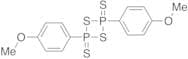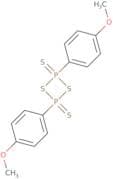
CAS 19172-47-5
:Lawesson-Reagenz
Beschreibung:
Lawesson-Reagenz, mit der CAS-Nummer 19172-47-5, ist eine chemische Verbindung, die hauptsächlich als Thioketon und als Reagenz in der organischen Synthese verwendet wird. Es zeichnet sich durch seine Fähigkeit aus, Carbonylverbindungen in Thione umzuwandeln, die Schwefelanaloga von Ketonen sind. Das Reagenz ist typischerweise ein gelb-brauner Feststoff und ist bekannt für seine Stabilität unter Umgebungsbedingungen. Lawesson-Reagenz wird häufig in der Synthese verschiedener schwefelhaltiger Verbindungen, einschließlich Thioestern und Thioketonen, verwendet, was es in der medizinischen Chemie und Materialwissenschaft wertvoll macht. Seine Reaktivität wird durch die Anwesenheit von Phosphor und Schwefel in seiner Struktur erklärt, was einen nucleophilen Angriff auf elektrophile Carbonylgruppen erleichtert. Darüber hinaus ist es wichtig, Lawesson-Reagenz mit Vorsicht zu behandeln, da es potenziell toxisch ist und während der Verwendung geeignete Sicherheitsmaßnahmen erforderlich sind. Insgesamt ist Lawesson-Reagenz ein vielseitiges Werkzeug in der synthetischen organischen Chemie, insbesondere für die Funktionalisierung von Carbonylverbindungen.
Formel:C14H14O2P2S4
InChl:InChI=1S/C14H14O2P2S4/c1-15-11-3-7-13(8-4-11)17(19)21-18(20,22-17)14-9-5-12(16-2)6-10-14/h3-10H,1-2H3
InChI Key:InChIKey=CFHGBZLNZZVTAY-UHFFFAOYSA-N
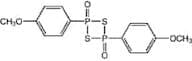
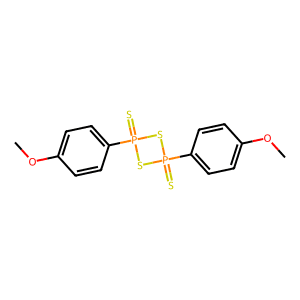
SMILES:S=P1(SP(=S)(S1)C2=CC=C(OC)C=C2)C3=CC=C(OC)C=C3
Synonyme:- 1,3,2,4-Dithiadiphosphetane, 2,4-bis(4-methoxyphenyl)-, 2,4-disulfide
- 19172-47-5
- 2,4-(4-Methoxyphenyl)-1,3,2,4-dithiadiphosphetane-2,4-disulfide
- 2,4-Bis(4-Methoxyphenyl)-1,3,2,4-Dithiadiphosphetane-2,4-Disulfide
- 2,4-Bis(4-Methoxyphenyl)-1,3-Dithia-2,4-Diphosphetane-2,4-Disulfide
- 2,4-Bis(4-methoxyphenyl)-2,4-dithioxo-1,3,2,4-dithiadiphosphetane
- 2,4-Bis(p-methoxyphenyl)-1,3,2,4-dithiadiphosphetane 2,4-disulfide
- 2,4-Di(p-methoxyphenyl)-1,3-dithiadiphosphetane disulfide
- 242-855-4
- Lawesson reagent
- NSC 150550
- Phosphonotrithioic acid, (p-methoxyphenyl)-, bimol. cyclic anhydrosulfide
- Reagents, Lawesson's
- p-Anisyldithiophosphonic anhydride
- p-Methoxyphenylthionophosphine sulfide dimer
- Weitere Synonyme anzeigen
Sortieren nach
Reinheit (%)
0
100
|
0
|
50
|
90
|
95
|
100
8 Produkte.
Lawesson's Reagent [Sulfurating Reagent]
CAS:Formel:C14H14O2P2S4Reinheit:>93.0%(T)Farbe und Form:White to Light yellow to Green powder to crystalMolekulargewicht:404.45Lawesson's Reagent, 97%
CAS:Lawesson's reagent is a thiation agent used to convert carbonyl compounds into thiocarbonyls. It is also used to thionate enones, esters, lactones, amides, lactams and quinones. Further, it is used to prepare thiols from alcohols. It is associated with silver perchlorate and utilized as and oxophili
Formel:C14H14O2P2S4Reinheit:97%Farbe und Form:White to pale cream or pale yellow, Crystals or powder or crystalline powderMolekulargewicht:404.452,4-Bis(4-methoxyphenyl)-2,4-dithioxo-1,3,2,4-dithiadiphosphetane
CAS:2,4-Bis(4-methoxyphenyl)-2,4-dithioxo-1,3,2,4-dithiadiphosphetaneReinheit:95%Molekulargewicht:404.47g/molLawesson's reagent
CAS:Lawesson's reagent is a thiation agent. It is incompatible with strong oxidizing agents.Formel:C14H14O2P2S4Reinheit:98%Farbe und Form:Light Yellow To Beige PowderMolekulargewicht:404.47Lawesson reagent
CAS:Formel:C14H14O2P2S4Reinheit:(Titration) ≥ 96.0%Farbe und Form:Off-white to light-yellow or pale beige-brown powderMolekulargewicht:404.47Lawesson’s Reagent
CAS:Kontrolliertes ProduktApplications Lawesson’s Reagent is used primarily in the conversion of carbonyls to thiocarbonyls. It is also used in the synthesis of β-D-ribonucleosides.
Not a dangerous good if item is equal to or less than 1g/ml and there is less than 100g/ml in the package
References Shimomura, N. et al.: Bull. Chem. Jpn., 67, 3100 (1994); Wang, F. et al.: Sens. Actu. Chem., 161, 948 (2012);Formel:C14H14O2P2S4Farbe und Form:NeatMolekulargewicht:404.467Lawesson's reagent
CAS:Lawesson's reagent is a solution of copper(II) acetate, ammonium chloride and hydrochloric acid. It is used in organic chemistry as an oxidizing agent for the conversion of amines to nitro compounds. Lawesson's reagent is also used in vitro as an antifungal agent. The mechanism of action is not fully understood, but it appears to act by producing reactive oxygen species that cause oxidative damage to fungal cell membranes. In addition, Lawesson's reagent has anti-inflammatory properties and can be used as a pharmaceutical preparation.Formel:C14H14O2P2S4Reinheit:(%) Min. 98%Farbe und Form:Off-White PowderMolekulargewicht:404.47 g/mol
![Lawesson's Reagent [Sulfurating Reagent]](/_next/image/?url=https%3A%2Fstatic.cymitquimica.com%2Fproducts%2F3B%2Fthumb%2FB1133.jpg&w=3840&q=75)