CAS 191723-65-6
:Glycinamid, glycyl-N-(4-methyl-2-oxo-2H-1-benzopyran-7-yl)-, monohydrochlorid
Beschreibung:
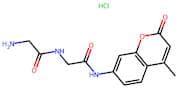
Glycinamid, glycyl-N-(4-methyl-2-oxo-2H-1-benzopyran-7-yl)-, monohydrochlorid ist eine chemische Verbindung, die durch ihre einzigartige Struktur gekennzeichnet ist, die eine Glycinamid-Gruppe enthält, die an ein Benzopyran-Derivat gebunden ist. Diese Verbindung zeigt typischerweise Eigenschaften, die sowohl mit Aminosäuren als auch mit heterozyklischen aromatischen Verbindungen assoziiert sind, was auf eine potenzielle biologische Aktivität hindeutet. Es ist wahrscheinlich, dass sie in polaren Lösungsmitteln löslich ist, aufgrund der Anwesenheit der Hydrochloridgruppe, die ihre Löslichkeit in Wasser erhöht. Die Benzopyran-Struktur könnte zu ihrem Potenzial als Pharmakophor beitragen, möglicherweise ihre Wechselwirkung mit biologischen Zielen beeinflussen. Das Vorhandensein von Methyl- und Carbonylgruppen im Benzopyran-Ring kann ihre Reaktivität und Stabilität beeinflussen. Als Hydrochloridsalz kann es eine verbesserte Stabilität und Bioverfügbarkeit im Vergleich zu seiner freien Basenform aufweisen. Insgesamt deuten die Eigenschaften dieser Verbindung darauf hin, dass sie Anwendungen in der medizinischen Chemie haben könnte, insbesondere bei der Entwicklung therapeutischer Mittel. Spezifische biologische Aktivitäten und Anwendungen würden jedoch weitere Untersuchungen durch empirische Studien erfordern.
Formel:C14H15N3O4
InChl:InChI=1S/C14H15N3O4.ClH/c1-8-4-14(20)21-11-5-9(2-3-10(8)11)17-13(19)7-16-12(18)6-15;/h2-5H,6-7,15H2,1H3,(H,16,18)(H,17,19);1H
InChI Key:InChIKey=ZRGZRZYKKHAMID-UHFFFAOYSA-N
SMILES:CC=1C=2C(=CC(NC(CNC(CN)=O)=O)=CC2)OC(=O)C1.Cl
Synonyme:- Glycinamide, glycyl-N-(4-methyl-2-oxo-2H-1-benzopyran-7-yl)-, monohydrochloride
- H-Gly-Gly-Amc Hcl
- 1225: PN: WO2023172654 SEQID: 1233 claimed sequence
- 555: PN: US20220128567 SEQID: 1233 claimed sequence
- 555: PN: US20220178935 SEQID: 1233 claimed sequence
Sortieren nach
Reinheit (%)
0
100
|
0
|
50
|
90
|
95
|
100
3 Produkte.
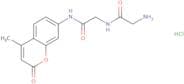
2-Amino-N-(2-((4-methyl-2-oxo-2H-chromen-7-yl)amino)-2-oxoethyl)acetamide hydrochloride
CAS:2-Amino-N-(2-((4-methyl-2-oxo-2H-chromen-7-yl)amino)-2-oxoethyl)acetamide hydrochlorideReinheit:97%Molekulargewicht:325.75g/molGlycyl-glycine 7-amido-4-methylcoumarin hydrochloride
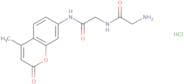
CAS:Glycyl-glycine 7-amido-4-methylcoumarin hydrochloride (Gly-Gly-AMC) is a fluorescent compound that can be used as a probe for the transfer of glycine in the brain. Gly-Gly-AMC binds to Langerhans cells and is transferred by an anterograde axonal transport mechanism from the peripheral nervous system to the central nervous system. The binding of Gly-Gly-AMC to Langerhans cells has been shown to activate them, which induces the release of inflammatory mediators into the surrounding tissue. This activity may be due to increased levels of calcium ions, which are known to induce exocytosis in these cells. Glycine is also involved in depression and other mental disorders, as well as muscle and brain activity.Formel:C14H16ClN3O4Molekulargewicht:325.75 g/molRef: 3D-G-6100
1gNachfragen5gNachfragen10gNachfragen500mgNachfragen2500mgNachfragen-Unit-ggNachfragenGlycyl-glycine 7-amido-4-methylcoumarin hydrochloride
CAS:Glycyl-glycine 7-amido-4-methylcoumarin hydrochloride is a synthetic peptide substrate used as a fluorogenic substrate for aminopeptidase.Formel:C14H16ClN3O4Reinheit:Min. 95%Farbe und Form:PowderMolekulargewicht:325.75 g/mol