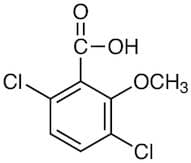
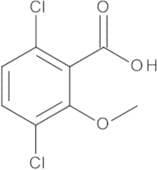
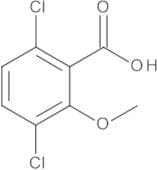
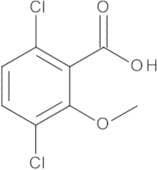
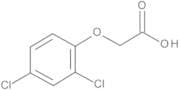
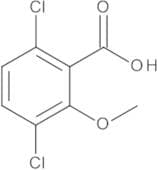
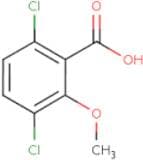
CAS 1918-00-9
:Pflanzenzellkultur von 3,6-Dichlor-O-anisinsäure
- 2,5-Dichloro-6-methoxybenzoic acid
- 2-Methoxy-3,6-dichlorobenzoic acid
- 3,6-Dichloro-2-methoxybenzoic acid
- 3,6-Dichloro-o-anisic acid
- Aviator
- Banvel
- Banvel 480
- Banvel 70WP
- Banvel SGF
- Benzoic acid, 3,6-dichloro-2-methoxy-
- Celebrity B
- DC
- Decamba
- Dianat
- Dicamba
- Mais Banvel WG
- Mdba
- Mediben
- Vanquish
- Velsicol 58CS11
- Velsicol Compound R
- Weitere Synonyme anzeigen
Dicamba
CAS:Formel:C8H6Cl2O3Reinheit:>98.0%(GC)(T)Farbe und Form:White to Almost white powder to crystalMolekulargewicht:221.03Dicamba
CAS:DicambaFormel:C8H6Cl2O3Reinheit:By hplc: 99.91% (Typical Value in Batch COA)Farbe und Form: white to off-white solidMolekulargewicht:221.03744g/molDicamba
CAS:Formel:C8H6Cl2O3Reinheit:≥ 95%Farbe und Form:White to off-white crystalline powderMolekulargewicht:221.03Dicamba 10 µg/mL in Acetonitrile
CAS:Formel:C8H6Cl2O3Farbe und Form:Single SolutionMolekulargewicht:221.04HJ 1022-2019 Pesticides Mixture 14 500 µg/mL in Acetone
CAS:Kontrolliertes ProduktFarbe und Form:MixturePesticide Mixture 254 200 µg/mL in Acetonitrile
CAS:- 114311-32-9
- 133-90-4
- 1702-17-6
- 1918-00-9
- 1918-02-1
- 25057-89-0
- 55335-06-3
- 81334-34-1
- 81335-37-7
- 81335-77-5
- 93-65-2
- 94-74-6
- 94-75-7
Formel:C8H6Cl2O3Farbe und Form:MixtureMolekulargewicht:221.04HJ 1022-2019 Phenoxycarboxylic Pesticides Mixture 10 100 µg/mL in Acetone
CAS:Kontrolliertes ProduktFarbe und Form:MixturePesticide-Mix 95 1000 µg/mL in Ethyl acetate
CAS:Kontrolliertes Produkt- 120-36-5
- 1689-83-4
- 1689-84-5
- 1918-00-9
- 25057-89-0
- 50-31-7
- 55335-06-3
- 93-65-2
- 93-76-5
- 94-74-6
- 94-75-7
- 94-81-5
- 94-82-6
Formel:C7H3Cl3O2Farbe und Form:MixtureMolekulargewicht:225.46Dicamba 100 µg/mL in Acetonitrile
CAS:Kontrolliertes ProduktFormel:C8H6Cl2O3Farbe und Form:Single SolutionMolekulargewicht:221.04Pesticide-Mix 128 20 µg/mL in Acetonitrile
CAS:Kontrolliertes Produkt- 120-36-5
- 1702-17-6
- 1918-00-9
- 1918-02-1
- 25057-89-0
- 314-40-9
- 55335-06-3
- 69335-91-7
- 69806-34-4
- 882-09-7
- 93-65-2
- 93-72-1
- 93-76-5
- 94-74-6
- 94-75-7
- 94-81-5
- 94-82-6
Formel:C8H5Cl3O3Farbe und Form:MixtureMolekulargewicht:255.48Chlorinated Acids Mix 1 100 µg/mL in Acetonitrile
CAS:Kontrolliertes ProduktFormel:C8H6Cl2O3Farbe und Form:MixtureMolekulargewicht:221.04EPA Method 515.2 Herbicide Mixture 402 100-1000 µg/mL in Methanol
CAS:Kontrolliertes ProduktFarbe und Form:MixtureDicamba
CAS:Applications Dicamba is a herbicide. Dicamba functions by increasing plant growth rate. At sufficient concentrations, the plant outgrows its nutrient supplies and dies. Dicamba has been approved by the EPA for use on genetically modified soybeans and cotton.Environmental toxin on US EPA Toxic Release Inventory list (TRI) list.
References Oehler, D.D., et al.: J. Agric. Food Chem., 28, 685 (1980); Griffin, J., et al.: Weed Techno., 27, 696 (2013); Chem. and Eng. News, Nov. 14, 2016, p. 17Formel:C8H6Cl2O3Farbe und Form:NeatMolekulargewicht:221.04Dicamba
CAS:Dicamba is a herbicide that is used to control weeds. It inhibits the biosynthesis of fatty acids and disrupts the integrity of plant membranes, leading to cell death. Dicamba can be used with other herbicides such as 2,4-D and glyphosate in order to control weed growth. Dicamba has been shown to inhibit the activities of various enzymes, including lipid synthase, which regulates the synthesis of fatty acids. Dicamba also binds to DNA and alters transcriptional regulation.
Formel:C8H6Cl2O3Reinheit:Min. 95%Farbe und Form:Off-White PowderMolekulargewicht:221.04 g/molDICAMBA for tissue culture, 95%
CAS:Formel:C8H6Cl2O3Reinheit:min. 95%Farbe und Form:White to off - white, Crystalline powderMolekulargewicht:221.043,6-Dichloro-2-methoxybenzoic acid
CAS:Formel:C8H6Cl2O3Reinheit:95.0%Farbe und Form:SolidMolekulargewicht:221.03