CAS 1918-02-1
:4-Amino-3,5,6-trichlorpicolinsäure
Beschreibung:
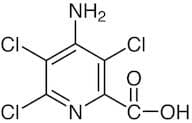
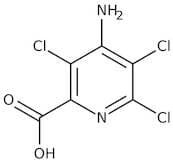
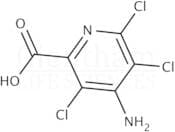
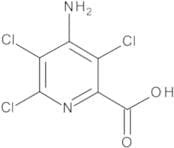
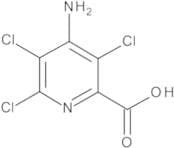
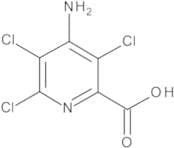
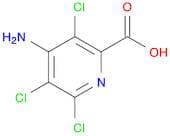
4-Amino-3,5,6-trichlorpicolinsäure, allgemein bekannt als Picloram, ist ein systemisches Herbizid, das hauptsächlich zur Bekämpfung von breitblättrigen Unkräutern und holzigen Pflanzen eingesetzt wird. Es gehört zur Klasse der Pyridincarbonsäuren und weist eine komplexe Struktur auf, die durch das Vorhandensein von drei Chloratomen und einer Aminogruppe, die an einen Pyridingring gebunden ist, gekennzeichnet ist. Diese Verbindung ist bekannt für ihre hohe Löslichkeit in Wasser, was ihre Aufnahme durch Pflanzen erleichtert. Picloram wirkt, indem es natürliche Pflanzenhormone nachahmt, normale Wachstumsprozesse stört und letztendlich zum Tod der Pflanze führt. Es ist in verschiedenen Umgebungen wirksam, einschließlich landwirtschaftlicher und nicht-landwirtschaftlicher Bereiche. Allerdings erfordert seine Persistenz im Boden und das Potenzial zur Kontamination von Grundwasser eine sorgfältige Anwendung und Verwaltung. Darüber hinaus unterliegt Picloram einer regulatorischen Prüfung aufgrund seiner Umweltauswirkungen und der potenziellen Toxizität für Nichtzielorganismen. Wie bei jedem Herbizid sind eine ordnungsgemäße Handhabung und die Einhaltung von Sicherheitsrichtlinien unerlässlich, um die mit seiner Verwendung verbundenen Risiken zu minimieren.
Formel:C6H3Cl3N2O2
InChl:InChI=1/C6H3Cl3N2O2/c7-1-3(10)2(8)5(9)11-4(1)6(12)13/h(H2,10,11)(H,12,13)
InChI Key:InChIKey=NQQVFXUMIDALNH-UHFFFAOYSA-N
SMILES:C(O)(=O)C1=C(Cl)C(N)=C(Cl)C(Cl)=N1
Synonyme:- 2-Pyridine carboxylic acid, 4-amino-3,5,6-trichloro-
- 2-Pyridinecarboxylic acid, 4-amino-3,5,6-trichloro-
- 3,5,6-Trichloro-4-Aminopicolinic acid
- 3,5,6-Trichloro-4-Aminopicolinicacid
- 3,5,6-Trichloro-4-Aminopyridine-2-Carboxylic Acid
- 4-Amino-3,5,6-Trichloro-2-Pyridinecarboxylic Acid
- 4-Amino-3,5,6-Trichloropyridine-2-Carboxylic Acid
- 4-Amino-3,5,6-trichloro-2-picolinic acid
- 4-Amino-3,5,6-trichlorpyridin-2-carbonsaure
- 4-Aminotrichloropicolinic acid
- Acide 4-amino-3,5,6-trichloropyridine-2-carboxylique
- Acido 4-Amino-3,5,6-Tricloropiridina-2-Carboxilico
- Atcp
- Grazon PC
- Nsc 233899
- Otava-Bb Bb5110090065
- Padron
- Padron (herbicide)
- Picloram
- Picloram Plant Cell Culture Tested
- Picolinic Acid, 4-Amino-3,5,6-Trichloro-
- Rarechem Al Bo 1809
- Timtec-Bb Sbb000816
- Tordon
- Tordon(R)
- 4-Amino-3,5,6-trichloropicolinic acid
- AKOS BBS-00001392
- 4-aminotrichloropicolinicacid
- IFLAB-BB F3055-0927
- 4-Amino-3,5,6-trichloro-2-pyridine carboxylic acid
- 4-amino-3,5,6-trichloro-2-pyridinecarboxylicaci
- 4-amino-3,5,6-trichloro-picolinicaci
- 4-amino-3,5,6-trichlorpicolinsaeure[german]
- Weitere Synonyme anzeigen
Sortieren nach
Reinheit (%)
0
100
|
0
|
50
|
90
|
95
|
100
20 Produkte.
Picloram
CAS:Formel:C6H3Cl3N2O2Reinheit:>98.0%(HPLC)Farbe und Form:White to Almost white powder to crystalMolekulargewicht:241.45Picloram, 95%
CAS:Picloram, 95%Formel:C6H3Cl3N2O2Reinheit:95%Farbe und Form:White to pale yellow to pale cream, PowderMolekulargewicht:241.45Picloram
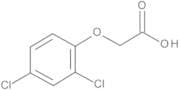
CAS:Formel:C6H3Cl3N2O2Reinheit:≥ 97.0%Farbe und Form:White to off-white or pale yellow-beige powder or crystalsMolekulargewicht:241.26Chlorinated Acids Mix 1 100 µg/mL in Acetonitrile
CAS:Kontrolliertes ProduktFormel:C8H6Cl2O3Farbe und Form:MixtureMolekulargewicht:221.04Pesticide-Mix 128 20 µg/mL in Acetonitrile
CAS:Kontrolliertes Produkt- 120-36-5
- 1702-17-6
- 1918-00-9
- 1918-02-1
- 25057-89-0
- 314-40-9
- 55335-06-3
- 69335-91-7
- 69806-34-4
- 882-09-7
- 93-65-2
- 93-72-1
- 93-76-5
- 94-74-6
- 94-75-7
- 94-81-5
- 94-82-6
Formel:C8H5Cl3O3Farbe und Form:MixtureMolekulargewicht:255.48Pesticide Mixture 254 200 µg/mL in Acetonitrile
CAS:- 114311-32-9
- 133-90-4
- 1702-17-6
- 1918-00-9
- 1918-02-1
- 25057-89-0
- 55335-06-3
- 81334-34-1
- 81335-37-7
- 81335-77-5
- 93-65-2
- 94-74-6
- 94-75-7
Formel:C8H6Cl2O3Farbe und Form:MixtureMolekulargewicht:221.04Picloram 100 ug/mL in Methanol
CAS:Kontrolliertes ProduktFormel:C6H3Cl3N2O2Farbe und Form:Single SolutionMolekulargewicht:241.46EPA Method 515.2 Herbicide Mixture 402 100-1000 µg/mL in Methanol
CAS:Kontrolliertes ProduktFarbe und Form:MixturePicloram
CAS:Picloram (Tordon) is an auxin-type herbicide with carcinogenic properties, controlling herbaceous weeds and woody plants.Formel:C6H3Cl3N2O2Reinheit:99.74%Farbe und Form:White Powder Physical Description Fine Beige Crystals Or White Powder Odor Of Chlorine (Ntp 1992)Molekulargewicht:241.464-Amino-3,5,6-trichloropyridine-2-carboxylic acid
CAS:Formel:C6H3Cl3N2O2Reinheit:97.0%Farbe und Form:SolidMolekulargewicht:241.45Picloram extrapure, 95%
CAS:Formel:C6H3Cl3N2O2Reinheit:min. 95%Farbe und Form:Off - white to tan, Powder, ClearMolekulargewicht:241.46Picloram
CAS:Applications Picloram is used as a herbicide. Studies show that Picloram can reduce seed germination rate and vigor as well as seedling growth in Bidens pilosa L.
References Freitas, M.R., et al.: RSC Adv., 5, 7547 (2015); Tian, X., et al.: Nongyao, 53, 485 (2014)Formel:C6H3Cl3N2O2Farbe und Form:NeatMolekulargewicht:241.464-Amino-3,5,6-trichloropyridine-2-carboxylic acid
CAS:4-Amino-3,5,6-trichloropyridine-2-carboxylic acid (4ATC) is a herbicide that inhibits the activity of pyridoxal phosphate (PLP)-dependent enzymes. 4ATC has been shown to be more toxic to plants than temozolomide and is used in vitro to study the effects of herbicides on cells. It inhibits cell growth and induces apoptosis in human cancer cells. In addition, 4ATC has been shown to inhibit the enzyme activities of group P2 proteins and nucleic acid synthesis. 4ATC also inhibits protein synthesis by inhibiting RNA synthesis in eukaryotic cells. 4ATC is not active against bacteria or fungi.Formel:C6H3Cl3N2O2Reinheit:Min. 95%Farbe und Form:White To Tan SolidMolekulargewicht:241.46 g/mol2-Pyridinecarboxylic acid, 4-amino-3,5,6-trichloro-
CAS:Formel:C6H3Cl3N2O2Farbe und Form:SolidMolekulargewicht:241.4592