CAS 192508-36-4
:(4-Fluor-3-nitrophenyl)essigsäure
Beschreibung:
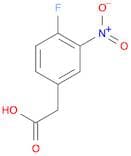
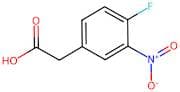
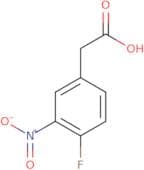
(4-Fluor-3-nitrophenyl)essigsäure ist eine organische Verbindung, die durch das Vorhandensein sowohl einer Fluor- als auch einer Nitrogruppe an einem Phenylring sowie einer Carbonsäurefunktion gekennzeichnet ist. Ihre molekulare Struktur weist einen Phenylring auf, der an der Para-Position mit einem Fluoratoms und an der Meta-Position mit einer Nitrogruppe substituiert ist, was ihre Reaktivität und Polarität beeinflusst. Die Carbonsäuregruppe trägt zu ihren sauren Eigenschaften bei, wodurch sie an verschiedenen chemischen Reaktionen, wie der Veresterung und Amidierung, teilnehmen kann. Diese Verbindung wird typischerweise in der organischen Synthese verwendet und kann als Zwischenprodukt in der Herstellung von Arzneimitteln oder Agrochemikalien dienen. Ihre einzigartigen Substituenten können ihre Löslichkeit in verschiedenen Lösungsmitteln sowie ihre Wechselwirkung mit biologischen Systemen beeinflussen, was sie in der medizinischen Chemie von Interesse macht. Sicherheitsdaten sollten für den Umgang konsultiert werden, da Verbindungen mit Nitro- und Fluorgruppen spezifische Gefahren aufweisen können.
Formel:C8H6FNO4
InChl:InChI=1/C8H6FNO4/c9-6-2-1-5(4-8(11)12)3-7(6)10(13)14/h1-3H,4H2,(H,11,12)
SMILES:c1cc(c(cc1CC(=O)O)N(=O)=O)F
Synonyme:- Benzeneacetic Acid, 4-Fluoro-3-Nitro-
- 3-Nitro-4-fluorophenylaceticacid
- 4-Fluoro-3-Nitrophenylacetic Acid
- 3-Nitro-4-Fluorophenylacetic Acid
Sortieren nach
Reinheit (%)
0
100
|
0
|
50
|
90
|
95
|
100
4 Produkte.
Benzeneacetic acid, 4-fluoro-3-nitro-
CAS:Formel:C8H6FNO4Reinheit:95%Farbe und Form:SolidMolekulargewicht:199.13592-(4-Fluoro-3-nitrophenyl)acetic acid
CAS:2-(4-Fluoro-3-nitrophenyl)acetic acidReinheit:98%Molekulargewicht:199.14g/mol4-Fluoro-3-nitrophenylacetic acid
CAS:Formel:C8H6FNO4Reinheit:95%Farbe und Form:SolidMolekulargewicht:199.1374-Fluoro-3-nitrophenylacetic acid
CAS:4-Fluoro-3-nitrophenylacetic acid is a chiral monomer that can be used to synthesize diphenyl ethers. The reaction requires a carbamic acid as the acid catalyst and a nucleophilic reagent, such as an amine. 4-Fluoro-3-nitrophenylacetic acid has been shown to have anti-cancer properties in vitro and in vivo. 4-Fluoro-3-nitrophenylacetic acid may also inhibit the synthesis of dihydroisoquinolines, which are important for the function of DNA polymerase. There are two strategies for synthesizing this compound: one is based on the condensation of two molecules of phenylacetaldehyde in the presence of an acid catalyst; the other employs a Lewis acid catalyst with a pyridine nucleophile.Formel:C8H6FNO4Reinheit:Min. 95%Farbe und Form:SolidMolekulargewicht:199.14 g/mol