CAS 1929-29-9
:3-(4-Methoxyphenyl)propionsäure
Beschreibung:
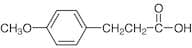
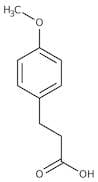
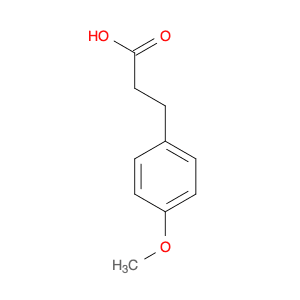
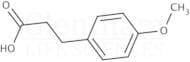
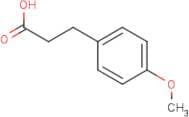
3-(4-Methoxyphenyl)propionsäure, mit der CAS-Nummer 1929-29-9, ist eine organische Verbindung, die durch ihr Propionsäuregerüst charakterisiert ist, das mit einer 4-Methoxyphenylgruppe substituiert ist. Diese Verbindung erscheint typischerweise als weißes bis off-white kristallines Feststoff. Sie ist in organischen Lösungsmitteln wie Ethanol und Methanol löslich, hat jedoch eine begrenzte Löslichkeit in Wasser. Die Anwesenheit der Methoxygruppe erhöht ihre Lipophilie, was ihre biologische Aktivität und Interaktionen beeinflussen kann. Die Verbindung weist saure Eigenschaften aufgrund der Carbonsäurefunktionalität auf, die es ihr ermöglicht, an verschiedenen chemischen Reaktionen, einschließlich Veresterung und Amidierung, teilzunehmen. Sie kann auch potenzielle pharmakologische Aktivitäten aufweisen, was sie in der medizinischen Chemie von Interesse macht. Darüber hinaus deuten ihre strukturellen Merkmale darauf hin, dass sie an Wasserstoffbrückenbindungen und π-π-Stapelinteraktionen teilnehmen könnte, die in biologischen Systemen relevant sind. Insgesamt ist 3-(4-Methoxyphenyl)propionsäure eine vielseitige Verbindung mit Anwendungen in der Forschung und potenziellen therapeutischen Anwendungen.
Formel:C10H12O3
InChl:InChI=1S/C10H12O3/c1-13-9-5-2-8(3-6-9)4-7-10(11)12/h2-3,5-6H,4,7H2,1H3,(H,11,12)
InChI Key:InChIKey=FIUFLISGGHNPSM-UHFFFAOYSA-N
SMILES:C(CC(O)=O)C1=CC=C(OC)C=C1
Synonyme:- 3-(2-Methoxyphenyl)Propanoic Acid
- 3-(4-Methoxyphenyl)Propanoate
- 3-(4-Methoxyphenyl)Propanoic Acid
- 3-(p-Methoxyphenyl)propanoic acid
- 3-(p-Methoxyphenyl)propionic acid
- 3-[4-(Methyloxy)phenyl]propanoic acid
- 4-Methoxybenzenepropanoic acid
- 4-Methoxyhydrocinnamic acid
- 4-Methoxyphenylpropiinic Acid
- Benzenepropanoic acid, 4-methoxy-
- Hydrocinnamic acid, p-methoxy-
- NSC 33134
- NSC 51509
- p-Methoxybenzenepropionic acid
- p-Methoxyhydrocinnamic acid
- Weitere Synonyme anzeigen
Sortieren nach
Reinheit (%)
0
100
|
0
|
50
|
90
|
95
|
100
8 Produkte.
3-(4-Methoxyphenyl)propionic Acid
CAS:Formel:C10H12O3Reinheit:>98.0%(GC)(T)Farbe und Form:White to Light yellow to Light orange powder to crystalMolekulargewicht:180.203-(4-Methoxyphenyl)propionic acid, 98%
CAS:This Thermo Scientific Chemicals brand product was originally part of the Alfa Aesar product portfolio. Some documentation and label information may refer to the legacy brand. The original Alfa Aesar product / item code or SKU reference has not changed as a part of the brand transition to Thermo SciFormel:C10H12O3Reinheit:98%Farbe und Form:White to cream to brown, Crystalline powder or powderMolekulargewicht:180.20Benzenepropanoic acid, 4-methoxy-
CAS:Formel:C10H12O3Reinheit:97%Farbe und Form:SolidMolekulargewicht:180.20053-(4-Methoxyphenyl)propanoic acid
CAS:3-(4-Methoxyphenyl)propanoic acidReinheit:98%Molekulargewicht:180.20g/mol3-(4-Methoxyphenyl)propanoic acid
CAS:3-(4-Methoxyphenyl)propanoic acid is a useful organic compound for research related to life sciences.Formel:C10H12O3Farbe und Form:SolidMolekulargewicht:180.2033-(4-Methoxyphenyl)propionic acid
CAS:3-(4-Methoxyphenyl)propionic acid is a nutrient solution that can be used to inhibit microbial growth by binding to the active site of enzymes such as carbonyl group, formation rate, acidic ph, chlorogenic acids, cinnamic acid derivatives. 3-(4-Methoxyphenyl)propionic acid has been shown to react with hydrogen bond and diltiazem hydrochloride in surface methodology experiments. This compound has also been shown to have activity against cavity microorganisms, including Streptococcus mutans and Lactobacillus acidophilus.
Formel:C10H12O3Reinheit:Min. 95%Farbe und Form:PowderMolekulargewicht:180.2 g/mol3-(4-Methoxyphenyl)propionic acid
CAS:Formel:C10H12O3Reinheit:97%Farbe und Form:SolidMolekulargewicht:180.203