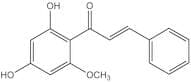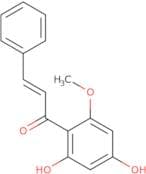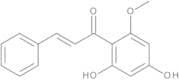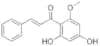
CAS 19309-14-9
:Cardamonin
Beschreibung:
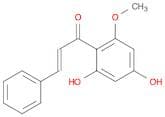
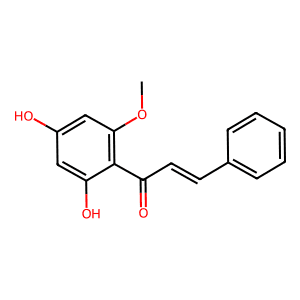
Cardamonin ist eine natürlich vorkommende Verbindung, die als Chalcon klassifiziert ist und hauptsächlich aus den Samen der Pflanze Elettaria cardamomum, allgemein bekannt als Kardamom, gewonnen wird. Sie zeichnet sich durch ihr gelbes kristallines Aussehen aus und hat eine molekulare Formel, die ihre komplexe Struktur widerspiegelt. Cardamonin zeigt verschiedene biologische Aktivitäten, einschließlich entzündungshemmender, antioxidativer und antimikrobieller Eigenschaften, was sie für die pharmakologische Forschung von Interesse macht. Ihr Wirkmechanismus umfasst oft die Modulation von Signalwegen, die die Zellproliferation und Apoptose beeinflussen können. Darüber hinaus wurde Cardamonin auf seine potenziellen therapeutischen Wirkungen bei Erkrankungen wie Krebs und Stoffwechselstörungen untersucht. Die Verbindung ist in organischen Lösungsmitteln löslich, hat jedoch eine begrenzte Löslichkeit in Wasser, was ihre Bioverfügbarkeit beeinträchtigen kann. Insgesamt stellt Cardamonin ein bedeutendes Interessengebiet in der Naturstoffchemie und der medizinischen Forschung dar, aufgrund seiner vielfältigen biologischen Aktivitäten und potenziellen Gesundheitsvorteile.
Formel:C16H14O4
InChl:InChI=1S/C16H14O4/c1-20-15-10-12(17)9-14(19)16(15)13(18)8-7-11-5-3-2-4-6-11/h2-10,17,19H,1H3/b8-7+
InChI Key:InChIKey=NYSZJNUIVUBQMM-BQYQJAHWSA-N
SMILES:C(/C=C/C1=CC=CC=C1)(=O)C2=C(OC)C=C(O)C=C2O
Synonyme:- (2E)-1-(2,4-Dihydroxy-6-methoxyphenyl)-3-phenyl-2-propen-1-one
- (2E)-1-(2,4-dihydroxy-6-methoxyphenyl)-3-phenylprop-2-en-1-one
- (E)-1-(2,4-Dihydroxy-6-Methoxy-Phenyl)-3-Phenyl-Propenone
- (E)-1-(2,4-Dihydroxy-6-methoxy-phenyl)-3-phenyl-
- 2-Propen-1-one, 1-(2,4-dihydroxy-6-methoxyphenyl)-3-phenyl-, (2E)-
- 2-Propen-1-one, 1-(2,4-dihydroxy-6-methoxyphenyl)-3-phenyl-, (E)-
- Alpinetin chalcone
- Cardamomin
- Chalcone, 2', 4'-dihydroxy-6'-methoxy-
- Chalcone, 2′,4′-dihydroxy-6′-methoxy-
- Cardamonin
Sortieren nach
Reinheit (%)
0
100
|
0
|
50
|
90
|
95
|
100
10 Produkte.
(E)-Cardamonin
CAS:(E)-Cardamonin (Alpinetin chalcone) is a chalconoid that has been isolated from several plants including Alpinia katsumadai and Alpinia conchigera.Formel:C16H14O4Reinheit:99.07% - 99.84%Farbe und Form:SolidMolekulargewicht:270.28(E)-1-(2,4-Dihydroxy-6-Methoxyphenyl)-3-Phenylprop-2-En-1-One
CAS:(E)-1-(2,4-Dihydroxy-6-Methoxyphenyl)-3-Phenylprop-2-En-1-OneReinheit:99%Molekulargewicht:270.28g/molCardamonin
CAS:Cardamonin is a naturally occurring chalcone with strong anti-inflammatory , anticancer, anti-melanogenesis, and vascular activity. It is a novel TRPA1 antagonist with IC50 of 454 nM and also a NF-kB inhibitor. It ameliorates insulin resistance induced by high insulin and high glucose through the mTOR and signal pathway. It also may be a potential whitening agent for use in cosmetics and in the medical treatment of hyperpigmentation disorders.Formel:C16H14O4Reinheit:95%~99%Molekulargewicht:270.284Cardamomin
CAS:Ketone phenolFormel:C16H14O4Reinheit:≥ 98.0 % (HPLC)Farbe und Form:PowderMolekulargewicht:270.29Cardamonin
CAS:Cardamonin is a natural chalcone, which is a type of aromatic ketone and an unsaturated polyphenolic compound. It is primarily sourced from various plants, particularly from the seeds of Alpinia katsumadai, a member of the Zingiberaceae family. Its mode of action involves modulation of multiple cellular pathways, including inhibition of NF-κB activation, which plays a critical role in inflammatory responses and cancer cell proliferation. Additionally, cardamonin has been shown to interfere with other signaling pathways like MAPK and PI3K/Akt, which are key in regulating cell growth and survival.Formel:C16H14O4Reinheit:Min. 95%Farbe und Form:Yellow PowderMolekulargewicht:270.28 g/molCardamonin
CAS:Applications Cardamonin maintains inhibitory effects of cardamonin on thromboxane A2-induced scratching response in mice. Also inhibits angiotensin II-induced vascular smooth muscle cell proliferation.
References Park, M. et al.: Pharm. Biochem. Behav., 126, 131 (2014); Shen, Y. et al.: J. Nat. Med., 68, 623 (2014);Formel:C16H14O4Farbe und Form:Off White SolidMolekulargewicht:270.28