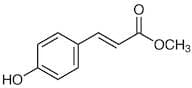
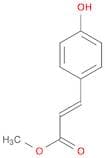
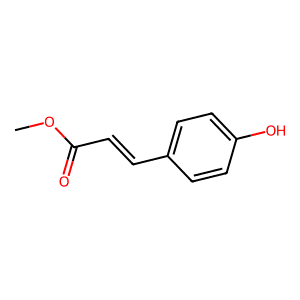
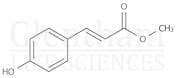
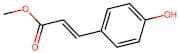
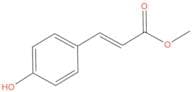
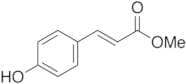
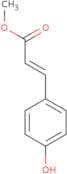
CAS 19367-38-5
:2-Propensäure, 3-(4-hydroxyphenyl)-, Methylester, (E)-
Beschreibung:
2-Propensäure, 3-(4-hydroxyphenyl)-, Methylester, (E)-, allgemein bekannt als Methyl 4-Hydroxycinnamat, ist eine organische Verbindung, die durch ihre Esterfunktionalgruppe und ein konjugiertes Doppelbindungssystem gekennzeichnet ist. Diese Verbindung weist eine Methoxygruppe auf, die an eine phenolische Struktur gebunden ist, was zu ihren potenziellen antioxidativen Eigenschaften beiträgt. Sie ist typischerweise eine farblose bis blassgelbe Flüssigkeit mit einem angenehmen Aroma, was sie in kosmetischen und duftenden Anwendungen nützlich macht. Die (E)-Konfiguration zeigt an, dass die Substituenten um die Doppelbindung auf gegenüberliegenden Seiten sind, was ihre Reaktivität und Interaktionen mit biologischen Systemen beeinflussen kann. Methyl 4-Hydroxycinnamat ist in organischen Lösungsmitteln löslich und zeigt eine moderate Löslichkeit in Wasser. Ihre chemische Struktur ermöglicht es ihr, an verschiedenen chemischen Reaktionen teilzunehmen, einschließlich Polymerisation und Veresterung. Darüber hinaus wurde sie auf ihre potenziellen gesundheitlichen Vorteile untersucht, einschließlich entzündungshemmender und antimikrobieller Aktivitäten. Wie bei vielen organischen Verbindungen sind eine ordnungsgemäße Handhabung und Sicherheitsvorkehrungen aufgrund ihrer potenziellen Reaktivität und Wirkungen unerlässlich.
Formel:C10H10O3
Synonyme:- methyl (2E)-3-(4-hydroxyphenyl)prop-2-enoate
- Methyl 4-hydroxyphenylacrylate
Sortieren nach
Reinheit (%)
0
100
|
0
|
50
|
90
|
95
|
100
12 Produkte.
Methyl trans-p-Coumarate
CAS:Formel:C10H10O3Reinheit:>98.0%(GC)Farbe und Form:White to Light yellow to Light orange powder to crystalMolekulargewicht:178.192-Propenoic acid, 3-(4-hydroxyphenyl)-, methyl ester, (2E)-
CAS:Formel:C10H10O3Reinheit:98%Farbe und Form:SolidMolekulargewicht:178.1846(E)-Methyl 4-coumarate
CAS:(E)-Methyl 4-coumarate (OMpCA) is a predicted metabolite generated by BioTransformer1 that is produced by the metabolism of methyl 3-phenylprop-2-enoate.Formel:C10H10O3Reinheit:99.68% - 99.97%Farbe und Form:White Crystal PowderMolekulargewicht:178.18Methyl 4-Hydroxy Cinnamate
CAS:Kontrolliertes ProduktApplications Cinnamic acid derivative used in structure-antifungal activity relationship study against Aspergillus flavus, Aspergillus terreus, and Aspergillus niger. An antifungal agent.
References Bisagno, F., et al.: J. Agric. Food Chem., 55, 10645 (2007),Formel:C10H10O3Farbe und Form:NeatMolekulargewicht:178.18Methyl 4-hydroxycinnamate
CAS:Methyl 4-hydroxycinnamate is a protocatechuic acid that can be produced by the reaction of hydrochloric acid and b16 mouse melanoma. This chemical has been shown to have an anti-inflammatory effect in rats with inflammatory bowel disease. Methyl 4-hydroxycinnamate is also a natural compound found in plants, such as celery, cinnamon, and apples. The mechanism of this chemical's action is unknown but it has been shown to inhibit the activity of rat liver microsomes. It is theorized that methyl 4-hydroxycinnamate may inhibit the production of proinflammatory substances by altering the membrane composition or activity of enzymes.br>br> br>br> Methyl 4-hydoxycinnamate may be synthesized from anhydrous sodium acetate and an acid complex in a model system using reaction solution. The product is then purified using column chromatography before being reacted with methylamine and sulfurFormel:C10H10O3Reinheit:Min. 95%Farbe und Form:PowderMolekulargewicht:178.18 g/mol(Methyl-d3) 4-Hydroxy Cinnamate
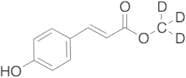
CAS:Kontrolliertes ProduktFormel:C10D3H7O3Farbe und Form:NeatMolekulargewicht:181.203