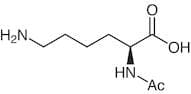
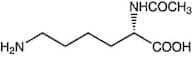
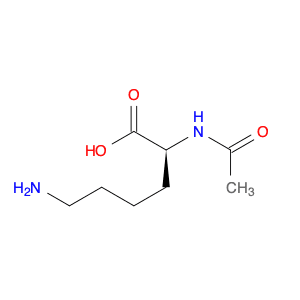
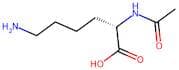
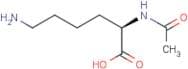
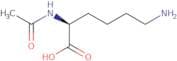
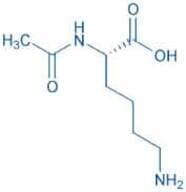
CAS 1946-82-3
:N-Acetyl-L-Lysin
Beschreibung:
N-Acetyl-L-Lysin ist ein Derivat der Aminosäure L-Lysin, das durch die Addition einer Acetylgruppe an die Aminogruppe von Lysin gekennzeichnet ist. Diese Modifikation verbessert die Löslichkeit in Wasser und verändert die biologische Aktivität. Die chemische Formel von N-Acetyl-L-Lysin ist C₆H₁₄N₂O₂, und es hat ein Molekulargewicht, das seine Zusammensetzung aus Kohlenstoff, Wasserstoff, Stickstoff und Sauerstoff widerspiegelt. Diese Verbindung wird häufig in der biochemischen Forschung verwendet und hat potenzielle Anwendungen in der Ernährung und Pharmazie, insbesondere in Studien zur Proteinsynthese und zum Stoffwechsel. N-Acetyl-L-Lysin ist bekannt dafür, eine Rolle in verschiedenen physiologischen Prozessen zu spielen, einschließlich der Funktion als Vorläufer für die Synthese von acetylierten Proteinen. Es wird allgemein als sicher für die Verwendung in Nahrungsergänzungsmitteln und Forschungsanwendungen angesehen. Wie bei vielen Aminosäurederivaten ist es wichtig, N-Acetyl-L-Lysin mit Vorsicht zu behandeln und die entsprechenden Sicherheitsprotokolle zu befolgen, um eine ordnungsgemäße Verwendung in Laborumgebungen zu gewährleisten.
Formel:C8H16N2O3
InChl:InChI=1S/C8H16N2O3/c1-6(11)10-7(8(12)13)4-2-3-5-9/h7H,2-5,9H2,1H3,(H,10,11)(H,12,13)/t7-/m0/s1
InChI Key:InChIKey=VEYYWZRYIYDQJM-ZETCQYMHSA-N
SMILES:[C@@H](CCCCN)(NC(C)=O)C(O)=O
Synonyme:- (2S)-2-Acetamido-6-aminohexanoic acid
- (2S)-6-Amino-2-acetamidohexanoic acid
- 6-Amino-<span class="text-smallcaps">L</span>-2-acetamidohexanoic acid
- <span class="text-smallcaps">L</span>-Lysine, N<sup>2</sup>-acetyl-
- Ac-Lys-Oh
- Lysine, N<sup>2</sup>-acetyl-, <span class="text-smallcaps">L</span>-
- N(alpha)-Acetyllysine
- N-Acetyl-<span class="text-smallcaps">L</span>-lysine
- N-acetyl-L-lysine
- N-alpha-Acetyl-L-lysine
- N<sup>2</sup>-Acetyl-<span class="text-smallcaps">L</span>-lysine
- N<sup>2</sup>-Acetyllysine
- N<sup>α</sup>-Acetyl-<span class="text-smallcaps">L</span>-lysine
- N<sup>α</sup>-Acetyllysine
- N~2~-acetyl-L-lysine
- Nα-Acetyl-L-lysine
- Lysine, N2-acetyl-, L-
- Nα-Acetyllysine
- N2-Acetyl-L-lysine
- Weitere Synonyme anzeigen
Sortieren nach
Reinheit (%)
0
100
|
0
|
50
|
90
|
95
|
100
12 Produkte.
Nα-Acetyl-L-lysine
CAS:Formel:C8H16N2O3Reinheit:>97.0%(T)(HPLC)Farbe und Form:White to Almost white powder to crystalineMolekulargewicht:188.23N(α)-Acetyl-L-lysine, 99%
CAS:N-Acetyl-L-lysine is a biologically available N-terminal capped form of the proteinogenic amino acid L-lysine. N-Acetyl-L-lysine is a substrate used to study and characterize lysyl oxidize(s). This Thermo Scientific Chemicals brand product was originally part of the Alfa Aesar product portfolio. SoFormel:C8H16N2O3Reinheit:99%Molekulargewicht:188.2Acetyl-L-lysine
CAS:Acetyl-L-lysine: N-acetylated amino acid, normally found in trace urine amounts, elevated in aminoacylase I deficiency.Formel:C8H16N2O3Reinheit:99.40% - 99.83%Farbe und Form:SolidMolekulargewicht:188.22Nα-Acetyl-L-Lysine
CAS:Applications Nα-Acetyl-L-Lysine is an antibacterial lysine analogue that targets lysine riboswitches. Nα-Acetyl-L-Lysine is used in the metabolomic characterization of ovarian epithelial carcinomas which allows for better therapeutic management of patients. The presence of Nα-Acetyl-L-Lysine and other N-acetylated amino acids in the urine can be used to detect aminoacylase I deficiency.
References Gerlo, E. et al.: Anal. Chim. Acta, 571, 191 (2006); Ben Sellem, D. et al.: J. Oncol., 174019, 9 (2011); Blount, K.F. et al.: Nat. Chem. Biol., 3, 44 (2007);Formel:C8H16N2O3Farbe und Form:NeatMolekulargewicht:188.22Nα-Acetyl-L-Lysine-13C6,15N2
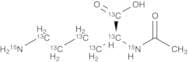
CAS:Kontrolliertes ProduktFormel:C6C2H1615N2O3Farbe und Form:NeatMolekulargewicht:196.167N-α-Acetyl-L-lysine
CAS:N-alpha-Acetyl-L-lysine is a reactive chemical that is used as an analytical method to measure the amount of aminotransferase activity in tissue samples. It reacts with the enzyme and produces a characteristic color change that can be quantified. This compound has been shown to cause lung damage in rats after inhalation and has been studied as a model system for bronchiolitis obliterans, which is caused by exposure to sulfur dioxide gas. N-alpha-Acetyl-L-lysine also binds to monoclonal antibody, which may lead to inhibition of protein synthesis. Titration calorimetry experiments have revealed a reaction mechanism for this compound involving the formation of a hydroxyl group from acetaldehyde via an intermediate hydroxide ion.Formel:C8H16N2O3Reinheit:Min. 95%Molekulargewicht:188.22 g/molAc-Lys-OH
CAS:Bachem ID: 4000486.
Formel:C8H16N2O3Reinheit:≥99%Farbe und Form:White PowderMolekulargewicht:188.23