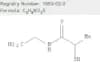
CAS 1953-02-2
:Tiopronin
Beschreibung:
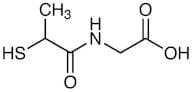
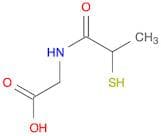
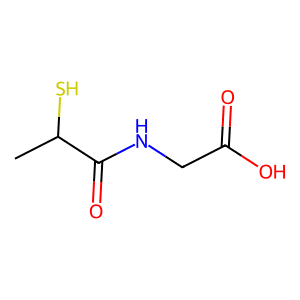
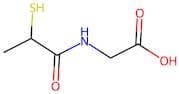
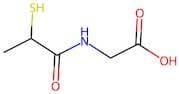
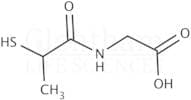
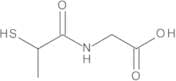
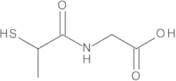
Tiopronin, mit der CAS-Nummer 1953-02-2, ist eine synthetische Thiolverbindung, die hauptsächlich als Medikament zur Behandlung von Cystinurie eingesetzt wird, einer genetischen Störung, die zur Bildung von Cystinsteinen in den Nieren führt. Es wirkt als Cystin-bindendes Mittel, das die Löslichkeit von Cystin im Urin fördert und somit die Steinbildung reduziert. Tiopronin zeichnet sich durch seine Fähigkeit aus, gemischte Disulfide mit Cystein zu bilden, was die Ausscheidung von Cystin verbessert. Die Verbindung wird typischerweise oral verabreicht und ist bekannt für ihr relativ niedriges Toxizitätsprofil. Neben seinen therapeutischen Anwendungen wurde Tiopronin auch auf seine potenziellen antioxidativen Eigenschaften untersucht, die auf die Anwesenheit der Thiolgruppe zurückzuführen sind, die freie Radikale abfangen kann. Seine chemische Struktur umfasst eine Thiol-Funktionelle Gruppe, die zu seiner Reaktivität und biologischen Aktivität beiträgt. Insgesamt ist Tiopronin ein wichtiges Mittel zur Behandlung von Cystinurie und hat Implikationen in breiteren biochemischen Forschungen im Zusammenhang mit der Thiolchemie.
Formel:C5H9NO3S
InChl:InChI=1S/C5H9NO3S/c1-3(10)5(9)6-2-4(7)8/h3,10H,2H2,1H3,(H,6,9)(H,7,8)
InChI Key:InChIKey=YTGJWQPHMWSCST-UHFFFAOYSA-N
SMILES:C(NCC(O)=O)(C(C)S)=O
Synonyme:- (.+-.)-Tiopronin
- (2-Mercaptopropionamido)acetic acid
- (2-Mercaptopropionyl)glycine
- 2-(2-Sulfanylpropanamido)acetic acid
- 2-(2-Sulfanylpropanoylamino)acetic acid
- <span class="text-smallcaps">DL</span>-(α-Mercaptopropionyl)glycine
- Acadione
- Brn 1859822
- Capen
- Captimer
- Ccris 1935
- DL-(α-Mercaptopropionyl)glycine
- Epatiol
- Glycine, N-(2-mercaptopropionyl)-
- Hepadigest
- MPG
- MPG (hepatoprotective)
- Meprin
- Meprin (detoxicant)
- Mercaptopropionylglycine
- Mucolysin
- N-(2-Mercapto-1-oxopropyl)glycine
- N-(2-Mercaptopropionyl)glycine
- N-(α-Mercaptopropionyl) glycine
- Sutilan
- Sutilan Cusi
- Thiola
- Thiolpropionamidoacetic acid
- Thiopronin
- Thiopronine
- Thiosol
- Tioglis
- Tiopronine
- Tiopronino
- Tioproninum
- Vincol
- α-Mercaptopropionyglycine
- α-Mercaptopropionylglycine
- Weitere Synonyme anzeigen
Sortieren nach
Reinheit (%)
0
100
|
0
|
50
|
90
|
95
|
100
12 Produkte.
Tiopronin
CAS:Formel:C5H9NO3SReinheit:>97.0%(GC)(T)Farbe und Form:White to Almost white powder to crystalMolekulargewicht:163.192-(2-sulfanylpropanamido)acetic acid
CAS:Formel:C5H9NO3SReinheit:98%Farbe und Form:SolidMolekulargewicht:163.1949Tiopronin
CAS:Tiopronin (Acadione), a sulfhydryl acylated derivative of glycine, leads to a reduction in urinary cystine concentration and subsequently reduces cystine stoneFormel:C5H9NO3SReinheit:97.19% - 98%Farbe und Form:SolidMolekulargewicht:163.19Tiopronin
CAS:Kontrolliertes ProduktApplications It is used as antidote against heavy metal poisoning; hepatoprotectant; mucolytic.
References Capasso, F., et al.: Agents Actions, 11, 741 (1981), Amor, B., et al.: Arthritis Rheum., 25, 698 (1982), Ichida, F., et al.: J. Int. Med. Res., 10, 325 (1982),Formel:C5H9NO3SFarbe und Form:NeatMolekulargewicht:163.19Tiopronin
CAS:Tiopronin is a drug that binds to the GSH-Px enzyme, which is responsible for breaking down hydrogen peroxide and lipid hydroperoxides. It also inhibits the ATP-binding cassette transporter, which is an important protein in the cell membrane that regulates the passage of substances into and out of cells. Tiopronin has been shown to inhibit chemiluminescence reactions in bacteria, such as infectious diseases. This drug has also been shown to be effective against hepatic steatosis by reducing fatty acid synthesis and increasing fatty acid oxidation in rats. Tiopronin has been used for the treatment of patients with Wilson's disease, because it facilitates copper excretion from liver cells by inhibiting metal chelate formation.Formel:C5H9NO3SReinheit:Min. 95%Farbe und Form:PowderMolekulargewicht:163.2 g/mol