CAS 197387-33-0
:Cyclohexanon, 4-(bromomethyl)-
Beschreibung:
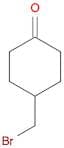
Cyclohexanon, 4-(bromomethyl)- ist eine organische Verbindung, die durch einen Cyclohexanonring mit einer bromomethylgruppe, die am vierten Kohlenstoffatom angebracht ist, gekennzeichnet ist. Es handelt sich um eine farblose bis blassgelbe Flüssigkeit mit einem charakteristischen Geruch, der typisch für Ketone ist. Die Anwesenheit der Bromomethylgruppe führt zu Reaktivität, was es zu einem nützlichen Zwischenprodukt in der organischen Synthese macht, insbesondere bei der Herstellung verschiedener Arzneimittel und Agrochemikalien. Diese Verbindung ist in organischen Lösungsmitteln wie Ethanol und Ether löslich, hat jedoch eine begrenzte Löslichkeit in Wasser aufgrund ihrer hydrophoben Cyclohexanstruktur. Zu seinen chemischen Eigenschaften gehört die Fähigkeit, nucleophile Substitutionsreaktionen aufgrund der elektrophilen Natur des Bromatoms durchzuführen. Darüber hinaus sind Cyclohexanon-Derivate für ihre Anwendungen in der Herstellung von Polymeren und als Lösungsmittel bekannt. Sicherheitsüberlegungen sollten berücksichtigt werden, da es Gesundheitsrisiken darstellen kann, wenn es eingeatmet oder eingenommen wird, und geeignete Handhabungsverfahren sollten befolgt werden, um die Exposition zu minimieren.
Formel:C7H11BrO
Synonyme:- 4-(bromomethyl)cyclohexanone
- Cyclohexanone, 4-(bromomethyl)-
- 4-(bromomethyl)cyclohexan-1-one
Sortieren nach
Reinheit (%)
0
100
|
0
|
50
|
90
|
95
|
100
4 Produkte.
Cyclohexanone, 4-(bromomethyl)-
CAS:Formel:C7H11BrOReinheit:97%Farbe und Form:SolidMolekulargewicht:191.06564-(Bromomethyl)cyclohexan-1-one
CAS:4-(Bromomethyl)cyclohexan-1-oneReinheit:96%Molekulargewicht:191.07g/mol4-(Bromomethyl)cyclohexan-1-one
CAS:<p>The bis-Grignard reagent, also known as a bifunctional organometallic compound, is an organic chemistry reactive intermediate used in the synthesis of diverse organic molecules. This type of reagent is prepared by the reaction of a magnesium halide with an alkyl or aryl halide. The Grignard reagent reacts with electrophiles to form carbon-carbon bonds. The catellani reaction is an example of this type of reaction. A new method for the efficient synthesis of 4-(bromomethyl)cyclohexan-1-one has been developed using a cross-coupling strategy and a phosphine ligand. This process begins with the formation of a palladium catalyst via oxidative addition, followed by nucleophilic displacement with methyl iodide to give 4-(bromomethyl)cyclohexan-1-one in high yield and excellent purity.</p>Formel:C7H11BrOReinheit:Min. 95%Molekulargewicht:191.07 g/mol