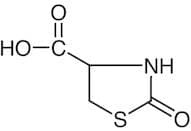
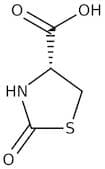
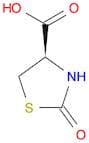
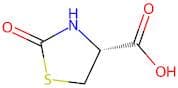
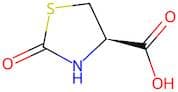
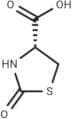
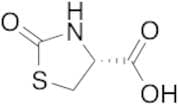
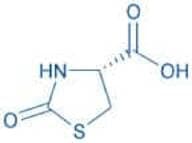
CAS 19771-63-2
:Procystein
Beschreibung:
Procystein, mit der CAS-Nummer 19771-63-2, ist ein synthetisches Aminosäurederivat von Cystein. Es ist durch das Vorhandensein einer Thiolgruppe (-SH) gekennzeichnet, die entscheidend für seine biochemischen Eigenschaften ist, insbesondere in Redoxreaktionen und der Stabilisierung der Proteinstruktur. Procystein ist bekannt für seine potenziellen antioxidativen Eigenschaften, da es bei der Neutralisierung von freien Radikalen helfen kann. Diese Verbindung wird häufig wegen ihrer Rolle in zellulären Prozessen, einschließlich der Proteinsynthese und der Entgiftungswege, untersucht. Darüber hinaus kann Procystein Implikationen für therapeutische Anwendungen haben, insbesondere bei Bedingungen, die mit oxidativem Stress verbunden sind. Seine Löslichkeit in Wasser und die Fähigkeit, Disulfidbindungen zu bilden, erhöhen seine biologische Relevanz weiter. Wie viele Aminosäuren kann Procystein an verschiedenen Stoffwechselwegen teilnehmen, was es zu einem interessanten Thema sowohl in der biochemischen Forschung als auch in der pharmazeutischen Entwicklung macht. Die spezifischen Anwendungen und Wirkungen können jedoch variieren, und laufende Forschungen untersuchen weiterhin sein volles Potenzial im Kontext von Gesundheit und Krankheit.
Formel:C4H5NO3S
InChl:InChI=1S/C4H5NO3S/c6-3(7)2-1-9-4(8)5-2/h2H,1H2,(H,5,8)(H,6,7)/t2-/m0/s1
InChI Key:InChIKey=BMLMGCPTLHPWPY-REOHCLBHSA-N
SMILES:C(O)(=O)[C@H]1NC(=O)SC1
Synonyme:- (-)-2-Oxo-4-thiazolidinecarboxylic acid
- (4R)-2-Oxo-1,3-thiazolidine-4-carboxylic acid
- (4R)-2-Oxo-4-thiazolidinecarboxylic acid
- (4R)-2-Oxothiazolidine-4-carboxylic acid
- (R)-(-)-2-Oxothiazolidine-4-carboxylic acid
- 2-Oxo-<span class="text-smallcaps">L</span>-thiazolidine-4-carboxylic acid
- 4-Thiazolidinecarboxylic acid, 2-oxo-, (4R)-
- 4-Thiazolidinecarboxylic acid, 2-oxo-, (R)-
- 4-Thiazolidinecarboxylic acid, 2-oxo-, <span class="text-smallcaps">L</span>-
- <span class="text-smallcaps">L</span>-2-Oxo-4-thiazolidinecarboxylic acid
- L-(-)-2-Oxo-4-thiazolidinecarboxylic Acid
- L-2-Thiazolidinone-4-carboxylic acid
- R-2-Oxo-1,3-thiazolidine-4-carboxylic acid
- Weitere Synonyme anzeigen
Sortieren nach
Reinheit (%)
0
100
|
0
|
50
|
90
|
95
|
100
11 Produkte.
L-2-Thiazolidinone-4-carboxylic Acid
CAS:Formel:C4H5NO3SReinheit:>97.0%(T)(HPLC)Farbe und Form:White to Almost white powder to crystalMolekulargewicht:147.15(R)-(-)-2-Oxothiazolidine-4-carboxylic acid
CAS:Reagent for hepatic glutathione studiesFormel:C4H5NO3SFarbe und Form:White, Crystals or crystalline powderMolekulargewicht:147.154-Thiazolidinecarboxylic acid, 2-oxo-, (4R)-
CAS:Formel:C4H5NO3SReinheit:95%Farbe und Form:SolidMolekulargewicht:147.1524(R)-2-Oxothiazolidine-4-Carboxylic Acid
CAS:(R)-2-Oxothiazolidine-4-Carboxylic AcidReinheit:98%Molekulargewicht:147.15g/molOxothiazolidinecarboxylic acid
CAS:Oxothiazolidinecarboxylic acidReinheit:≥95%Molekulargewicht:147.15g/molOxothiazolidinecarboxylic acid
CAS:Oxothiazolidinecarboxylic acid (Procysteine) is a precursor to glutathione (GSH) which is an important antioxidant in plants, animals, and fungi.Formel:C4H5NO3SReinheit:98.33% - 98.8%Farbe und Form:White To Off-White PowderMolekulargewicht:147.15(4R)-2-oxo-1,3-thiazolidine-4-carboxylic acid
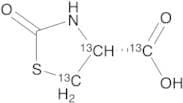
CAS:Formel:C4H5NO3SReinheit:95%Farbe und Form:SolidMolekulargewicht:147.15(R)-(-)-2-Oxothiazolidine-4-carboxylic-13C3 Acid
CAS:Kontrolliertes ProduktApplications Isotope labelled (R)-(-)-2-Oxothiazolidine-4-carboxylic Acid (O870505), a precursor to glutathione (GSH) which is an important antioxidant in plants, animals and fungi.
References Meister, A., et al,: J. Am. Coll. Nutr., 5, 137 (1986);Formel:C3CH5NO3SFarbe und Form:NeatMolekulargewicht:150.13(R)-(-)-2-Oxothiazolidine-4-carboxylic Acid
CAS:Kontrolliertes ProduktFormel:C4H5NO3SFarbe und Form:NeatMolekulargewicht:147.15L-2-Oxothiazolidine-4-carboxylic acid
CAS:A strong antioxidant and a cysteine prodrug. OTC, a 5-oxoproline analog, is metabolized by 5-oxoprolinase and converted to cysteine, the rate-limiting amino acid for glutathione synthesis. It may therefore be useful in restoring depleted glutathione stores in HIV-1-infected persons, which may in turn inhibit the progression of HIV disease. OTC may be inserted in place of Pyr. The chemical behaviour of OTC was studied by MacLaren. OTC was employed in the total synthesis of Latrunculin A.
Formel:C4H5NO3SReinheit:> 99%Farbe und Form:White PowderMolekulargewicht:147.16