CAS 1988-11-0
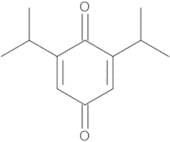
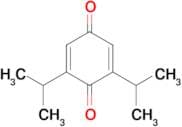
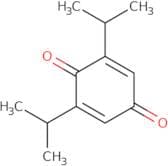
:2,6-Diisopropyl-1,4-benzochinon
Beschreibung:
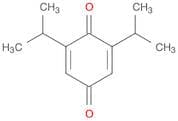
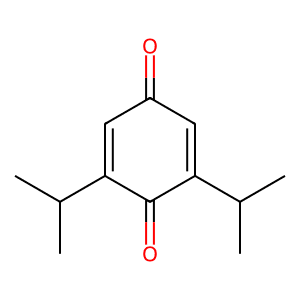
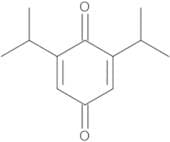
2,6-Diisopropyl-1,4-benzochinon ist eine organische Verbindung, die durch ihre Chinonstruktur gekennzeichnet ist, die einen sechsgliedrigen aromatischen Ring mit zwei an den Positionen 2 und 6 angehängten Isopropylgruppen aufweist. Diese Verbindung ist bekannt für ihre leuchtend gelbe Farbe und wird typischerweise in der organischen Synthese und als Reagenz in verschiedenen chemischen Reaktionen verwendet. Sie weist aufgrund der Anwesenheit der Chinon-Funktion starke oxidierende Eigenschaften auf, die es ihr ermöglichen, an Redoxreaktionen teilzunehmen. Die Verbindung ist unter Standardbedingungen relativ stabil, kann jedoch je nach Umgebung und vorhandenen Reaktanten weiteren Reaktionen wie Polymerisation oder Reduktion unterliegen. Ihre Löslichkeit ist in der Regel in organischen Lösungsmitteln höher als in Wasser, was sie für Anwendungen in der organischen Chemie geeignet macht. Darüber hinaus kann 2,6-Diisopropyl-1,4-benzochinon Auswirkungen auf biologische Systeme haben, wo sie als Elektronenakzeptor fungieren kann. Sicherheitsvorkehrungen sollten beim Umgang mit dieser Verbindung getroffen werden, da sie gesundheitliche Risiken darstellen kann, wenn sie eingeatmet oder eingenommen wird.
Formel:C12H16O2
InChl:InChI=1S/C12H16O2/c1-7(2)10-5-9(13)6-11(8(3)4)12(10)14/h5-8H,1-4H3
InChI Key:InChIKey=DDXYWFGBQZICBD-UHFFFAOYSA-N
SMILES:C(C)(C)C=1C(=O)C(C(C)C)=CC(=O)C1
Synonyme:- 2,3-Diisopropyl-p-benzoquinone
- 2,5-Cyclohexadiene-1,4-dione, 2,6-bis(1-methylethyl)-
- 2,6-Bis(1-methylethyl)-2,5-cyclohexadiene-1,4-dione
- 2,6-Bis(propan-2-yl)cyclohexa-2,5-diene-1,4-dione
- 2,6-Di(propan-2-yl)cyclohexa-2,5-diene-1,4-dione
- 2,6-Diisopropyl-1,4-benzoquinone
- 2,6-Diisopropyl-p-benzoquinone
- 2,6-Diisopropylcyclohexa-2,5-diene-1,4-dione
- p-Benzoquinone, 2,6-diisopropyl-
Sortieren nach
Reinheit (%)
0
100
|
0
|
50
|
90
|
95
|
100
12 Produkte.
Propofol impurity J
CAS:Propofol impurity JFormel:C12H16O2Farbe und Form:YellowMolekulargewicht:192.2542Propofol Related Compound B (2,6-Diisopropyl-1,4-benzoquinone)
CAS:Other quinonesFormel:C12H16O2Farbe und Form:Yellow LiquidMolekulargewicht:192.115032,5-Cyclohexadiene-1,4-dione, 2,6-bis(1-methylethyl)-
CAS:Formel:C12H16O2Reinheit:95%Farbe und Form:LiquidMolekulargewicht:192.25422,6-Diisopropylcyclohexa-2,5-diene-1,4-dione
CAS:2,6-Diisopropylcyclohexa-2,5-diene-1,4-dioneReinheit:95%Molekulargewicht:192.26g/mol2,6-Diisopropyl-1,4-benzoquinone
CAS:Impurity Propofol EP Impurity J
Applications 2,6-Diisopropyl-1,4-benzoquinone (Propofol EP Impurity J) is a Propofol (P829750) impurity.
Not a dangerous good if item is equal to or less than 1g/ml and there is less than 100g/ml in the package
References McMahon, R., et al.: J. Med. Chem., 22, 1100 (1979), Mamada, K., et al.: Drug Metab. Dispos., 14, 509 (1986),Formel:C12H16O2Farbe und Form:NeatMolekulargewicht:192.252,6-Diisopropyl-1,4-benzoquinone
CAS:2,6-Diisopropyl-1,4-benzoquinone is a diphenol that reacts with a variety of organic compounds in the presence of heat. It has been used as a mesoporous material to adsorb hydrogen gas and carbon dioxide in the water treatment process. 2,6-Diisopropyl-1,4-benzoquinone is also able to react with oxygen to form an n-oxide. This compound is most often used for the manufacture of phenolic antioxidants such as dibenzoyl peroxide and pentafluorobenzoic acid. The active site on this molecule is thought to be at the double bond between carbons 6 and 7. Impurities may include anisidine and other aromatic amines that can cause reactions with hydrogen peroxide when exposed to light or certain wavelengths of radiation.Formel:C12H16O2Reinheit:Min. 95%Molekulargewicht:192.25 g/mol