CAS 20125-39-7
:N6-(2-phenylethyl)adenosin
Beschreibung:
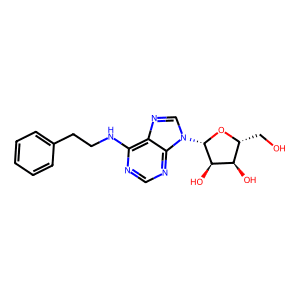
N6-(2-phenylethyl)adenosin ist ein modifiziertes Nukleosidderivat von Adenosin, das durch die Substitution einer 2-Phenylethylgruppe am Stickstoffatom in der N6-Position der Adeninbasis gekennzeichnet ist. Diese Modifikation verbessert seine biologische Aktivität und Rezeptorselektivität, insbesondere gegenüber Adenosinrezeptoren, die an verschiedenen physiologischen Prozessen beteiligt sind, einschließlich Neurotransmission, Entzündung und kardiovaskulärer Regulation. Die Verbindung weist Eigenschaften auf, die typisch für Adenosinanaloga sind, wie potenzielle entzündungshemmende und neuroprotektive Effekte. Ihre Struktur ermöglicht eine erhöhte Lipophilie, die ihre Pharmakokinetik und Bioverfügbarkeit beeinflussen kann. N6-(2-phenylethyl)adenosin ist von Interesse in der pharmakologischen Forschung, insbesondere im Kontext der Entwicklung therapeutischer Wirkstoffe, die auf Adenosinrezeptoren abzielen, für Erkrankungen wie Schmerzen, Angstzustände und neurodegenerative Krankheiten. Wie bei vielen Nukleosidanaloga umfasst die Synthese und Charakterisierung Standardtechniken der organischen Chemie, und sie kann hinsichtlich ihrer Wechselwirkungen mit verschiedenen biologischen Systemen untersucht werden.
Formel:C18H21N5O4
InChl:InChI=1/C18H21N5O4/c24-8-12-14(25)15(26)18(27-12)23-10-22-13-16(20-9-21-17(13)23)19-7-6-11-4-2-1-3-5-11/h1-5,9-10,12,14-15,18,24-26H,6-8H2,(H,19,20,21)
SMILES:c1ccc(cc1)CCNc1c2c(ncn1)n(cn2)C1C(C(C(CO)O1)O)O
Synonyme:- 9-pentofuranosyl-N-(2-phenylethyl)-9H-purin-6-amine
Sortieren nach
Reinheit (%)
0
100
|
0
|
50
|
90
|
95
|
100
4 Produkte.
N6-(2-Phenylethyl)adenosine
CAS:Formel:C18H21N5O4Reinheit:≥ 95.0%Farbe und Form:White to off-white powderMolekulargewicht:371.39N6-(2-Phenylethyl)adenosine
CAS:N6-(2-Phenylethyl)adenosine (N6-PEA) is an adenosine analogue that is a chemosensitive agent. It has been shown to inhibit cancer cell growth and to induce apoptosis in vitro. N6-PEA binds to the adenosine receptor and blocks viral replication, including human pathogens such as herpes simplex virus type 1 and 2, cytomegalovirus, and varicella zoster virus. N6-PEA also has antiviral effects against HIV type 1 in cell-based assays. It is hydrophobic and binds to the adenosine receptor with high affinity. N6-PEA was modeled using molecular dynamics simulations with a combination of computational chemistry techniques, which revealed its binding mode at the adenosine receptor site.
Formel:C18H21N5O4Reinheit:Min. 95%Molekulargewicht:371.39 g/molN6-(2-Phenylethyl)adenosine
CAS:N6-(2-Phenylethyl)adenosine (N6-Phenethyladenosine) is an adenosine derivative and an agonist of adenosine receptors with Ki values of 11.8 nM and 30.1 nM forFormel:C18H21N5O4Reinheit:99.83%Farbe und Form:SolidMolekulargewicht:371.39