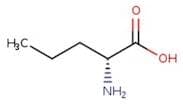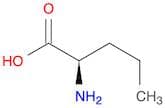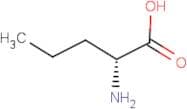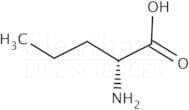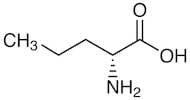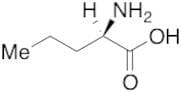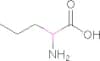
CAS 2013-12-9
:D-Norvalin
Beschreibung:
D-Norvalin ist eine nicht-proteinogene Aminosäure, was bedeutet, dass sie während der Translation nicht in Proteine eingebaut wird. Sie ist ein Isomer von Valin, das sich in der Anordnung seiner Kohlenstoffkette unterscheidet. D-Norvalin zeichnet sich durch seine verzweigte Kettenstruktur aus, die eine Seitenkette umfasst, die zu seinen hydrophoben Eigenschaften beiträgt. Diese Aminosäure wird oft wegen ihrer potenziellen Rolle in verschiedenen biologischen Prozessen untersucht, einschließlich ihrer Auswirkungen auf die Aktivität der Stickstoffmonoxid-Synthase und ihrer Implikationen im Muskelstoffwechsel. D-Norvalin wird auch für seine potenzielle Verwendung als Nahrungsergänzungsmittel hervorgehoben, insbesondere im Kontext von Bodybuilding und sportlicher Leistung, aufgrund seiner Fähigkeit, den Blutfluss und die Nährstoffzufuhr zu beeinflussen. In Bezug auf die Löslichkeit ist D-Norvalin im Allgemeinen in Wasser löslich, was es für verschiedene Anwendungen in der biochemischen Forschung und Supplementierung geeignet macht. Wie bei vielen Aminosäuren ist es wichtig, seine Stereochemie zu berücksichtigen, da die D- und L- Formen unterschiedliche biologische Aktivitäten aufweisen können.
Formel:C5H11NO2
InChl:InChI=1S/C5H11NO2/c1-2-3-4(6)5(7)8/h4H,2-3,6H2,1H3,(H,7,8)/t4-/m1/s1
InChI Key:InChIKey=SNDPXSYFESPGGJ-SCSAIBSYSA-N
SMILES:[C@@H](CCC)(C(O)=O)N
Synonyme:- (2R)-2-aminopentanoic acid
- (R)-2-Aminopentanoic acid
- (R)-Norvaline
- <span class="text-smallcaps">D</span>-Norvaline
- <span class="text-smallcaps">D</span>-α-Aminovaleric acid
- D-(-)-2-Aminovaleric acid
- Norvaline, <span class="text-smallcaps">D</span>-
- D-Norvaline
- Norvaline, D-
- D-α-Aminovaleric acid
Sortieren nach
Reinheit (%)
0
100
|
0
|
50
|
90
|
95
|
100
9 Produkte.
D-Norvaline, 99%
CAS:This Thermo Scientific Chemicals brand product was originally part of the Alfa Aesar product portfolio. Some documentation and label information may refer to the legacy brand. The original Alfa Aesar product / item code or SKU reference has not changed as a part of the brand transition to Thermo SciFormel:C5H11NO2Reinheit:99%Farbe und Form:White, Crystals or powder or crystalline powderMolekulargewicht:117.15D-Norvaline
CAS:Formel:C5H11NO2Reinheit:>99.0%(T)Farbe und Form:White to Almost white powder to crystalMolekulargewicht:117.15D-Norvaline
CAS:Formel:C5H11NO2Reinheit:99.0%Farbe und Form:Powder or Crystalline Powder or GranulesMolekulargewicht:117.148D-Norvaline
CAS:Applications D-Norvaline is used as a catalyst in the enantioselective α-bromination of carbonyl and 1,3-dicarbonyl compounds. D-Norvaline is also incorporated into jadomycins (a group of compounds that are widely used as antibiotics), ultimately producing compounds that have potential antiproliferative/anti-cancer properties.
References Doull, J., et al.: J. Ind. Micro., 13, 120 (1994); Dupuis, S., et al.: J. Nat. Prod., 74, 2420 (2011); Goswami, P., et al.: Adv. Synth. Catal., 351, 1483 (2009)Formel:C5H11NO2Farbe und Form:NeatMolekulargewicht:117.146D-Norvaline
CAS:D-Norvaline is a chemical compound that is used as a building block for the synthesis of complex compounds. D-Norvaline is an important intermediate in the synthesis of many fine chemicals and pharmaceuticals, such as L-DOPA, which is used to treat Parkinson's disease. As it is a versatile building block, it can be used in the synthesis of complex compounds with high purity. It also has a CAS number 2013-12-9.Formel:C5H11NO2Molekulargewicht:117.15 g/molRef: 3D-N-9000
1kgNachfragen100gNachfragen250gNachfragen500gNachfragen2500gNachfragen-Unit-ggNachfragenD-Norvaline
CAS:D-Norvaline is a non-protein amino acid that is an intermediate in the biosynthesis of L-norvaline. It is synthesized from D-alanine by the racemase enzyme and converted to L-norvaline by the hydrolysis of an acetyl group. D-Norvaline has shown inhibitory effects on gamma-aminobutyric acid (GABA) and chloride ion channels, which may be helpful for treating t2d patients. Norvaline binds to GABA with high affinity and inhibits the opening of chloride ion channels in the central nervous system.Formel:C5H11NO2Reinheit:Min. 95%Farbe und Form:White PowderMolekulargewicht:117.15 g/mol