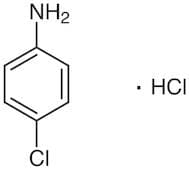
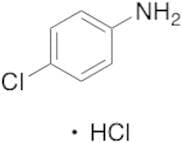
CAS 20265-96-7
:4-Chloranilin-hydrochlorid
- 4-Chloroaniline monohydrochloride
- 4-Chloroanilinium chloride
- 4-Chlorobenzenamine Hydrochloride
- 4-Chlorophenylammonium chloride
- Aniline, p-chloro-, hydrochloride
- Benzenamine, 4-chloro-, hydrochloride
- Benzenamine, 4-chloro-, hydrochloride (1:1)
- p-Chloroaniline hydrochloride
- p-Chloroanilinium chloride
- p-Chlorophenylamine hydrochloride
4-Chloroaniline Hydrochloride
CAS:Formel:C6H6ClN·HClReinheit:>98.0%(T)(HPLC)Farbe und Form:White to Almost white powder to crystalMolekulargewicht:164.03Benzenamine, 4-chloro-, hydrochloride
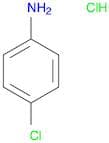
CAS:Formel:C6H7Cl2NReinheit:98%Farbe und Form:SolidMolekulargewicht:164.0325Chloroaniline hydrochloride
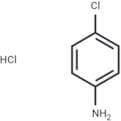
CAS:Chloroaniline hydrochloride is an aniline derivative widely used in biochemical experiments and drug synthesis research.Formel:C6H7Cl2NReinheit:99.91%Farbe und Form:SolidMolekulargewicht:164.034-Chloroaniline hydrochloride
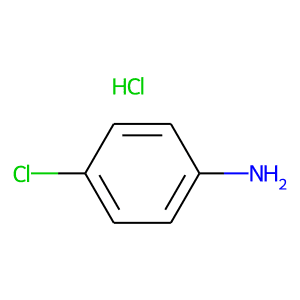
CAS:4-Chloroaniline hydrochlorideFormel:C6H6ClN·ClHReinheit:98%Farbe und Form: off-white solidMolekulargewicht:164.03g/molp-Chloroaniline Hydrochloride
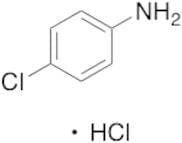
CAS:Kontrolliertes ProduktApplications p-Chloroaniline Hydrochloride
Not a dangerous good if item is equal to or less than 1g/ml and there is less than 100g/ml in the packageFormel:C6H6ClN·ClHFarbe und Form:NeatMolekulargewicht:164.034-chloroaniline hydrochloride
CAS:Kontrolliertes ProduktFormel:C6H6ClN·ClHFarbe und Form:White To Off-WhiteMolekulargewicht:164.03p-Chloroaniline-d4 Deuterium Chloride
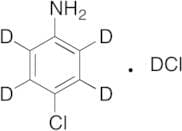
CAS:Kontrolliertes ProduktApplications p-Chloroaniline-d4 Deuterium Chloride is an intermediate in synthesizing N1-(4-chlorophenyl)-3,12-diimino-N14-2-chlorophenyl-2,4,11,13-Tetraazatetradecanediimidamide-d4 (C377537), an isotope labelled analog of N1-(4-chlorophenyl)-3,12-diimino-N14-2-chlorophenyl-2,4,11,13-Tetraazatetradecanediimidamide. N1-(4-chlorophenyl)-3,12-diimino-N14-2-chlorophenyl-2,4,11,13-Tetraazatetradecanediimidamide is an impurity of Chlorhexidine Digluconate (C292770). Chlorhexidine gluconate is an antimicrobial irrigant that is used as an antiseptic for the skin in the healthcare industry. It is used in hospitals to prevent infection of patients during surgeries and can also be found in mouth rinses.
References Addy, M. & Wright, R.: J. Clin. Periodont., 5, 198 (1978); Kuruvilla, J. & Kamath, M.: J. Endododont., 24, 472 (1998); Maki, D., et al.: Lancet, 338, 339 (1991); Popovich, K., et al.: Inf. Cont. Hosp. Epidem., 30, 959 (2009); Rosenberg, A., et al.: Surg. Gyn. Obst., 143, 789 (1976)Formel:C6H2D4ClN•DClFarbe und Form:NeatMolekulargewicht:169.06p-Chloroaniline-d4 Deuterium Chloride
CAS:p-Chloroaniline-d4 Deuterium Chloride is a polymerase chain reaction (PCR) reagent that is used for the detection of DNA. The long-term toxicity, toxicological studies, genotoxic effects, conformational properties, biochemical properties and locomotor activity of this compound are still not fully understood. This chemical has been shown to be carcinogenic in rats that were exposed to high doses. p-Chloroaniline-d4 Deuterium Chloride can also be used as a wastewater treatment agent. It binds to potassium dichromate and forms an insoluble precipitate which can then be removed by filtration. The reaction mechanism of this compound is not yet known.
Formel:C6H2D4ClN·DClReinheit:Min. 95%Molekulargewicht:131.6 g/mol