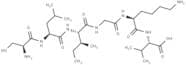
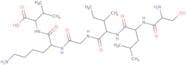
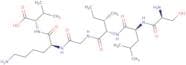
CAS 202933-49-1
:H-Ser-Leu-Ile-Gly-Lys-Val-Oh
Beschreibung:
Die chemische Substanz, die als H-Ser-Leu-Ile-Gly-Lys-Val-Oh bekannt ist, mit der CAS-Nummer 202933-49-1, ist ein Peptid, das aus einer Sequenz von Aminosäuren besteht. Dieses Peptid weist eine Kombination aus hydrophilen und hydrophoben Resten auf, was zu seiner potenziellen biologischen Aktivität und Interaktionen beiträgt. Das Vorhandensein von Serin (Ser), Leucin (Leu), Isoleucin (Ile), Glycin (Gly), Lysin (Lys) und Valin (Val) weist auf eine Vielzahl von Eigenschaften hin, einschließlich der Fähigkeit, an Wasserstoffbrückenbindungen und hydrophoben Interaktionen teilzunehmen. Die terminale Hydroxylgruppe (OH) deutet darauf hin, dass es eine verbesserte Löslichkeit in wässrigen Umgebungen haben könnte. Peptide wie dieses können eine bedeutende Rolle in verschiedenen biologischen Prozessen spielen, einschließlich Signalwegen und Enzymfunktionen. Darüber hinaus kann die spezifische Sequenz der Aminosäuren die Konformation, Stabilität und Reaktivität des Peptids beeinflussen, was es in Bereichen wie Biochemie, Pharmakologie und Biotechnologie von Interesse macht. Weitere Studien wären erforderlich, um seine spezifischen Funktionen und Anwendungen zu klären.
Sortieren nach
Reinheit (%)
0
100
|
0
|
50
|
90
|
95
|
100
4 Produkte.
PAR-2 (1-6) (human)
CAS:PAR-2 (1-6) (human) (SLIGKV), a peptide ligand, is a PAR-2 agonist [1] .Formel:C28H53N7O8Farbe und Form:SolidMolekulargewicht:615.76H-Ser-Leu-Ile-Gly-Lys-Val-OH
CAS:H-Ser-Leu-Ile-Gly-Lys-Val-OH is a potent inhibitor of the enzyme soybean trypsin. It is a member of the class of chemical inhibitors that are active against enzymes that regulate cell signaling and inflammatory responses. H-Ser-Leu-Ile-Gly-Lys-Val-OH inhibits toll receptor signaling, which triggers an inflammatory response in cells. This compound has been shown to be effective in animal models for bowel disease and asthma. H Ser Leu Ile Gly Lys Val OH also has low potency, which may be due to its ability to form covalent bonds with other molecules, such as DNA polymerase.Formel:C28H53N7O8Reinheit:Min. 95%Molekulargewicht:615.76 g/molPAR-2 (1-6) (human) trifluoroacetate salt
CAS:PAR-2 is a cytosolic protein that is activated by calcium. PAR-2 activation induces the synthesis of prostaglandins and other inflammatory mediators, which stimulate the release of substances from cells such as cytokines and chemokines. PAR-2 also has an important role in cell proliferation, differentiation, apoptosis, and cancer development. PAR-2 activation is induced by proteases such as trypsin or soybean trypsin inhibitor. The trifluoroacetate salt form of PAR-2 (1-6) has been used to inhibit protease activity in colon cancer cells and prostate cancer cells. PAR-2 (1-6) (human) trifluoroacetate salt H-Ser-Leu-Ile-Gly-Lys-Val-OH trifluoroacetate salt is a potent chemical inhibitor of trypsin activity with IC50 values of 0.5 µM for soybean trypsin inhibitorFormel:C28H53N7O8Reinheit:Min. 95%Molekulargewicht:615.76 g/molPAR-2 (1-6) (human)
CAS:The PAR-2 agonist SLIGKV can be used for the investigation of receptor functions.
Formel:C28H53N7O8Reinheit:98.6%Farbe und Form:White LyophilisateMolekulargewicht:615.77