CAS 20316-62-5
:Tilirosid
Beschreibung:
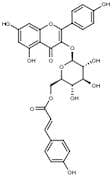
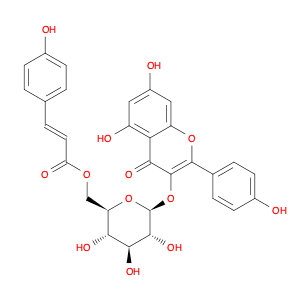
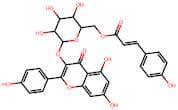
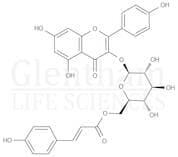
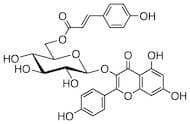
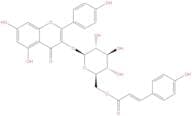
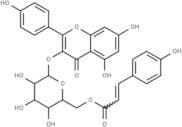
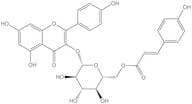
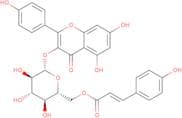
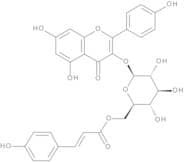
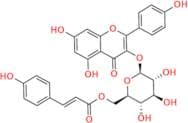
Tilirosid ist ein Flavonoidglycosid, das hauptsächlich in verschiedenen Pflanzen vorkommt, insbesondere in der Gattung Tilia (Lindenbäume) und anderen Heilkräutern. Es ist durch seine Struktur gekennzeichnet, die aus einem Flavonoid-Aglykon besteht, das an eine Zuckereinheit, typischerweise Glukose, gebunden ist. Tilirosid zeigt mehrere biologische Aktivitäten, einschließlich antioxidativer, entzündungshemmender und potenziell kardioprotektiver Wirkungen, was es in der pharmakologischen Forschung von Interesse macht. Seine antioxidativen Eigenschaften werden seiner Fähigkeit zugeschrieben, freie Radikale zu scavengen, die zu Zellschäden und verschiedenen Krankheiten beitragen können. Darüber hinaus wurde Tilirosid auf seine potenzielle Rolle bei der Modulation von Stoffwechselprozessen und seine Auswirkungen auf die Herz-Kreislauf-Gesundheit untersucht. Die Verbindung wird im Allgemeinen als sicher angesehen, aber ihre Bioverfügbarkeit und Wirksamkeit können je nach Quelle und Extraktionsmethode variieren. Während die Forschung fortschreitet, könnte Tilirosid Einblicke in natürliche therapeutische Mittel und deren Anwendungen in Gesundheit und Wohlbefinden bieten.
Formel:C30H26O13
InChl:InChI=1S/C30H26O13/c31-16-6-1-14(2-7-16)3-10-22(35)40-13-21-24(36)26(38)27(39)30(42-21)43-29-25(37)23-19(34)11-18(33)12-20(23)41-28(29)15-4-8-17(32)9-5-15/h1-12,21,24,26-27,30-34,36,38-39H,13H2/b10-3+/t21-,24-,26+,27-,30+/m1/s1
InChI Key:InChIKey=DVGGLGXQSFURLP-VWMSDXGPSA-N
SMILES:O(C1=C(OC=2C(C1=O)=C(O)C=C(O)C2)C3=CC=C(O)C=C3)[C@@H]4O[C@H](COC(/C=C/C5=CC=C(O)C=C5)=O)[C@@H](O)[C@H](O)[C@H]4O
Synonyme:- (2E)-3-(4-Hydroxyphényl)acrylate de [(2R,3S,4S,5R,6S)-6-{[5,7-dihydroxy-2-(4-hydroxyphényl)-4-oxo-4H-chromén-3-yl]oxy}-3,4,5-trihydroxytétrahydro-2H-pyran-2-yl]méthyle
- 2-Propenoic acid, 3-(4-hydroxyphenyl)-, 6′-ester with 3-(β-<span class="text-smallcaps">D</span>-glucopyranosyloxy)-5,7-dihydroxy-2-(4-hydroxyphenyl)-4H-1-benzopyran-4-one, (E)-
- 20316-62-5
- 3-O-Kaempferol 6-O-(trans-p-coumaroyl)-β-<span class="text-smallcaps">D</span>-glucopyranoside
- 4H-1-Benzopyran-4-one, 5,7-dihydroxy-2-(4-hydroxyphenyl)-3-[[6-O-[(2E)-3-(4-hydroxyphenyl)-1-oxo-2-propen-1-yl]-β-<span class="text-smallcaps">D</span>-glucopyranosyl]oxy]-
- 4H-1-Benzopyran-4-one, 5,7-dihydroxy-2-(4-hydroxyphenyl)-3-[[6-O-[(2E)-3-(4-hydroxyphenyl)-1-oxo-2-propenyl]-.beta.-D-glucopyranosyl]oxy]-
- 4H-1-Benzopyran-4-one, 5,7-dihydroxy-2-(4-hydroxyphenyl)-3-[[6-O-[(2E)-3-(4-hydroxyphenyl)-1-oxo-2-propenyl]-β-<span class="text-smallcaps">D</span>-glucopyranosyl]oxy]-
- 4H-1-Benzopyran-4-one, 5,7-dihydroxy-2-(4-hydroxyphenyl)-3-[[6-O-[3-(4-hydroxyphenyl)-1-oxo-2-propenyl]-β-<span class="text-smallcaps">D</span>-glucopyranosyl]oxy]-, (E)-
- 5,7-Dihydroxy-2-(4-hydroxyphenyl)-3-[[6-O-[(2E)-3-(4-hydroxyphenyl)-1-oxo-2-propen-1-yl]-β-<span class="text-smallcaps">D</span>-glucopyranosyl]oxy]-4H-1-benzopyran-4-one
- 5,7-Dihydroxy-2-(4-hydroxyphenyl)-4-oxo-4H-chromen-3-yl 6-O-[(2E)-3-(4-hydroxyphenyl)-2-propenoyl]-beta-D-glucopyranoside
- 5,7-Dihydroxy-2-(4-hydroxyphenyl)-4-oxo-4H-chromen-3-yl 6-O-[(2E)-3-(4-hydroxyphenyl)prop-2-enoyl]-b-D-glucopyranoside
- 5,7-Dihydroxy-2-(4-hydroxyphenyl)-4-oxo-4H-chromen-3-yl 6-O-[(2E)-3-(4-hydroxyphenyl)prop-2-enoyl]-beta-D-glucopyranoside
- Astragalin-6"-trans-p-coumarate
- Kaempferol 3-O-(6′′-O-p-coumaroyl)glucoside
- Kaempferol 3-O-(6′′-trans-p-coumaroyl)-β-<span class="text-smallcaps">D</span>-glucopyranoside
- Kaempferol 3-O-[6′′-O-(E)-p-coumaroyl]-β-<span class="text-smallcaps">D</span>-glucopyranoside
- Kaempferol 3-O-[6′′-O-(trans-p-coumaroyl)]-β-<span class="text-smallcaps">D</span>-glucopyranoside
- Kaempferol 3-O-β-<span class="text-smallcaps">D</span>-(6-O-trans-4-hydroxycinnamoyl)glucopyranoside
- Kaempferol 3-O-β-<span class="text-smallcaps">D</span>-(6-O-trans-p-coumaroyl)glucopyranoside
- Kaempferol 3-O-β-<span class="text-smallcaps">D</span>-(6′′-E-p-coumaroyl)glucopyranoside
- Kaempferol 3-O-β-<span class="text-smallcaps">D</span>-(6′′-O-p-coumaryl)glycoside
- Kaempferol 3-O-β-<span class="text-smallcaps">D</span>-6-O-(p-hydroxycinnamoyl)glucopyranoside
- Kaempferol 3-β-<span class="text-smallcaps">D</span>-(6-O-trans-p-coumaryl)glucopyranoside
- Kaempferol-3-O-β-<span class="text-smallcaps">D</span>-(6′′-O-(E)-p-coumaroyl)glucopyranoside
- Kaempferol-3-O-β-<span class="text-smallcaps">D</span>-(6′′-trans-p-coumaroyl) glucopyranoside
- Potengriffioside A
- RonaCare Tiliroside
- [(2R,3S,4S,5R,6S)-6-{[5,7-Dihydroxy-2-(4-hydroxyphenyl)-4-oxo-4H-chromen-3-yl]oxy}-3,4,5-trihydroxytetrahydro-2H-pyran-2-yl]methyl (2E)-3-(4-hydroxyphenyl)acrylate
- [(2R,3S,4S,5R,6S)-6-{[5,7-Dihydroxy-2-(4-hydroxyphenyl)-4-oxo-4H-chromen-3-yl]oxy}-3,4,5-trihydroxytetrahydro-2H-pyran-2-yl]methyl-(2E)-3-(4-hydroxyphenyl)acrylat
- trans-Tiliroside
- 5,7-Dihydroxy-2-(4-hydroxyphenyl)-3-[[6-O-[(2E)-3-(4-hydroxyphenyl)-1-oxo-2-propen-1-yl]-β-D-glucopyranosyl]oxy]-4H-1-benzopyran-4-one
- 4H-1-Benzopyran-4-one, 5,7-dihydroxy-2-(4-hydroxyphenyl)-3-[[6-O-[(2E)-3-(4-hydroxyphenyl)-1-oxo-2-propenyl]-β-D-glucopyranosyl]oxy]-
- Tiliroside
- 4H-1-Benzopyran-4-one, 5,7-dihydroxy-2-(4-hydroxyphenyl)-3-[[6-O-[(2E)-3-(4-hydroxyphenyl)-1-oxo-2-propen-1-yl]-β-D-glucopyranosyl]oxy]-
- Weitere Synonyme anzeigen
Sortieren nach
Reinheit (%)
0
100
|
0
|
50
|
90
|
95
|
100
12 Produkte.
Tiliroside
CAS:Tiliroside analytical standard provided with w/w absolute assay, to be used for quantitative titration.Formel:C30H26O13Reinheit:(HPLC) ≥99%Farbe und Form:PowderMolekulargewicht:594.53Kaempferol-3-O-(6''-O-p-Coumaroyl)Glucoside (Tiliroside)
CAS:Formel:C30H26O13Farbe und Form:Yellow SolidMolekulargewicht:594.53Potengriffioside A
CAS:Formel:C30H26O13Reinheit:>95.0%(HPLC)(qNMR)Farbe und Form:White to Light orange to Pale yellow green powder to crystalMolekulargewicht:594.53Ref: TM-T5S1172
2mg37,00€5mg54,00€1mL*10mM (DMSO)71,00€10mg93,00€25mg156,00€50mg224,00€100mg331,00€200mg489,00€Tiliroside
CAS:Natural glycosideFormel:C30H26O13Reinheit:≥ 95.0 % (HPLC)Farbe und Form:PowderMolekulargewicht:594.53Kaempferol-3-(p-coumaryl)glucoside
CAS:Kaempferol-3-(p-coumaryl)glucoside is a bioactive phenolic compound found in the plant Tilia tomentosa. It has been shown to have hypoglycemic and anti-inflammatory effects, as well as an ability to inhibit the production of cytokines that are important for the development of inflammatory bowel disease. Kaempferol-3-(p-coumaryl)glucoside has also been shown to have an antiviral effect against infectious diseases such as HIV and herpes simplex virus type 2 (HSV2). This compound binds to the signal pathways that regulate apoptosis, which leads to cell death. Kaempferol-3-(p-coumaryl)glucoside can also cause DNA damage and genotoxic activity in bacteria.
Formel:C30H26O13Reinheit:Min. 95%Farbe und Form:PowderMolekulargewicht:594.52 g/mol