


CAS 20325-40-0
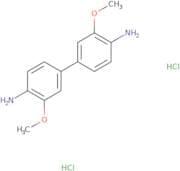
:3,3'-Dimethoxybenzidin-dihydrochlorid
- 2-Dianisidine Dihcl
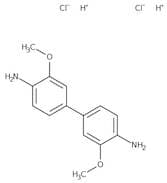
- 3,3-Dimethoxybiphenyl-4,4-Ylenediammonium Dichloride
- Benzidine, 3,3′-dimethoxy-, dihydrochloride
- [1,1′-Biphenyl]-4,4′-diamine, 3,3′-dimethoxy-, dihydrochloride
- [1,1′-Biphenyl]-4,4′-diamine, 3,3′-dimethoxy-, hydrochloride (1:2)
- o-Dianisidine dihydrochloride
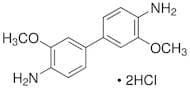
- 3,3′-Dimethoxybenzidine dihydrochloride
- C.I. Disperse Black 6 dihydrochloride
- DMB DIHYDROCHLORIDE
- 4,4'-DIAMINO-3,3'-DIMETHOXYBIPHENYL DIHYDROCHLORIDE
- 3,3'-Dimethoxy-[1,1'-biphenyl]-4,4'-diamine dihydrochloride
- O-DIANISIDINE REAGENT
- FAST BLUE B
- ortho-dianisidine dihydrochloride
- BLUE BN BASE DIHYDROCHLORIDE
- 3,3’-dimethoxy-4,4’-diaminobiphenyldihydrochloride
- 1’-biphenyl)-4,4’-diamine,3,3-dimethoxy-(dihydrochloride
- O-DIANISIDINE DIHYDROCHLORIC ACID
- c.i.disperseblack6dihydrochloride
- FAST BLUE B BASE DIHYDROCHLORIDE
- DIMETHOXYBENZIDINE DIHYDROCHLORIDE
- 3,3’-dimethoxy-benzidindihydrochloride
- o-Dianisidinehydrochloride
- Weitere Synonyme anzeigen
o-Dianisidine dihydrochloride, 98%
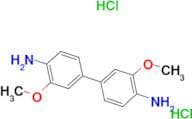
CAS:It is suitable for use in ELISA procedures. In neurohistochemistry o-Dianisidine dihydrochloride has demonstrated perikaryal labeling as well as retrograde and anterograde transport to the primary olfactory cortex. It has also been used for a paper based-micro fluidic device to semi-quantitatively mFormel:C14H18Cl2N2O2Reinheit:98%Farbe und Form:White to cream to grey to purple-grey, Crystals or powder or crystalline powderMolekulargewicht:317.21o-Dianisidine dihydrochloride
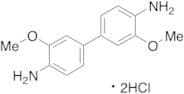
CAS:Formel:C14H16N2O2·2HClReinheit:≥ 98.0%Farbe und Form:White to grey or beige powderMolekulargewicht:317.213,3-Dimethoxybenzidine dihydrochloride
CAS:Reinheit:98.0%Farbe und Form:Solid, solidMolekulargewicht:317.2099914550781o-Dianisidine Dihydrochloride (>90%)
CAS:Kontrolliertes ProduktApplications o-Dianisidine Dihydrochloride is used in biological studies to determine the rodent carcinogenicity of aromatic amines using a quantitative structure-activity relationships model. Dyes and metabolites.Environmental toxin on US EPA Toxic Release Inventory list (TRI) list.
References Franke, R., et al.: Carcinogenesis, 22, 1561 (2001);Formel:C14H18Cl2N2O2Reinheit:>90%Farbe und Form:NeatMolekulargewicht:317.213,3'-Dimethoxybenzidine dihydrochloride
CAS:Kontrolliertes Produkt3,3'-Dimethoxybenzidine dihydrochloride is a fluorogenic probe that has been shown to have activity index in the range of 0.1-0.5, which makes it suitable for use as a fluorescent dye in biological samples such as human serum or cerebrospinal fluid. 3,3'-Dimethoxybenzidine dihydrochloride can be used in histological studies for the detection of cell lysis and cardiac disease activity. It has also been shown to cause liver lesions when administered orally to rats.
Formel:C14H16N2O2•(HCl)2Reinheit:Min. 98 Area-%Farbe und Form:PowderMolekulargewicht:317.21 g/molo-Dianisidine Dihydrochloride extrapure, 98%
CAS:Formel:C14H16N2O2·2HClReinheit:min. 98.0%Farbe und Form:White to pale grey, Crystalline powderMolekulargewicht:317.21o-Dianisidine Dihydrochloride [for Biochemical Research]
CAS:Formel:C14H16N2O2·2HClReinheit:>98.0%(HPLC)Farbe und Form:White to Gray to Red powder to crystalMolekulargewicht:317.21






![o-Dianisidine Dihydrochloride [for Biochemical Research]](/_next/image/?url=https%3A%2Fstatic.cymitquimica.com%2Fproducts%2F3B%2Fthumb%2FD3893.jpg&w=3840&q=75)
