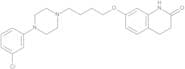
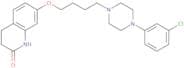
![7-[4-[4-(3-Chlorophenyl)-1-piperazinyl]butoxy]-3,4-dihydro-2(1H)-quinolinone](/_next/image/?url=https%3A%2Fstatic.cymitquimica.com%2Fcas-image%2Fthumb-webp%2F144661-7-4-4-3-chlorophenyl-1-piperazinyl-butoxy-34-dihydro-2-1h-quinolinone.webp&w=3840&q=75)
CAS 203395-82-8
:7-[4-[4-(3-Chlorphenyl)-1-piperazinyl]butoxy]-3,4-dihydro-2(1H)-chinolinon
Beschreibung:
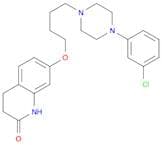
Die chemische Substanz, die als 7-[4-[4-(3-Chlorphenyl)-1-piperazinyl]butoxy]-3,4-dihydro-2(1H)-chinolinon bekannt ist, mit der CAS-Nummer 203395-82-8, ist eine synthetische organische Verbindung, die durch ihre komplexe molekulare Struktur gekennzeichnet ist. Sie weist einen Quinolinon-Kern auf, der eine bicyclische Verbindung ist, die für ihre vielfältigen biologischen Aktivitäten bekannt ist. Die Anwesenheit einer Piperazin-Gruppe trägt zu ihren potenziellen pharmakologischen Eigenschaften bei, die oft mit neuroaktiven Verbindungen assoziiert werden. Die Chlorphenylgruppe erhöht ihre Lipophilie, was potenziell ihre Fähigkeit beeinflussen kann, biologische Membranen zu durchdringen. Diese Verbindung kann verschiedene Wechselwirkungen mit biologischen Zielen aufweisen, was sie in der medizinischen Chemie von Interesse macht, insbesondere bei der Entwicklung therapeutischer Mittel. Ihre spezifischen Eigenschaften, wie Löslichkeit, Stabilität und Reaktivität, würden von den vorhandenen funktionellen Gruppen und der allgemeinen molekularen Konformation abhängen. Wie bei vielen Verbindungen dieser Klasse ist das Verständnis ihrer Struktur-Wirkungs-Beziehung entscheidend, um ihr Verhalten in biologischen Systemen und ihre potenziellen Anwendungen in der Arzneimittelentwicklung vorherzusagen.
Formel:C23H28ClN3O2
InChl:InChI=1S/C23H28ClN3O2/c24-19-4-3-5-20(16-19)27-13-11-26(12-14-27)10-1-2-15-29-21-8-6-18-7-9-23(28)25-22(18)17-21/h3-6,8,16-17H,1-2,7,9-15H2,(H,25,28)
InChI Key:InChIKey=SHHUSQIOAKPGMO-UHFFFAOYSA-N
SMILES:O(CCCCN1CCN(CC1)C2=CC(Cl)=CC=C2)C=3C=C4C(=CC3)CCC(=O)N4
Synonyme:- 2(1H)-Quinolinone, 7-[4-[4-(3-chlorophenyl)-1-piperazinyl]butoxy]-3,4-dihydro-
- 7-[4-[4-(3-Chlorophenyl)-1-piperazinyl]butoxy]-3,4-dihydro-2(1H)-quinolinone
Sortieren nach
Reinheit (%)
0
100
|
0
|
50
|
90
|
95
|
100
7 Produkte.
2-Dechloro Aripiprazole (7-(4-(4-(3-chlorophenyl)piperazin-1-yl)butoxy)-3,4-dihydroquinolin-2(1H)-one)
CAS:Lactams, nesoiFormel:C23H28ClN3O2Farbe und Form:White Off-White SolidMolekulargewicht:413.187Aripiprazole EP Impurity D
CAS:Formel:C23H28ClN3O2Farbe und Form:White To Off-White SolidMolekulargewicht:413.957-[4-[4-(3-Chlorophenyl)piperazin-1-yl]butoxy]-3,4-dihydroquinolin-2(1H)-one
CAS:Kontrolliertes ProduktFormel:C23H28ClN3O2Farbe und Form:NeatMolekulargewicht:413.942-Deschloro Aripiprazole
CAS:Impurity Aripiprazole EP Impurity D
Applications 2-Deschloro Aripiprazole (Aripiprazole EP Impurity D) is an impurity of the antipsychotic agent Aripiprazole (A771000). Aripiprazole impurity B.
References Akaike, A., et al.: Brain Res., 418, 262 (1987); Kikuchi, K., et al.: Life Sci., 42, 343 (1988); Caprathe, B., et al.: J. Med. Chem., 34, 2736 (1991); Yamada, S., et al.: J. Pharm. Pharmacol., 49, 206 (1997);Formel:C23H28ClN3O2Farbe und Form:WhiteMolekulargewicht:413.942-Deschloro aripiprazole
CAS:2-Deschloro aripiprazole is a drug that belongs to the class of antipsychotics. It is an atypical antipsychotic with a high affinity for human albumin and α1-acid glycoprotein, which are plasma proteins. 2-Deschloro aripiprazole has been shown to interact with human albumin and α1-acid glycoprotein in vitro, and it has been suggested that this interaction may be responsible for its pharmacological effects. 2-Deschloro aripiprazole has also been shown to bind to the dopamine D2 receptor, which is thought to be responsible for its therapeutic effects as an antipsychotic. The molecular interactions between 2-deschloro aripiprazole and human albumin have been studied using isothermal titration calorimetry (ITC) and molecular docking studies. These studies have helped us understand how 2-deschloro aripiprazole binds to human albumFormel:C23H28ClN3O2Reinheit:Min. 95%Molekulargewicht:413.94 g/mol




![7-[4-[4-(3-Chlorophenyl)piperazin-1-yl]butoxy]-3,4-dihydroquinolin-2(1H)-one](/_next/image/?url=https%3A%2Fstatic.cymitquimica.com%2Fproducts%2F86%2Fthumb%2FMM0961.07-0025.jpg&w=3840&q=75)