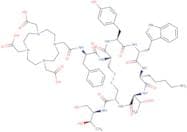
CAS 204318-14-9
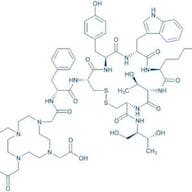
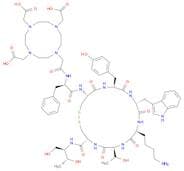
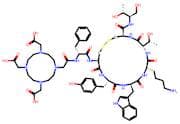
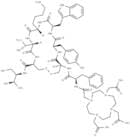
:2,2',2''-[10-(2-{[(2R)-1-{[(4R,7S,10S,13R,16S,19R)-10-(4-aminobutyl)-4-{[(2R,3R)-1,3-dihydroxybutan-2-yl]carbamoyl}-16-(4-hydroxybenzyl)-7-[(1R)-1-hydroxyethyl]-13-(1H-indol-3-ylmethyl)-6,9,12,15,18-pentaoxo-1,2-dithia-5,8,11,14,17-pentaazacycloicosan-19-
Beschreibung:
Die chemische Substanz mit dem Namen "2,2',2''-[10-(2-{[(2R)-1-{[(4R,7S,10S,13R,16S,19R)-10-(4-aminobutyl)-4-{[(2R,3R)-1,3-dihydroxybutan-2-yl]carbamoyl}-16-(4-hydroxybenzyl)-7-[(1R)-1-hydroxyethyl]-13-(1H-indol-3-ylmethyl)-6,9,12,15,18-pentaoxo-1,2-dithia-5,8,11,14,17-pentaazacycloicosan-19-" und der CAS-Nummer "204318-14-9" ist ein komplexes organisches Molekül, das durch seine komplizierte Struktur gekennzeichnet ist, die mehrere funktionelle Gruppen und Stereocenter umfasst. Diese Verbindung weist wahrscheinlich aufgrund ihrer strukturellen Merkmale, die Amin-, Hydroxyl- und Carbonylgruppen umfassen können, eine signifikante biologische Aktivität auf, die zu ihren potenziellen Wechselwirkungen mit biologischen Zielen beiträgt. Das Vorhandensein eines Pentaazacycloicosan-Kerns deutet auf einen einzigartigen zyklischen Rahmen hin, der ihre Pharmakokinetik und Pharmakodynamik beeinflussen kann. Darüber hinaus impliziert die durch die Bezeichnungen (R) und (S) angegebene Stereochemie, dass das Molekül spezifische räumliche Anordnungen haben kann, die für seine biologische Funktion entscheidend sind. Insgesamt stellt diese Substanz ein anspruchsvolles Beispiel für synthetische organische Chemie mit potenziellen Anwendungen in der medizinischen Chemie oder der Arzneimittelentwicklung dar.
Formel:C65H92N14O18S2
InChl:InChI=1/C65H92N14O18S2/c1-39(81)51(36-80)72-64(96)53-38-99-98-37-52(73-60(92)48(28-41-10-4-3-5-11-41)68-54(84)32-76-20-22-77(33-55(85)86)24-26-79(35-57(89)90)27-25-78(23-21-76)34-56(87)88)63(95)70-49(29-42-15-17-44(83)18-16-42)61(93)71-50(30-43-31-67-46-13-7-6-12-45(43)46)62(94)69-47(14-8-9-19-66)59(91)75-58(40(2)82)65(97)74-53/h3-7,10-13,15-18,31,39-40,47-53,58,67,80-83H,8-9,14,19-30,32-38,66H2,1-2H3,(H,68,84)(H,69,94)(H,70,95)(H,71,93)(H,72,96)(H,73,92)(H,74,97)(H,75,91)(H,85,86)(H,87,88)(H,89,90)/t39-,40-,47+,48-,49+,50-,51-,52+,53+,58+/m1/s1
Sortieren nach
Reinheit (%)
0
100
|
0
|
50
|
90
|
95
|
100
5 Produkte.
DOTA-(Tyr³)-Octreotide
CAS:Somatostatin analog for tumor scintigraphy and radionuclide therapy.Formel:C65H92N14O18S2Reinheit:98.4%Farbe und Form:WhiteMolekulargewicht:1421.662,2',2''-(10-(2-(((R)-1-(((4R,7S,10S,13R,16S,19R)-13-((1H-Indol-3-yl)methyl)-10-(4-aminobutyl)-4-(((2R,3R)-1,3-dihydroxybutan-2-yl)carbamoyl)-16-(4-hydroxybenzyl)-7-((R)-1-hydroxyethyl)-6,9,12,15,18-pentaoxo-1,2-dithia-5,8,11,14,17-pentaazacycloicosan-19-yl)amino)-1-oxo-3-phenylpropan-2-yl)amino)-2-oxoethyl)-1,4,7,10-tetraazacyclododecane-1,4,7-triyl)triacetic acid
CAS:Formel:C65H92N14O18S2Reinheit:98%Farbe und Form:SolidMolekulargewicht:1421.6390Edotreotide
CAS:Edotreotide (SMT-487) is an Indicator and Reagent. It also is used in the Diagnosis and Staging of Tumors Expressing Somatostatin Receptors.Formel:C65H92N14O18S2Reinheit:96.95%Farbe und Form:SolidMolekulargewicht:1421.64Edotreotide trifluoroacetate
CAS:Edotreotide trifluoroacetate is a diagnostic agent that is used to diagnose hepatic steatosis. It is a synthetic analog of somatostatin, which can be synthesized by the reaction of trifluoroacetic acid and hydroxyl compounds. Edotreotide trifluoroacetate is radiolabeled with technetium-99m and administered intravenously. The drug binds to receptors on the surface of proximal tubule cells in the liver, causing an uptake of this radionuclide in the area of interest. This diagnostic agent has also been shown to inhibit insulin release from pancreatic beta cells and improve glucose tolerance in patients with type 2 diabetes mellitus.Formel:C65H92N14O18S2·xC2HF3O2Reinheit:Min. 95%Farbe und Form:Powder