CAS 2050-23-9
:Diethylsuberat
Beschreibung:
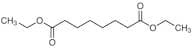
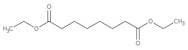
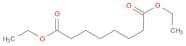
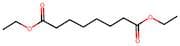
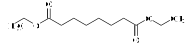
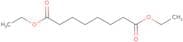
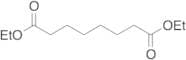
Diethylsuberat ist ein Ester, der aus der Reaktion von Suberinsäure und Ethanol gebildet wird. Er zeichnet sich durch seine molekulare Struktur aus, die eine lange Kohlenstoffkette umfasst, was zu seinen Eigenschaften als Ester mittelkettiger Fettsäuren beiträgt. Typischerweise erscheint Diethylsuberat als farblose bis blassgelbe Flüssigkeit mit einem angenehmen, fruchtigen Geruch. Er ist in organischen Lösungsmitteln löslich, hat jedoch eine begrenzte Löslichkeit in Wasser aufgrund seiner hydrophoben Natur. Diese Verbindung wird häufig in der Synthese verschiedener Chemikalien und als Aromastoff in der Lebensmittelindustrie aufgrund ihrer aromatischen Eigenschaften verwendet. Darüber hinaus kann Diethylsuberat als Weichmacher in Polymerformulierungen dienen, um Flexibilität und Haltbarkeit zu verbessern. Seine relativ geringe Toxizität macht ihn für Anwendungen in Lebensmitteln und Konsumgütern geeignet, obwohl Sicherheitsdaten immer konsultiert werden sollten, um spezifische Handhabungs- und Nutzungshinweise zu erhalten. Insgesamt wird Diethylsuberat für seine funktionalen Eigenschaften sowohl in industriellen als auch in kulinarischen Kontexten geschätzt.
Formel:C12H22O4
InChl:InChI=1S/C12H22O4/c1-3-15-11(13)9-7-5-6-8-10-12(14)16-4-2/h3-10H2,1-2H3
InChI Key:InChIKey=PEUGOJXLBSIJQS-UHFFFAOYSA-N
SMILES:C(CCCCCCC(OCC)=O)(OCC)=O
Synonyme:- 2050-23-9Diethyl suberate
- Diethyl suberate, (Diethyl octanedioate
- Diethyl Octanedioate
- Diethyl octanedioate~Suberic acid diethyl ester
- NSC 62701
- Octanedioic acid diethyl ester~Suberic acid diethyl ester
- Octanedioic acid, 1,8-diethyl ester
- Octanedioic acid, diethyl ester
- Suberic acid d
- Suberic acid, diethyl ester
- Diethyl suberate
Sortieren nach
Reinheit (%)
0
100
|
0
|
50
|
90
|
95
|
100
10 Produkte.
Diethyl Suberate
CAS:Formel:C12H22O4Reinheit:>98.0%(GC)Farbe und Form:Colorless to Almost colorless clear liquidMolekulargewicht:230.30Diethyl suberate, 99%
CAS:This Thermo Scientific Chemicals brand product was originally part of the Alfa Aesar product portfolio. Some documentation and label information may refer to the legacy brand. The original Alfa Aesar product / item code or SKU reference has not changed as a part of the brand transition to Thermo SciFormel:C12H22O4Reinheit:99%Farbe und Form:Liquid, Clear colorlessMolekulargewicht:230.3Octanedioic acid, 1,8-diethyl ester
CAS:Formel:C12H22O4Reinheit:98%Farbe und Form:LiquidMolekulargewicht:230.3007Diethyl suberate
CAS:Diethyl succinate is a chemical compound that is soluble in both organic solvents and water. It has been used as a phase transfer catalyst in sample preparation, as well as a solid catalyst for the synthesis of biodiesel. Diethyl succinate is also known to be reactive with solutes, and it has been shown to be an effective nutrient solution in the growth of microorganisms. Diethyl succinate has also been found to be an activator for non-enzymatic reactions, such as lipid peroxidation and oxidation of hydrocarbons. This chemical reacts with diphenyl ether and ethyl decanoate to form diethyl suberate, which is a fatty acid ester.Formel:C12H22O4Reinheit:Min. 95%Molekulargewicht:230.3 g/molDiethyl Suberate
CAS:Kontrolliertes ProduktApplications Diethyl suberate is one of the volatile components in alcoholic beverages (such as mango wines and Chinese rice wines). Diethyl suberate is also one of the components included in the topical vehicle used to administer Emedastine (E521520) transdermally.
References Harada, S., et al.: Biol. Pharm. Bull., 16, 884 (1993); Luo, T., et al.: J. Inst. Brew., 114, 172 (2008); Pino, J. & Queris, O.: Food Chem., 125, 1141 (2011); Ter Heide, R., et al.: Anal. Food. Bev., No vol. given, 249 (1978)Formel:C12H22O4Farbe und Form:NeatMolekulargewicht:230.3