CymitQuimica logo

CAS 20525-62-6

:

Dibutyl(diethyl)zinn

Beschreibung:
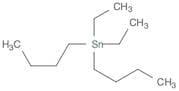
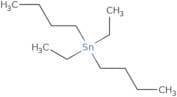
Dibutyl(diethyl)zinn, mit der CAS-Nummer 20525-62-6, ist eine Organotinverbindung, die durch ihre Struktur gekennzeichnet ist, die zwei Butylgruppen und zwei Ethylgruppen umfasst, die an ein Zinnatom gebunden sind. Diese Verbindung erscheint typischerweise als farblose bis blassgelbe Flüssigkeit und ist bekannt für ihre relativ geringe Flüchtigkeit und hohe Stabilität unter Standardbedingungen. Sie wird hauptsächlich in der organischen Synthese und als Reagenz in verschiedenen chemischen Reaktionen verwendet, insbesondere im Bereich der Organometallchemie. Dibutyl(diethyl)zinn weist Eigenschaften auf, die für Organotinverbindungen typisch sind, wie potenzielle Toxizität und Umweltbedenken, insbesondere hinsichtlich ihrer Bioakkumulation und Auswirkungen auf das aquatische Leben. Sicherheitsvorkehrungen sind beim Umgang mit dieser Substanz unerlässlich, da sie Gesundheitsrisiken durch Inhalation oder Hautkontakt darstellen kann. Darüber hinaus ist es wichtig zu beachten, dass Organotinverbindungen aufgrund ihrer Umweltauswirkungen regulatorischer Prüfung unterliegen, was zu Einschränkungen in bestimmten Anwendungen führt. Insgesamt dient Dibutyl(diethyl)zinn als wertvolles Werkzeug in der synthetischen Chemie, erfordert jedoch einen sorgfältigen Umgang und Berücksichtigung ihres ökologischen Fußabdrucks.
Formel:C12H28Sn
InChl:InChI=1/2C4H9.2C2H5.Sn/c2*1-3-4-2;2*1-2;/h2*1,3-4H2,2H3;2*1H2,2H3;/rC12H28Sn/c1-5-9-11-13(7-3,8-4)12-10-6-2/h5-12H2,1-4H3
SMILES:CCCC[Sn](CC)(CC)CCCC
Synonyme:
  • Dibutyldiethylstannane
  • Stannane, dibutyldiethyl-
  • Dibutyl(diethyl)stannane
Sortieren nach

Reinheit (%)
0
100
|
0
|
50
|
90
|
95
|
100
4 Produkte.
  • Stannane, dibutyldiethyl-

    CAS:
    Formel:C12H28Sn
    Farbe und Form:Liquid
    Molekulargewicht:291.0517

    Ref: IN-DA0029Z7

    ne
    Nachfragen
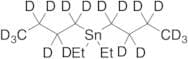
  • Dibutyldiethyltin-d18

    Kontrolliertes Produkt
    CAS:
    <p>Applications Dibutyldiethyltin belongs to a class of organotin compounds that are commonly used as pesticides and fungicides and as plastics additives.<br> Not a dangerous good if item is equal to or less than 1g/ml and there is less than 100g/ml in the package<br>References Krupp, E.M. et al.: Environ. Sci. Technol., 45, 943 (2011);<br></p>
    Formel:C12H10D18Sn
    Farbe und Form:Colourless
    Molekulargewicht:309.17

    Ref: TR-D429457

    5mg
    256,00€
    50mg
    1.690,00€
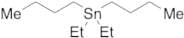
  • Dibutyldiethyltin

    Kontrolliertes Produkt
    CAS:
    <p>Applications Dibutyldiethyltin belongs to a class of organotin compounds that are commonly used as pesticides and fungicides and as plastics additives.<br>References Krupp, E.M. et al.: Environ. Sci. Technol., 45, 943 (2011)<br></p>
    Formel:C12H28Sn
    Farbe und Form:Neat
    Molekulargewicht:291.06

    Ref: TR-D429455

    1g
    2.060,00€
    100mg
    318,00€
  • Dibutyldiethyltin

    CAS:
    <p>Dibutyldiethyltin is a divalent hydrocarbon that has been used as an agrochemical to control weeds. It is a monomer that can be polymerized to form polydibutyldiethyltin (PDDBT). Dibutyldiethyltin has optical properties, such as a high refractive index and low viscosity, which make it useful for specialty optical applications. The chemical structure of PDDBT consists of a chlorine atom and two fluorine atoms attached to two ethyl groups. PDDBT also contains two methyl groups with ether linkages. This compound is insoluble in water, but soluble in organic solvents and deionized water. Hydrogenation of PDDBT yields a ring-opening product known as dibutyltindiacetate.</p>
    Formel:C12H28Sn
    Reinheit:Min. 95%
    Molekulargewicht:291.1 g/mol

    Ref: 3D-VAA52562

    10mg
    Nachfragen
    25mg
    Nachfragen
    50mg
    Nachfragen
    100mg
    Nachfragen
    250mg
    Nachfragen