CAS 20559-18-6
:1-Lauroyl-2-hydroxy-sn-glycero-3-phosphocholin
Beschreibung:
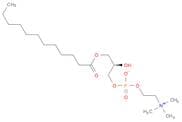
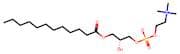
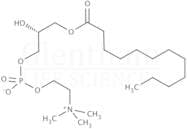
1-Lauroyl-2-hydroxy-sn-glycero-3-phosphocholin, allgemein als LPC bezeichnet, ist ein Phospholipid, das eine bedeutende Rolle in Zellmembranen und Signalprozessen spielt. Es weist eine Lauroyl-(Dodecanoil)-Fettsäurekette auf, die zu seiner amphiphilen Natur beiträgt und es ihm ermöglicht, sowohl mit hydrophilen als auch mit hydrophoben Umgebungen zu interagieren. Das Molekül enthält ein Glycerolgerüst, eine Phosphatgruppe und eine Cholin-Kopfgruppe, die seine Löslichkeit in wässrigen Lösungen erhöht. LPC ist bekannt für seine Fähigkeit, Lipid-Doppelschichten und Mizellen zu bilden, was es in Studien zu Membrandynamik und Arzneimittellieferungssystemen unerlässlich macht. Darüber hinaus wurde es in verschiedenen biologischen Prozessen wie Zellsignalgebung, Entzündung und Stoffwechsel involviert. Seine einzigartige Struktur ermöglicht es ihm, an der Bildung von Lipidflößen teilzunehmen, die für die Organisation und Funktion der Membran entscheidend sind. Insgesamt ist LPC eine wichtige Verbindung in der Biochemie und Pharmakologie mit Anwendungen in der Forschung und potenziellen therapeutischen Anwendungen.
Formel:C20H42NO7P
InChl:InChI=1S/C20H42NO7P/c1-5-6-7-8-9-10-11-12-13-14-20(23)26-17-19(22)18-28-29(24,25)27-16-15-21(2,3)4/h19,22H,5-18H2,1-4H3/t19-/m1/s1
InChI Key:InChIKey=BWKILASWCLJPBO-LJQANCHMSA-N
SMILES:P(OC[C@@H](COC(CCCCCCCCCCC)=O)O)(OCC[N+](C)(C)C)(=O)[O-]
Synonyme:- (2R)-3-(dodecanoyloxy)-2-hydroxypropyl 2-(trimethylammonio)ethyl phosphate
- 1-Dodecanoyl-sn-glycero-3-phosphocholine
- 1-Dodecanoyl-sn-glycerol-3-phosphorylcholine
- 1-Dodecanoyllysolecithin
- 1-Lauroyl-2-hydroxy-sn-glycero-3-phosphocholine
- 1-Lauroyl-<span class="text-smallcaps">L</span>-α-phosphorylcholine
- 3,5,9-Trioxa-4-phosphaheneicosan-1-aminium, 4,7-dihydroxy-N,N,N-trimethyl-10-oxo-, inner salt, 4-oxide, (7R)-
- 3,5,9-Trioxa-4-phosphaheneicosan-1-aminium, 4,7-dihydroxy-N,N,N-trimethyl-10-oxo-, inner salt, 4-oxide, (R)-
- C12-Lysophosphatidylcholine
- Choline, hydroxide, dihydrogen phosphate, inner salt, 3-ester with 1-monolaurin, <span class="text-smallcaps">L</span>-
- L-alpha-Lysophosphatidylcholine, lauroyl
- Laurin, 1-mono-, 3-(dihydrogen phosphate), monoester with choline hydroxide, inner salt, <span class="text-smallcaps">L</span>-
- LysoPC 12
- alpha-L-Lysophosphatidylcholine dodecyl
- Laurin, 1-mono-, 3-(dihydrogen phosphate), monoester with choline hydroxide, inner salt, L-
- Weitere Synonyme anzeigen
Sortieren nach
Reinheit (%)
0
100
|
0
|
50
|
90
|
95
|
100
6 Produkte.
LysoFos Choline 12
CAS:LysoFos Choline 12 (1-lauroyl-2-hydroxy-sn-glycero-3-phosphocholine) is an amphoteric surfactant that acts as a biofilm mimic for self-aggregation in aqueous solution.Formel:C20H42NO7PReinheit:99.89%Farbe und Form:SolidMolekulargewicht:439.52L-α-LYSOPHOSPHATIDYLCHOLINE, LAUROYL
CAS:Formel:C20H42NO7PReinheit:99%Farbe und Form:SolidMolekulargewicht:439.52371-Lauroyl-2-Hydroxy-sn-Glycero-3-Phosphatidylcholine
CAS:Formel:C20H42NO7PReinheit:>98%Farbe und Form:SolidMolekulargewicht:439.5241-Lauroyl-2-Hydroxy-sn-Glycero-3-Phosphatidylcholine
CAS:1-Lauroyl-2-Hydroxy-sn-Glycero-3-Phosphatidylcholine is a synthetic compound that has been shown to inhibit the growth of viruses, such as HIV and herpes simplex virus. It also inhibits the replication of hepatitis C virus in cell culture. This compound has been used to study the biochemical properties of phospholipids, including their function in gene expression and lipid metabolism, as well as their role in viral replication. 1-Lauroyl-2-Hydroxy-sn-Glycero-3-Phosphatidylcholine is not active against bacteria and fungi. This compound interacts with cellular membranes by binding with hydroxyl groups on glycerol molecules, which are part of the phospholipid bilayer structure, forming hydrogen bonds with other hydroxyl groups on adjacent molecules. The molecule can then be cleaved by an enzyme or oxidized by an organic acid to form a fattyFormel:C20H42NO7PReinheit:Min. 95%Molekulargewicht:439.52 g/mol