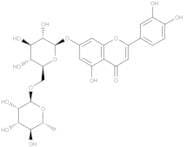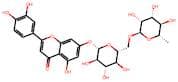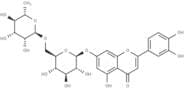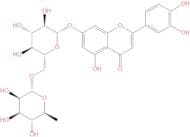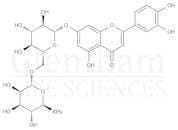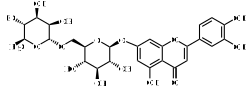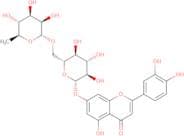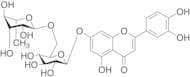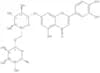
CAS 20633-84-5
:Lonicerin
Beschreibung:
Lonicerin, mit der CAS-Nummer 20633-84-5, ist eine chemische Verbindung, die hauptsächlich aus der Pflanzenfamilie Lonicera, allgemein bekannt als Geißblatt, gewonnen wird. Es wird als Flavonoid-Glykosid klassifiziert, was bedeutet, dass es aus einem Flavonoid-Molekül besteht, das an ein Zuckermolekül gebunden ist. Lonicerin ist bekannt für seine potenziellen pharmakologischen Eigenschaften, einschließlich entzündungshemmender, antioxidativer und antimikrobieller Aktivitäten. Diese Eigenschaften machen es sowohl in der traditionellen Medizin als auch in der modernen Pharmakologie von Interesse. Die Verbindung ist typischerweise in verschiedenen Teilen der Geißblatt-Pflanze zu finden, was zu ihren therapeutischen Effekten beiträgt. Die Löslichkeit und Stabilität von Lonicerin können je nach Lösungsmittel und Umweltbedingungen variieren, was für seine Anwendung in pflanzlichen Formulierungen und Nahrungsergänzungsmitteln wichtig ist. Die Forschung untersucht weiterhin seine Wirkmechanismen und potenziellen Gesundheitsvorteile, insbesondere in Bezug auf seine Rolle bei der Unterstützung der Immunfunktion und des allgemeinen Wohlbefindens.
Formel:C27H30O15
InChl:InChI=1S/C27H30O15/c1-9-20(32)22(34)24(36)26(39-9)38-8-18-21(33)23(35)25(37)27(42-18)40-11-5-14(30)19-15(31)7-16(41-17(19)6-11)10-2-3-12(28)13(29)4-10/h2-7,9,18,20-30,32-37H,8H2,1H3/t9-,18+,20-,21+,22+,23-,24+,25+,26+,27+/m0/s1
InChI Key:InChIKey=MGYBYJXAXUBTQF-FOBVWLSUSA-N
SMILES:O=C1C=2C(OC(=C1)C3=CC(O)=C(O)C=C3)=CC(O[C@@H]4O[C@H](CO[C@H]5[C@H](O)[C@H](O)[C@@H](O)[C@H](C)O5)[C@@H](O)[C@H](O)[C@H]4O)=CC2O
Synonyme:- Glucopyranoside, luteolin-7 6-O-(6-deoxy-α-L-mannopyranosyl)-, β-D-
- Luteolin 7-rutinoside
- Scolymoside
- 7-[[6-O-(6-Deoxy-α-L-mannopyranosyl)-β-D-glucopyranosyl]oxy]-2-(3,4-dihydroxyphenyl)-5-hydroxy-4H-1-benzopyran-4-one
- 4H-1-Benzopyran-4-one, 7-[[6-O-(6-deoxy-α-L-mannopyranosyl)-β-D-glucopyranosyl]oxy]-2-(3,4-dihydroxyphenyl)-5-hydroxy-
Sortieren nach
Reinheit (%)
0
100
|
0
|
50
|
90
|
95
|
100
9 Produkte.
Luteolin-7-O-rutinoside
CAS:Luteolin-7-O-rutinoside analytical standard provided with chromatographic purity, to be used as reference material for qualitative determination.Formel:C27H30O15Reinheit:(HPLC) ≥95%Farbe und Form:PowderMolekulargewicht:594.532-(3,4-Dihydroxyphenyl)-5-hydroxy-7-(((2S,3R,4S,5S,6R)-3,4,5-trihydroxy-6-((((2R,3R,4R,5R,6S)-3,4,5-trihydroxy-6-methyltetrahydro-2H-pyran-2-yl)oxy)methyl)tetrahydro-2H-pyran-2-yl)oxy)-4H-chromen-4-on
CAS:2-(3,4-Dihydroxyphenyl)-5-hydroxy-7-(((2S,3R,4S,5S,6R)-3,4,5-trihydroxy-6-((((2R,3R,4R,5R,6S)-3,4,5-trihydroxy-6-methyltetrahydro-2H-pyran-2-yl)oxy)methyl)tetrahydro-2H-pyran-2-yl)oxy)-4H-chromen-4-onReinheit:98%Molekulargewicht:594.52g/molLuteolin-7-rutinoside
CAS:Luteolin-7-rutinoside is a natural product that alleviates acute liver injury by inhibiting PI3K/AKT/AMPK/NF-κB nd suppressing TNF-α, IL-6, and IL-1β.Formel:C27H30O15Reinheit:99.99%Farbe und Form:SolidMolekulargewicht:594.52Luteolin-7-rutinoside
CAS:Luteolin-7-rutinoside is a flavonoid glycoside, which is typically sourced from various plant species, including Japanese honeysuckle and passionflower. This compound is known for its strong antioxidant and anti-inflammatory activities. The mode of action of Luteolin-7-rutinoside involves the modulation of several signaling pathways and inhibition of oxidative stress at the molecular level. This is achieved by scavenging free radicals and reducing the expression of pro-inflammatory cytokines. As a result, it can mitigate cellular damage and inflammation.Formel:C27H30O15Reinheit:Min. 95%Farbe und Form:Off-White PowderMolekulargewicht:594.52 g/molLuteolin 7-O-Rutinoside
CAS:Kontrolliertes ProduktFormel:C27H30O15Farbe und Form:NeatMolekulargewicht:594.52