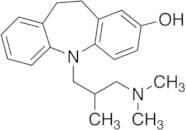
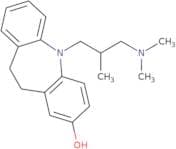
![5-[3-(dimethylamino)-2-methylpropyl]-10,11-dihydro-5H-dibenzo[b,f]azepin-2-ol](/_next/image/?url=https%3A%2Fstatic.cymitquimica.com%2Fcas-image%2Fthumb-webp%2F147961-5-3-dimethylamino-2-methylpropyl-1011-dihydro-5h-dibenzo-b-f-azepin-2-ol.webp&w=3840&q=75)
CAS 2064-15-5
:5-[3-(dimethylamino)-2-methylpropyl]-10,11-dihydro-5H-dibenzo[b,f]azepin-2-ol
- 5H-Dibenz(b,f)azepin-2-ol, 5-(3-(dimethylamino)-2-methylpropyl)-10,11-dihydro-
- 5-[3-(Dimethylamino)-2-methylpropyl]-10,11-dihydro-5H-dibenzo[b,f]azepin-2-ol
5H-Dibenz[b,f]azepin-2-ol, 5-[3-(dimethylamino)-2-methylpropyl]-10,11-dihydro-
CAS:Formel:C20H26N2OFarbe und Form:SolidMolekulargewicht:310.43322-Hydroxy Trimipramine
CAS:Kontrolliertes ProduktStability Light Sensitive
Applications A metabolite of Trimipramine.
References De Jongh, G.D., et al.: Drug Metab. Dispos., 2, 48 (1981), Suckow, R.F., et al.: J. Pharm. Sci., 73, 1745 (1984), Fraser, A.D., et al.: J. Anal. Toxicol., 11, 168 (1987),Formel:C20H26N2OFarbe und Form:NeatMolekulargewicht:310.432-Hydroxy trimipramine
CAS:Trimipramine is a drug used to treat depression. It is an alicyclic compound that has been shown to have antidepressant effects in humans and animal models. Trimipramine can be detected in human plasma using liquid chromatography, with the enantiomer being separated from the racemate by chiral stationary phase. Trimipramine has been shown to have an effect on clinical response and plasma concentrations of other drugs, such as trifluoroacetic acid, when administered concurrently. Trimipramine also has interactions with other drugs through its inhibition of cytochrome P450 enzymes.
Formel:C20H26N2OReinheit:Min. 95 Area-%Farbe und Form:PowderMolekulargewicht:310.43 g/mol
![5H-Dibenz[b,f]azepin-2-ol, 5-[3-(dimethylamino)-2-methylpropyl]-10,11-dihydro-](/_next/image/?url=https%3A%2Fstatic.cymitquimica.com%2Fproducts%2FIN%2Fthumb%2FDA002IHR.jpg&w=3840&q=75)