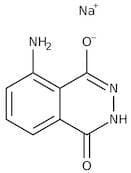
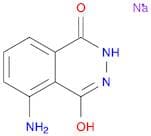
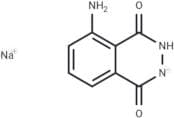
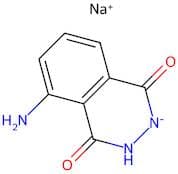
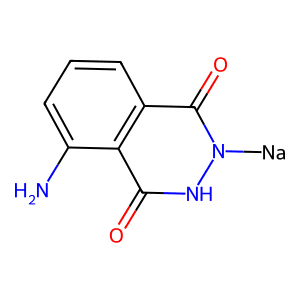
CAS 20666-12-0
:5-amino-2,3-dihydro-1,4-phthalazindion-natrium
- 3-Aminophthalhydrazide monosodium salt
- Luminol monosodium salt~Sodium luminol
- 5-Amino-2,3-Dihydrophthalazine-1,4-Dione
- 1,4-Phthalazinedione, 5-Amino-2,3-Dihydro-, Sodium Salt (1:1)
- 3-Aminophthalhydrazidemonosodium Salt
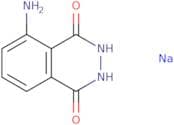
3-Aminophthalhydrazide monosodium salt, 98+%
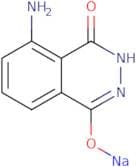
CAS:3-Aminophthalhydrazide monosodium salt is used for chemiluminescence analysis of metal cations, blood and glucococorticoids. It is also to image myeloperoxidase activity. This Thermo Scientific Chemicals brand product was originally part of the Alfa Aesar product portfolio. Some documentation and laFormel:C8H6N3NaO2Reinheit:98+%Farbe und Form:powder, White to cream or pale greyMolekulargewicht:199.15Sodium 8-amino-4-oxo-3,4-dihydrophthalazin-1-olate
CAS:Formel:C8H7N3NaO2Reinheit:98%Farbe und Form:SolidMolekulargewicht:200.1499Tamerit
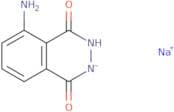
CAS:Tamerit as an efficient inhibitor of oxidative burst in monocytes.Formel:C8H6N3NaO2Reinheit:99.76% - ≥95%Farbe und Form:SolidMolekulargewicht:199.14Luminol sodium salt
CAS:Luminol sodium saltFormel:C8H6N3NaO2Reinheit:>98.0% (nmr) (Typical Value in Batch COA)Farbe und Form: white to off-white solidMolekulargewicht:199.14g/mol5-Amino-2,3-dihydro-1,4- phthalazinedione sodium salt (Sodium Luminol)
CAS:Formel:C8H6N3NaO2Molekulargewicht:199.15Luminol sodium salt
CAS:Chemiluminescence detection of biological residuesFormel:C8H6N3O2NaReinheit:Min. 98 Area-%Farbe und Form:White PowderMolekulargewicht:199.14 g/mol3-Aminophthalhydrazide monosodium
CAS:3-Aminophthalhydrazide monosodium (APHA) is a chemiluminescent agent that is used as a pharmaceutical dosage form. It reacts with luminol to produce light emission in the presence of peroxide, which is used for detection of hydrogen peroxide. APHA has been shown to be effective in measuring free radicals and other oxidizing agents that are released by cells or tissues during diseases such as nervous system disorders. The addition of sodium salts increases the sensitivity of the assay.
Formel:C8H7N3O2•NaReinheit:Min. 95%Molekulargewicht:200.15 g/molLuminol, sodium salt
CAS:Luminol is a molecule that contains an active oxygen group, which reacts with various substances to produce light. It is used as a reagent in clinical development, highlighting and validating drugs. Luminol can be used to detect the presence of blood in urine, semen and other fluids. The safety profile of this compound has been studied extensively and shown to be safe for use in humans. The reactive nature of luminol makes it effective as an enhancer of fluorescence due to its ability to increase the production of excited states. In addition, luminol reacts with selenium compounds, which are often found in some drugs. This allows for the detection or identification of these drugs using only a small amount of luminol solution.
Formel:C8H6N3NaO2Reinheit:Min. 98.0 Area-%Molekulargewicht:199.15 g/molRef: 3D-L-8620
Ausgelaufenes produkt